
available 24/7
Free Consultation
In Arizona, a writ of habeas corpus challenges unlawful restraint or custody, regardless of which government entity is holding the person. A habeas corpus petition is how you can challenge the legal basis for your incarceration or its duration.
A writ of habeas corpus is a potent legal remedy, but it is subject to important limitations and is frequently misunderstood. If you are detained in Arizona, an experienced habeas corpus lawyer at AZ Defenders can determine whether a writ of habeas corpus is appropriate for your case.
Our criminal defense attorneys understand when habeas corpus relief is appropriate in Arizona state and federal proceedings, and when to use it alongside other judicial remedies, such as direct appeals and post-conviction relief.
With your future and freedom at risk, the skills, knowledge, and experience of your lawyer mean everything for your case.
With more than 200 years of combined legal experience, our attorneys include former state, county, and city prosecutors who have successfully represented thousands of people. We use our intensive investigative abilities and comprehensive trial litigation experience to do everything possible to secure the best possible outcome on your behalf.
To learn more, you can call our law offices at any time, day or night, at (480) 456-6400 or contact us online to speak with one of our experienced habeas corpus lawyers in a free consultation.
Habeas corpus comes from Latin; it literally means “you shall have the body.” A writ of habeas corpus is a court order directing the custodian of a detained person to bring that individual before the court and justify the detention.
When you file a petition for a writ of habeas corpus, you are asking the court to order the government agency holding you to appear and prove:
Through a writ of habeas corpus, you can also seek specific relief. What is available depends on whether you file in state or federal court.
In Arizona, the writ of habeas corpus is accomplished through a petition for a writ of habeas corpus. It seeks to:
On the other hand, federal habeas corpus is a federal review of a conviction after state remedies have been exhausted through appeal and post-conviction relief. The one-year deadline is strict, but it can be tolled while state post-conviction proceedings are pending, may be equitably tolled in extraordinary circumstances (Holland v. Florida), and can be overcome by a credible showing of actual innocence (McQuiggin v. Perkins). Talk to a lawyer even if you think you are late.
In federal habeas corpus, the federal district court will either deny relief, reverse the conviction, or send it back for further state review. The standard of review is very difficult. A habeas corpus petitioner must show that the state court not only was wrong, but that its decision was contrary to federal Supreme Court precedent. It may grant:
A writ of habeas corpus can be issued under Arizona state law or federal law. Here are some of the ways these two kinds of writs work.
Your petition for a writ of habeas corpus because you are being confined illegally is filed under Arizona law in an Arizona state court. It is confined to issues involving Arizona state law and the legality of custody under Arizona statutes.
Your petition for a federal writ of habeas corpus goes through a federal court. Its purpose is to challenge custody based on violations of federal law or the United States Constitution.
These writs are not necessarily exclusive. You can file a writ for each, but as a general rule, federal habeas corpus relief is only available after you have exhausted your remedies under Arizona law. What this means is that you must:
Only after you have taken all these steps can you seek federal habeas corpus relief.
Arizona and federal habeas corpus petitions work under different systems to establish how much time you have to file them.
Arizona does not have a specific statute of limitations for writ of habeas corpus petitions. Arizona courts will scrutinize your petition with the following questions in mind:
The more questions you answer “yes” to, the more likely the court will deny your Arizona habeas corpus petition.
Federal Statute of Limitation
Under 28 U.S.C. § 2244(d), you have one year to file your petition for a federal writ of habeas corpus. When this time limit starts to run depends on which of the following circumstances applies to you:
The computation of time is a complicated process depending upon ever-changing federal law. An experienced habeas corpus attorney can help you know which of these factors applies to your particular case. It is best to contact an attorney as soon as possible, even before your state remedies are exhausted, to ensure you do not miss the deadline.
Which kind of habeas relief is applicable to you depends on the kind of relief you seek.
Arizona habeas is limited to facially unlawful custody, such as a lack of jurisdiction or an expired sentence.
For example, in Arizona, those who can petition for state habeas corpus relief include state prisoners, county jail detainees, and juvenile detainees. Immigration detainees generally must file federal habeas petitions instead, because immigration detention is federal, not state, custody.
By contrast, federal habeas relief is generally available for federal constitutional violations, violations of federal law, and to review state court decisions that are contrary to, or unreasonably apply, U.S. Supreme Court precedent.
The table below summarizes some of the ways in which Arizona and federal habeas corpus cases differ.
| Topic | Arizona State Habeas Corpus | Federal Habeas Corpus (28 U.S.C. § 2254) |
| Statute of Limitations | None. Arizona imposes no filing deadline for state habeas petitions | 1‑year statute of limitations, generally running from the date the conviction becomes final |
| Governing Law | A.R.S. §§ 13‑4121 to 13‑4142 | 28 U.S.C. § 2254; AEDPA (1996) |
| Purpose | Challenges illegal detention only. Not a substitute for appeal or post-conviction relief | Challenges state convictions or sentences on federal constitutional grounds |
| Scope of Review | Narrow. You cannot raise issues that could have been raised on appeal or post-conviction relief | Broader than state habeas but limited by deference to state courts |
| Custody Requirement | You must be “in custody” under the challenged restraint | You must be “in custody” under the conviction or sentence being challenged |
| Exhaustion Requirement | No statutory exhaustion rule, but courts deny habeas relief if post-conviction relief remedies were available | Mandatory exhaustion of all state remedies (direct appeal and post-conviction relief) |
| Standard of Review | Focuses on whether your detention is facially illegal | Federal district court must defer to state court unless the decision was contrary to clearly established federal law, or an unreasonable application of federal law, or was based on an unreasonable factual determination |
| Successive Petitions | Not formally barred, but courts routinely deny repetitive petitions | Strict limits. Requires authorization from the U.S. Court of Appeals. |
| Untimely Petitions | Not formally barred, but a credible explanation for the delay is required | Dismissed unless an exception applies — talk to a lawyer. |
| Filing Court | Arizona Superior Court (usually in the county of your detention) | U.S. District Court (District of Arizona) |
| Relief Available | Release from unlawful custody | Release, retrial, resentencing, or other federal remedies |
| Common Reasons for Denial | You should have raised the issue through post-conviction relief You were not “in custody”This is not a proper habeas issue | Untimely filingFailure to exhaust state remediesProcedural defaultDeference to state court rulings |
When seeking habeas relief through Arizona state law, your attorney must consider some threshold factors that can influence the chances of your petition’s success. Here are some of these key factors.
Your habeas petition must show that your imprisonment itself violates the law or your constitutional protections. Examples include:
This is a narrower inquiry than general complaints about trial errors.
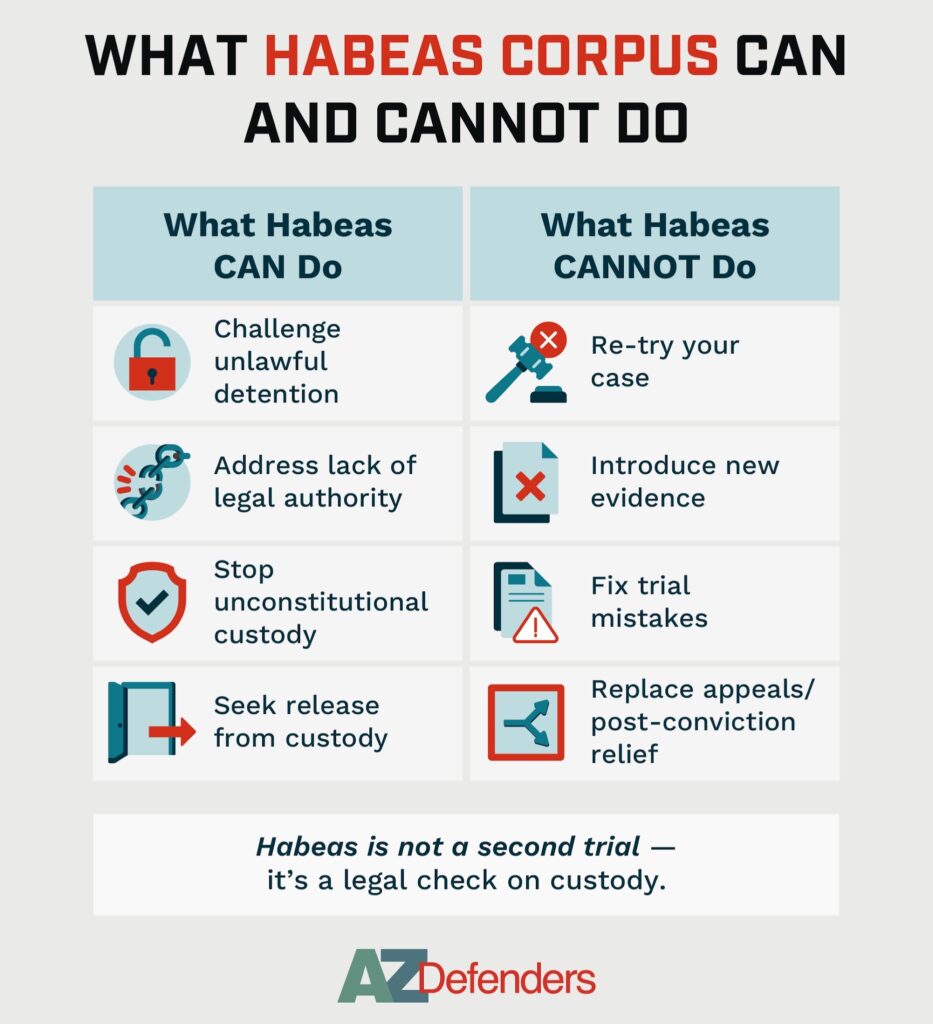
Mistaking habeas corpus for post-conviction relief is common. Suitable Arizona habeas challenges include lack of jurisdiction, detention after a sentence expires, or detention without charges. Conditions-of-confinement issues, such as excessive force or inadequate medical care, should be filed under 42 U.S.C. § 1983 and not as habeas claims in Arizona.
Conditions-of-confinement claims — like excessive force, medical neglect, or unconstitutional jail conditions — are not proper habeas issues in Arizona; those claims are typically brought under 42 U.S.C. § 1983.
Issues more suitable for post-conviction relief include claims for ineffective assistance of counsel or issues that you could not raise on direct appeal. The reviewing court will rely heavily on the existing record when it considers your petition. It will seldom consider new evidence, unless it directly relates to the legality of your detention.
The more it appears to the court reviewing your habeas claim that you are effectively trying to re-litigate your case through your petition, like trying to overturn a conviction, or to modify your sentence, or to re-open factual disputes, the less your chance of seeing your petition granted.
By now, you may be wondering what this “post-conviction relief” is, which can seem so easy to mix up with habeas corpus relief.
If you have been convicted of a crime in Arizona, post‑conviction relief is a legal process that allows you to challenge your conviction or sentence after the trial, plea, or direct appeal process has ended. Post‑conviction relief is the primary method for raising claims not available on direct appeal.
Issues suitable for post-conviction relief include:
The table below summarizes how habeas corpus relief differs from post-conviction relief in Arizona.
| Feature | Post‑Conviction Relief (PCR) | Habeas Corpus |
|---|---|---|
| Primary Purpose | To challenge your conviction or sentence, based on specific legal grounds like constitutional violations, newly discovered evidence, or an illegal sentence | To challenge the legality of custody itself: whether the state has lawful authority to detain you |
| Governing Law | Arizona Rules of Criminal Procedure Rule 32 (trial convictions) and Rule 33 (plea cases) | Arizona habeas statute (A.R.S. § 13‑4121) for state habeas; 28 U.S.C. § 2254 for federal habeas |
| Who Can File | Anyone convicted in Arizona state court proceedings | Anyone “in custody,” but Arizona state habeas is extremely narrow; federal habeas requires state remedies to be exhausted |
| When It Applies | After your conviction and sentencing; also used when appeals are unavailable, such as when you plead guilty | Only when custody is unlawful on its face (Arizona) or after post-conviction relief is completed (federal) |
| Typical Issues Raised | Ineffective assistance of counsel, constitutional violations, newly discovered evidence, illegal sentence, significant change in law, actual innocence | Jurisdictional defects, expired sentence, detention without legal authority; federal habeas may raise constitutional violations already exhausted in state court |
| Record Expansion Allowed? | Yes: evidentiary hearings, new evidence, affidavits, expert reports | Arizona habeas: No record expansion; limited to facial legality of custody.Federal habeas: limited |
| Right to Counsel | Yes, in some cases | No right to counsel in Arizona habeas; limited right in federal habeas |
| Deadlines | Strict deadlines (usually 90 days after sentencing or mandate, with exceptions for certain claims) | Arizona habeas has no strict deadline, but is rarely applicable; federal habeas has a 1‑year statute of limitations |
| Standard of Review | Varies by claim; often requires showing prejudice or constitutional harm | Arizona habeas: extremely narrow, only whether custody is lawful.Federal habeas: deferential to state courts |
| Available Relief | New trial, new sentencing, withdrawal of plea, vacating conviction, resentencing | Release from custody (Arizona); federal habeas may order retrial or release |
| Availability After Guilty Plea | Yes: post-conviction relief is the only avenue for challenging a guilty plea | Arizona habeas: almost neverFederal habeas: possible only after PCR exhaustion |
| Court That Hears It | Filed in the Arizona trial court that entered the conviction | Arizona habeas: Arizona Superior Court.Federal habeas: U.S. District Court (after Arizona state remedies are exhausted) |
| Frequency of Use | Common and essential part of Arizona criminal procedure | Arizona habeas is rare; federal habeas is used but highly restricted |
Once you have exhausted your Arizona remedies, a federal writ of habeas corpus can be used to challenge a state conviction or sentence based on a federal constitutional violation. A habeas corpus lawyer will usually evaluate your case against three recurring grounds.
Under Strickland v. Washington, 466 U.S. 668 (1984), you have a Sixth Amendment right to effective counsel. To win relief, you must show two things:
Common examples include failing to investigate key evidence, failing to call important witnesses, or giving bad advice on whether to accept a plea.
A habeas corpus petition is one of the primary vehicles for bringing forward evidence that was not available at trial. Two pathways are typical:
New evidence can include DNA results, recanted testimony, previously undisclosed witnesses, or scientific advances that discredit the evidence used at trial.
Several categories of prosecutor conduct can support a federal habeas claim:
Each of these grounds is procedurally and factually complex. An experienced habeas corpus attorney can help you evaluate whether your case fits any of them, gather the evidence the court will require, and frame the petition to satisfy the federal standards.
Your attorney’s approach to seeking habeas relief under Arizona law must be methodical and systematic to maximize your chances of a successful petition. Here are some of the important steps to consider.
The table below summarizes how this checklist works.
| Question for Consideration | If YES | If NO |
|---|---|---|
| Are you in custody? | Continue | Habeas unavailable |
| Is your detention itself unlawful? | Continue | Use direct appeal or post-conviction relief |
| Is no other remedy available to you? | Continue | Habeas is improper |
| Is the issue jurisdictional or fundamental? | Continue | Use post-conviction relief |
| Does your claim rely only on the existing record? | Continue | Use post-conviction relief |
| Is the relief you seek limited to release/custody legality? | Continue | Use post-conviction relief |
| Have you chosen the proper court? | Proceed | Redirect to proper forum |
If the court approves your petition for a writ of habeas corpus, then the court may order the custodian to produce you or may require the custodian to show cause why the writ should not issue.
The court will set a date for your hearing. At the hearing, you and the government agency holding you will have the opportunity to present your arguments and evidence.
Your habeas corpus attorney will lead off in the hearing and present your evidence to prove that your confinement — or the duration of your confinement — is unlawful.
Next, an attorney representing the state or federal government will have the opportunity to challenge your lawyer’s evidence, and to argue that your incarceration — or its duration — is lawful.
When both sides have concluded presenting their arguments and evidence, the court will decide on what relief to give you, if any.
Habeas corpus relief is effective for the purposes it was designed for, but it can be easy to confuse it with other kinds of relief, most notably post-conviction relief.
Furthermore, knowing which kind of habeas relief may apply to you, Arizona or federal, can be complex to determine and involve issues like exhaustion of remedies that require careful consideration.
An experienced Arizona criminal defense attorney, like those at AZ Defenders, can determine if you will benefit from a state or federal court habeas corpus petition and assist you in filing your petition in a way that can improve your chances of the court granting habeas relief for you.
To learn more about your habeas corpus relief options under Arizona or federal law, call AZ Defenders at (480) 456-6400 to speak with one of our skilled criminal defense lawyers. Or, you can use our online contact form to reach us and to schedule a free initial consultation.