
available 24/7
Free Consultation
Post-conviction relief is a way you can seek a judicial remedy to vacate a criminal conviction, reduce your sentence, or restore certain civil rights when you have already been convicted of a crime.
Post-conviction relief can be easily confused with an appeal of a criminal conviction, but these are distinct remedies. Here, we focus on post-conviction relief in Arizona. Specifically, we cover:
AZ Defenders’ appeal lawyers have many years of combined experience representing people convicted of committing a crime (or crimes) in Arizona. We thoroughly understand the controlling Arizona laws and the Arizona Rules of Criminal Procedure that govern appeals and post-conviction relief, and we can put this knowledge and in-depth experience to work for you.
To speak with one of our skilled and experienced criminal appeals attorneys and to schedule a confidential, free initial consultation with a post-conviction relief lawyer, call our law offices at (480) 456-6400 or reach us online.
When you seek post-conviction relief, you are petitioning the trial court to vacate or modify your conviction, change the terms of a plea agreement that involved a guilty plea, or reduce or modify your sentence.
Rule 32 and Rule 33 of the Arizona Rules of Criminal Procedure provide for post-conviction relief.
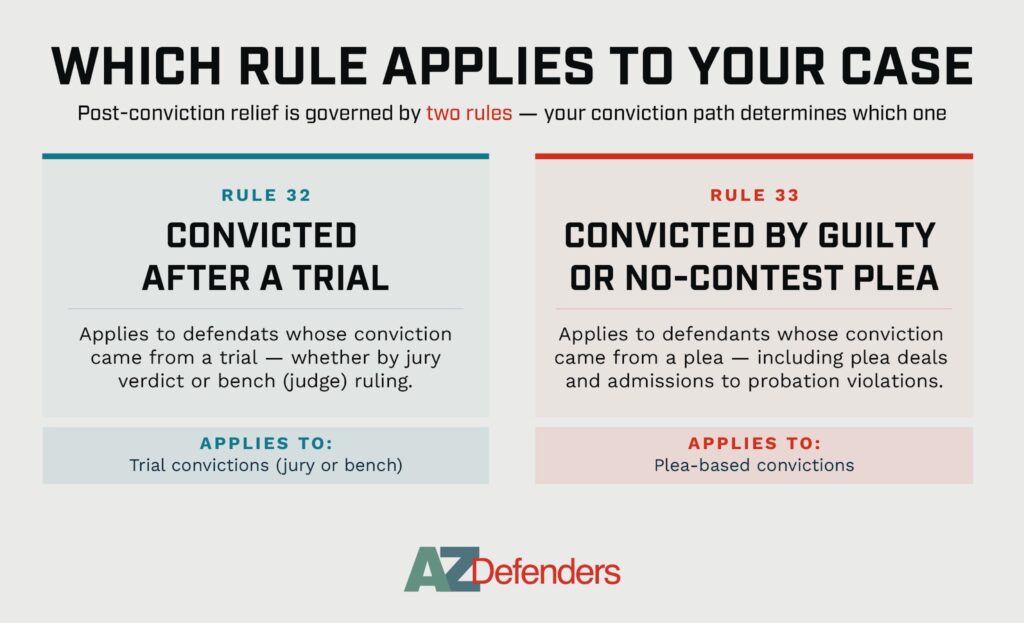
Post-conviction relief and criminal appeals share some similarities. For example, in both you can seek to challenge your conviction and/or your sentence, or to obtain a new trial or a new sentencing hearing. But there are key differences between these two remedies that we need to make clear.
An Arizona post-conviction relief proceeding can also be significant if you are considering a federal habeas corpus petition. Following Arizona’s post-conviction relief procedures carefully is crucial to preserving claims for possible federal habeas corpus review.
This is because federal law generally requires a prisoner to exhaust all available state court remedies before a federal court will entertain a habeas corpus petition.
This means you must complete the Arizona post-conviction relief process, including any petition for review to an Arizona appellate court, for each federal constitutional claim. Doing so gives Arizona appellate courts the chance to rule first on the issue(s).
If you fail to raise a claim in the Arizona state court properly, your claim is considered procedurally defaulted. A federal habeas court will not review a defaulted claim unless you show a valid cause for the default and actual prejudice, or show that a fundamental miscarriage of justice would occur, such as by proving your actual innocence.
Under the Antiterrorism and Effective Death Penalty Act (AEDPA), a state prisoner has one year from the date the conviction becomes final after direct review to file a federal habeas corpus petition. The AEDPA one‑year clock is tolled only while a properly filed post-conviction relief petition is pending. Untimely or improper PCR filings do not toll the federal deadline.
Once your Arizona post-conviction relief effort concludes, the federal clock resumes where it left off.
In summary, Arizona’s post-conviction relief process is typically the final avenue for state relief after conviction. It also serves to meet the exhaustion requirement for federal habeas corpus relief.
A well-handled post-conviction relief petition can preserve important federal constitutional claims, such as ineffective counsel or newly discovered evidence of innocence, for potential federal review.
But failures in your post-conviction review, such as missing a deadline or omitting a claim, can result in forfeiture of these claims at the federal level due to procedural default.
Arizona Rules of Criminal Procedure 32.1 and 33.1 lay out eight specific reasons for which you can seek post-conviction relief.
These grounds include:
Your post-conviction relief petition must explicitly assert at least one of these grounds. If a claim does not fit any of these specific grounds, then it cannot proceed.
Post-conviction relief requires that you stick to a strict timeline.
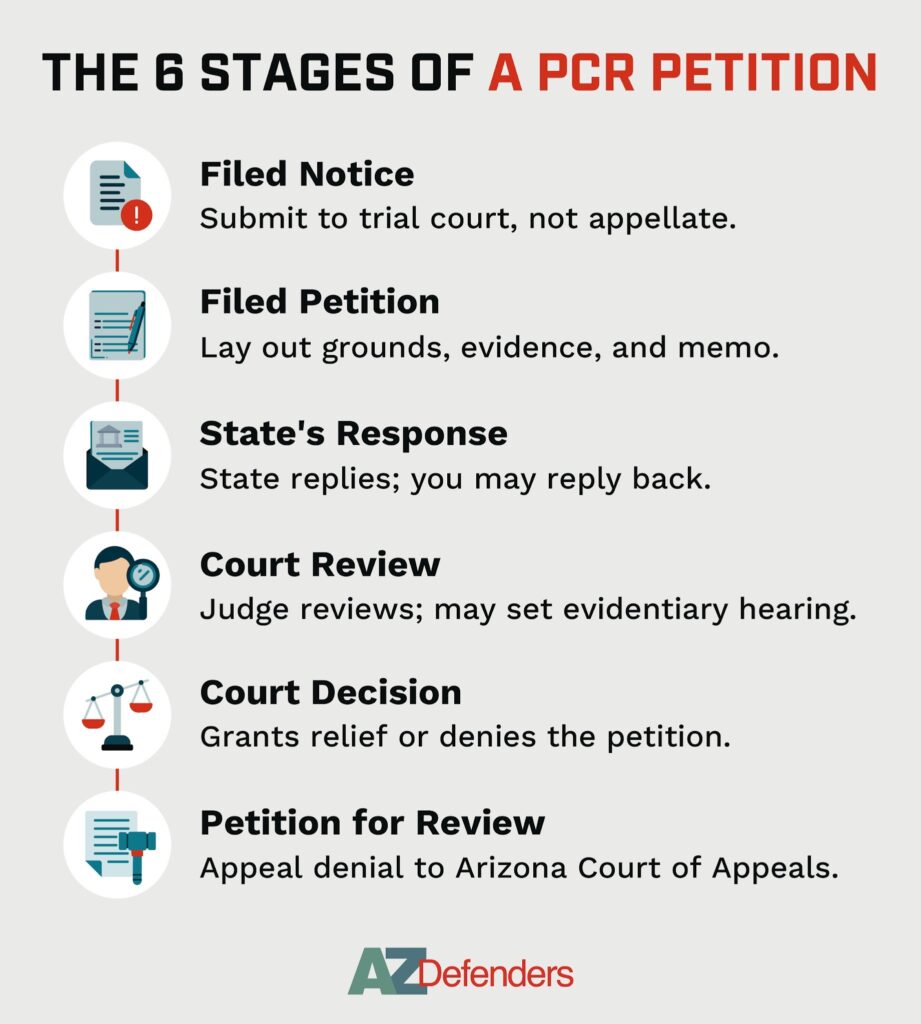
Your first post-conviction relief petition is also known as an “of-right” petition.
Because this is your first opportunity to seek post-conviction relief, an of-right petition is not subject to the preclusion rules that bar claims in successive petitions — you cannot be denied relief on the ground that you should have raised a claim earlier. The court must rule on each claim you properly present.
The court can, however, summarily dismiss any claim that does not state a “colorable claim” — a claim that, even if its factual allegations are taken as true, could entitle you to relief. To survive summary dismissal and earn an evidentiary hearing, your petition must set forth at least one colorable claim with specific facts, court records, transcripts, and/or affidavits.
If you cannot afford a lawyer, you are generally entitled to court-appointed counsel for your of-right petition.
You submit your notice requesting post-conviction relief to the trial court. This is another distinction from a direct appeal, which generally goes to the Arizona Court of Appeals.
In all non-capital cases, you must file a notice of post-conviction relief no later than 90 days after the entry of judgment and sentence, or no later than 30 days after the issuance of an order and mandate in a direct appeal, whichever is later.
For all other grounds, like newly discovered evidence or a change in law, you must file your notice within a reasonable time after discovering the basis for your claim. The Arizona Rules of Criminal Procedure do not give a fixed number of days for these claims. Instead, courts decide on a case-by-case basis if a delay is reasonable and the delay was not the fault of the defendant, so it is best to act promptly.
Your notice must include information about you as well as your sentence or conviction, the case’s procedural history, and the grounds for your claim.
If you fail to follow the time limit that applies to your claim, absent good grounds for late post-conviction relief, this can lead to the preclusion of otherwise valid claims you may have had to have your conviction or sentence overturned.
Once you file the notice, you will need to work on your petition for post-conviction relief. Usually, you must file the petition for post-conviction relief within 60 days.
This petition must include more specific information about the grounds for your relief claim, including newly discovered material facts, court records, testimony transcripts, affidavits, and any other relevant information.
Your petition must also include a memorandum establishing how the facts you present support your relief claim. It should also include supporting legal authorities, if applicable.
Once you file your petition for post-conviction relief, the state will have an opportunity to file a response, usually within 45 days. The state’s attorney may argue that your claim or claims lack merit or are precluded by prior proceedings.
You will have the right to file a reply to the state’s response, which you typically must submit within 15 days.
Once the petition and responses are filed, the trial court judge will review them. If the filings show that you have a colorable claim, meaning that material factual disputes exist that, if resolved in your favor, could entitle you to relief, the court will schedule an evidentiary hearing.
In most cases, the court will decide your post-conviction relief claim based on the written briefings you and the state submit to it.
If the court does hold an evidentiary hearing, then you can present evidence and witnesses.
After considering the written submissions and, if applicable, any additional evidence and testimony from the evidentiary hearing, the trial court judge will issue a ruling on your post-conviction relief petition.
The court may grant you relief, like ordering a new trial, vacating your conviction, or conducting a resentencing, or it may deny your petition and affirm its original decision.
If the court denies your petition for post-conviction relief, or if it grants you relief but the state disagrees with that decision, then either you or the state, as appropriate, can file a petition for review with the Arizona Court of Appeals.
You have 30 days from the trial court’s final decision to file this petition for review.
The Court of Appeals has the discretion to accept or decline to review a petition for review.
Once the highest available Arizona court has issued its decision or declined to review the petition for review, then the post-conviction review process is complete.
Any later post-conviction relief petitions you may file after the first one are considered “successive” petitions. Arizona’s rules of criminal procedure strongly discourage successive petitions. Generally, you are expected to raise all known claims in your first petition.
If you raised a claim that was decided before, or could have been raised earlier but was not, then it is generally barred from being raised in a new petition. There are exceptions, like jurisdictional issues, newly discovered evidence, significant legal changes, or actual innocence.
Also, under Rule 33, a limited successive petition is allowed to allege ineffective assistance of your first post-conviction relief counsel, but only if you file it within 30 days after the first post-conviction relief’s final order or mandate. Outside of such narrow exceptions, successive post-conviction relief attempts are usually dismissed.
If you have been convicted of a criminal offense in Arizona, then, depending on your specific circumstances, you may have a claim for post-conviction relief. Having a claim and how to win post-conviction relief, though, are two different things. And your attorney’s experience with post-conviction relief claims can make all the difference.
An experienced AZ Defenders Phoenix criminal defense attorney can help you understand if post-conviction relief is appropriate for you or your loved one. Our attorneys at AZ Defenders have decades of criminal defense experience, including petitions for post-conviction relief and appeals. We offer free consultations to help you make the right choice for your case.
Call us today at (480) 456-6400, or use our online contact form to schedule your free consultation with a post-conviction relief attorney.