
available 24/7
Free Consultation
Many Arizona professions are subject to state licensing requirements. Generally, the state licensing board or agency responsible for issuing licenses handles complaints about individuals under its purview.
A professional license defense attorney represents licensed professionals who are facing a complaint, investigation, or disciplinary action before the board or agency that issued their license.
That work can include responding to the initial complaint, preparing for and appearing at an administrative hearing, negotiating a consent agreement or stipulated settlement, and, where necessary, appealing an adverse decision to the courts.
As a licensed professional, your reputation matters. Often, disciplinary proceedings and sanctions are a matter of public record, and if there is a blemish on your record, then it can have a direct negative impact on your ability to pursue your livelihood.
In many license complaint matters, you can retain legal counsel to assist in your defense. At AZ Defenders, our experienced professional license defense attorneys can help you if your license is under threat because of an alleged violation.
To learn more about our professional license defense attorney services, call us at (480) 456-6400 or contact us online to schedule a free consultation.
The kinds of license violations that can subject you as a professional to possible disciplinary actions generally fall into the following categories.
These kinds of complaints often involve alleged behavior that undermines public trust in your profession or violates your profession’s governing statutes and rules.
Examples of unprofessional conduct complaints include:
The Arizona agency or board that governs your profession will frequently define what constitutes unprofessional conduct in its regulations and rules.
This is a frequent source of professional complaints, and can include activities like:
Licensing agencies and boards treat these violations as serious matters because they can pose public safety risks.
Professions, including medicine, nursing, behavioral health, and law, can be subject to accusations of professional malpractice. Malpractice claims often involve allegations that, as a professional, you failed to meet the accepted standard of care for members of your profession. This is a different standard than the ordinary “reasonable person” general negligence standard.
A common source of complaints against licensed professionals is that the accused kept incomplete or inaccurate records, or failed to maintain records and documentation required by their profession.
Documentation-related complaints often arise alongside other complaints, such as billing irregularities, professional judgment issues, or patient safety concerns.
Substance Abuse or Impairment
The abuse of alcohol or drugs can seriously impair your ability to perform your professional obligations in many ways. Clients whose property or financial interests or whose physical or mental health and well-being are harmed by a substance-abusing professional are a frequent source of complaints.
For some professions, Arizona state law encourages mandatory reporting in cases where suspected alcohol or drug abuse poses a potential risk to public health or safety.
Some Arizona licensing agencies and boards require professionals to report criminal charges or convictions, and to do so within a certain time period. Some of these deadlines are tight.
For example, under A.R.S. § 32-3208, most health-profession licensees must report felony charges and misdemeanor charges involving conduct that may affect patient safety within 10 working days of the charge being filed. Failing to report can constitute an independent act of unprofessional conduct and may incur a separate civil penalty.
Sources of complaints here can arise from the failure to mention a reportable offense like driving under the influence of alcohol or drugs, or any other crime that relates to your professional fitness.
In these cases, the underlying conviction itself can also trigger an independent disciplinary action.
Some professions require you to comply with ongoing education and training qualification requirements. If you fail to keep these obligations current, it may result in an administrative complaint and a related investigation.
These kinds of alleged license violations are usually not as serious as some of the others we mentioned above, but can still result in disciplinary action against you if you do not resolve them.
If you are subject to a complaint and investigation, Arizona licensing agencies and boards will require you to cooperate with the investigation. Non-cooperation by itself is a potential basis for disciplinary action.
When a complaint is filed against you, it will be reviewed by the agency or board responsible for overseeing compliance. You should receive notification from the agency or board of the existence of the complaint. In many cases, if not all, you may receive a request for a written response to the complaint.
Usually, the agency or board will assign an investigator to your case. Sometimes, this will be a preliminary screening investigation to decide whether to proceed with formal proceedings against you.
The investigator may seek access to your relevant files, police records, or third-party information, and may also communicate with the person who made the complaint.
Sometimes the complaint will be a matter of public record, although on occasion the identity of the complainant will be kept private, especially if the agency or board decides that the accusations could place the complainant at personal risk.
Once the investigator has reviewed evidence and interviewed witnesses, the results are presented to the agency or board responsible for your licensure.
The next step is for the board to decide whether to take disciplinary action against you, and what the nature of that action should be. Depending on the board and the allegations, this can be a formal hearing, a negotiated resolution, or a summary dismissal.
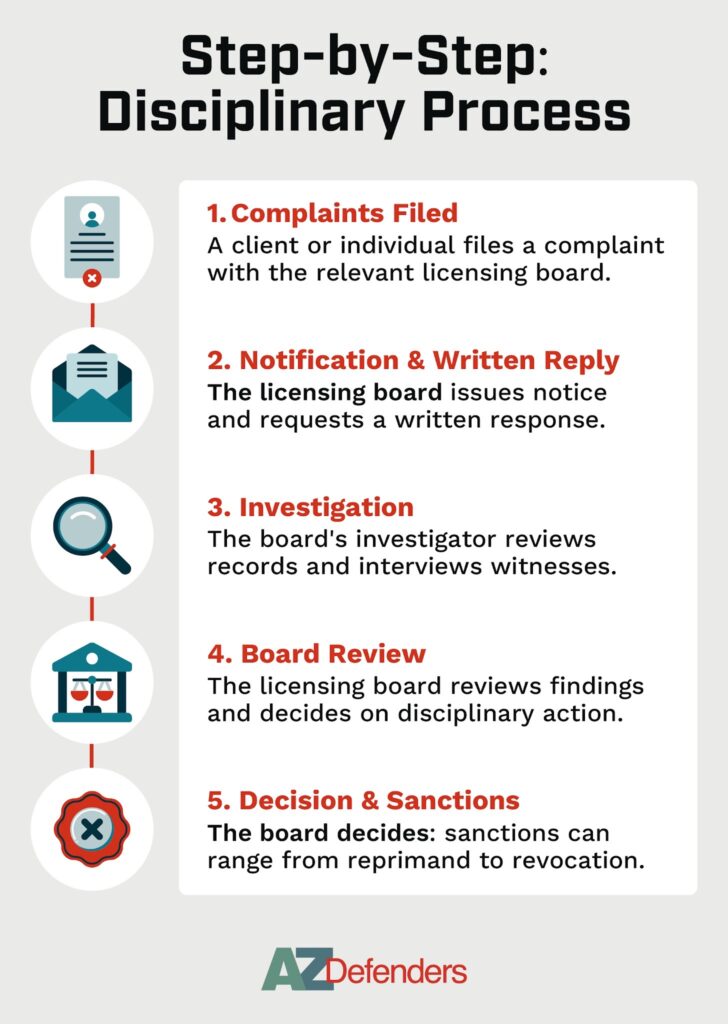
If the agency or board decides to pursue formal disciplinary action against you after its investigation, your case will proceed to an administrative hearing.
Most Arizona licensing hearings are governed by the Arizona Administrative Procedure Act (A.R.S. Title 41, Chapter 6) and are conducted by the Arizona Office of Administrative Hearings (OAH), although some boards conduct their own hearings with their own procedural rules.
At the hearing, you generally have the right to:
An experienced professional license hearing lawyer can help you prepare testimony, subpoena witnesses, review and challenge the board’s evidence, and draft a written closing argument.
In many cases, your attorney can also negotiate a consent agreement or stipulated settlement before the hearing date, which allows you to resolve the matter on more favorable terms without a full evidentiary proceeding.
After the hearing, the administrative law judge issues a recommended decision that is returned to the licensing board for final review. The board can accept, modify, or reject the recommendation before entering a final order in your case.
If the licensing board issues a final order you disagree with, you generally have the right to appeal. The appeals process typically involves two stages.
Board reconsideration: In many cases, you can first ask the board itself to reconsider its decision. This is usually a short window — often 30 days from the date of the final order, depending on the board.
Judicial review: If the board denies reconsideration, or if you choose to go straight to court, you can file a complaint for judicial review in the Arizona Superior Court under A.R.S. § 12-904. The deadline here is also strict — generally 35 days from the date the final administrative decision is served on you.
On judicial review, the court examines whether the board’s decision was supported by substantial evidence and whether the agency acted within its authority. The court does not grant a new trial; it reviews the administrative record from your hearing.
Appeals involve strict procedural requirements and tight deadlines. Missing a filing window can waive your right to challenge the board’s decision. If you are considering an appeal, contact a professional license lawyer as soon as possible after the final order — ideally before the reconsideration window closes.
If your licensing agency or board finds that you have committed a violation of your professional obligations, then you may be subject to disciplinary action. Depending on the nature and severity of the violation, the sanctions you could face include:
The negative consequences to you of a disciplinary action do not necessarily end with the agency or board’s official decision.
Disciplinary and non-disciplinary action, even including milder sanctions like a letter of concern or reprimand, can be viewed as a matter of public record, meaning that your public reputation can be on the line.
Given how much you have invested in the education and training needed to obtain your professional license or certification, when you are the subject of a complaint or accusation of a licensing violation, the stakes to your career can be considerable.
The need for a strategic approach to preparing a strong defense is particularly true if you have been accused of a violation that could lead to suspension or loss of your professional reputation.
By working with a skilled Arizona professional license defense lawyer, you can improve your chances of receiving a favorable outcome from any administrative action your licensing or certification authority may take in your case.
At AZ Defenders, we have extensive experience defending professionals under investigation by professional licensing boards. Our license defense attorneys have experience vigorously defending Arizona professionals facing licensing issues, including disciplinary hearings, compliance inspections, and criminal defense if you have been accused of a crime.
If you need help with a professional licensing issue before an Arizona professional licensing board, our license defense attorneys are a phone call away at (480) 456-6400. You can also reach us via our online contact form for a free initial consultation.
Your career depends on your good standing in your profession. Before you agree to any kind of disciplinary action by a professional board — even lesser penalties like a reprimand letter or restitution — consult a professional license defense attorney about your options.