
available 24/7
Free Consultation
Arizona law makes it illegal for any person under the legal drinking age of 21 to consume alcohol in any quantity. The relevant statute is Arizona Revised Statutes (ARS) Section 4-244(41). A criminal conviction under this minor in consumption (MIC) law is a Class 2 misdemeanor under ARS 4-246(A), which can lead to up to 4 months in jail, up to 2 years of probation, and a fine and surcharges.
AZ Defenders represents Arizona residents charged with alcohol-related offenses, including underage drinking charges. In this blog post, we discuss Arizona’s minor-in-consumption law.
If you or your child has been charged with minor in consumption, call us at (480) 456-6400 or contact us online to speak with a criminal defense lawyer and schedule a free consultation.
ARS 4-244(41) does not make it illegal to have alcohol in your body as a minor. The law makes it unlawful for a person under 21 to have any spirituous liquor in their body, regardless of intoxication. This can be a significant distinction, as we will see below.
ARS 4-101(38) answers this question. A spirituous liquor can be any of:
A spirituous liquor also includes:
Some beverages contain alcohol, but they do not exceed 0.5% alcohol by volume. Technically speaking, under ARS 4-101(38), these beverages do not meet the threshold definition of spirituous liquor, even though they contain alcohol.
Arizona law prohibits a minor from purchasing, receiving, or possessing spirituous liquor under ARS § 4-244(9). Because ‘spirituous liquor’ is a defined term that only includes beverages with more than 0.5% alcohol by volume, beverages at or below that threshold fall outside the statute’s scope.
Similarly, ARS 4 244(41) does not prohibit the presence of alcohol in a minor’s body, but rather the presence of a spirituous liquor. As we will see below, this distinction may be a legal defense if, as a minor, you are found to have alcohol in your system.
As we mentioned above, under ARS 4-246(A), a conviction for a minor who consumes spirituous liquor is a Class 2 misdemeanor.
The potential penalties for a Class 2 misdemeanor conviction can include:
Minor in consumption penalties in Arizona vary depending on the circumstances. For example, a court can consider the following when deciding what kind of sentence to issue:
The judge will usually be lenient in first-offense sentencing. A common first-time sentence for violation of Arizona’s MIC law can be:
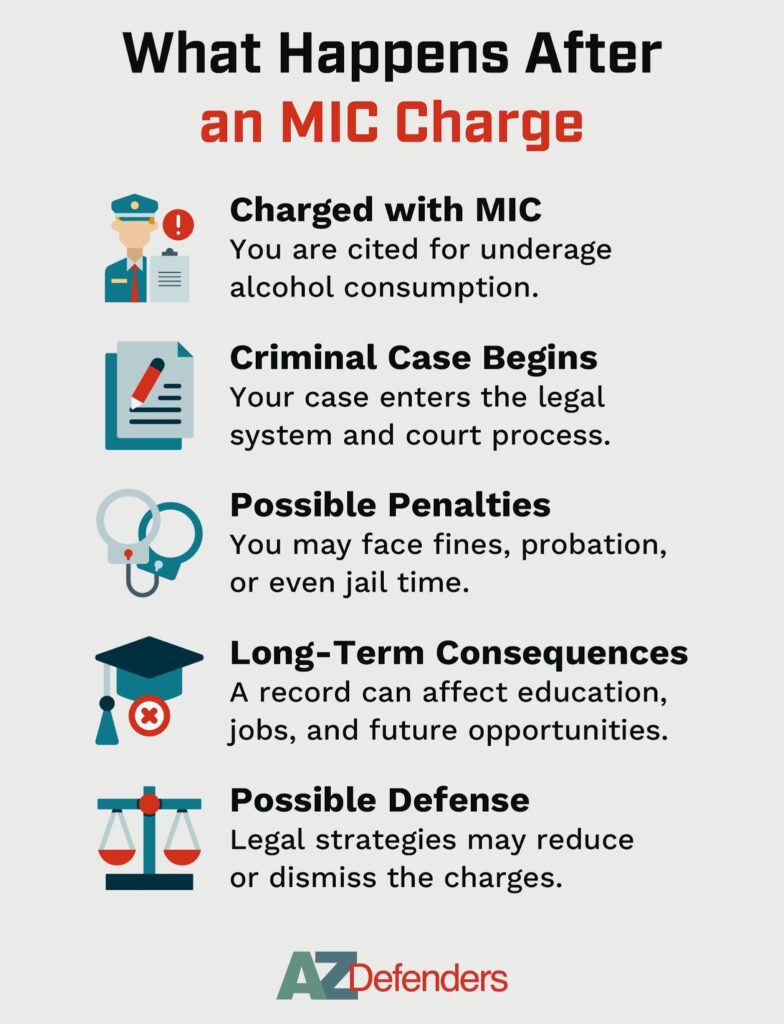
In some cases, it is possible to receive deferred prosecution in an Arizona minor in consumption case. What this means is that instead of issuing a judgment, the prosecution may require you to complete certain requirements that, if you complete them satisfactorily, may lead to dismissal of the charge. Deferred prosecution is not available in every case and is at the discretion of the prosecutor.
Sometimes, especially if they involve other crimes like driving under the influence of alcohol or assault, a minor in consumption charge can be more serious. In these situations, the judge may impose jail time, even for a first-time offense.
Collateral effects of a Class 2 misdemeanor conviction can include losing a scholarship or financial aid, being rejected by colleges, difficulty finding future employment, and difficulty obtaining on-campus housing.
Depending on the circumstances, you may have one or more defenses to the legal consequences of a charge of being a minor in consumption.
ARS 4-244(41) identifies two ways in which a minor can legally consume alcohol in Arizona:
As we have seen above, Arizona’s MIC law can be technical in its application, raising questions about whether a substance is spirituous liquor and how much alcohol by volume is actually present. These technicalities can give rise to equally technical defenses.
For example, in a “near beer” case it is at least arguable that if the Arizona legislature meant it to be illegal for a minor to have any trace of alcohol in his or her body then when it drafted the MIC law the state legislature would not have carved out a specific exception to “spirituous liquor” for a beverage that has 0.5% (or less) alcohol by volume in it.
That being said, if the same minors are found with even a single open container of a spirituous liquor among them, the police officer at the scene may not be inclined to give them the benefit of the doubt, and they may still face a charge of minor in possession of alcohol, if not underage drinking.
Sometimes it may be possible to cast reasonable doubt on the prosecution’s case in an MIC charge arising from law enforcement personnel’s failure to properly follow procedures. These failures can call the accuracy of evidence against you into doubt or even cause evidence to be inadmissible in court.
Examples of these defenses include:
These are not the only available potential defenses to a charge of being a minor in consumption in Arizona. An experienced criminal defense attorney can thoroughly investigate the facts and circumstantial evidence involved in your case to raise every practical legal defense in your particular case.
If you or your child is under 21, having an alcohol-related criminal offense on your record is a serious matter with potentially serious consequences. Aside from possible jail time and financial penalties that come with a Class 2 misdemeanor conviction, a misdemeanor record stays with you and can threaten you with collateral consequences that follow you for years.
The criminal defense attorneys at AZ Defenders have decades of combined experience defending Arizona residents against alcohol-related criminal charges, including charges against minors.
If you have been accused of being a minor in consumption, or if you are the parent or guardian of a child facing such a charge, call our law office at (480) 456-6400 to schedule a free consultation or use our online contact form to reach us at any time.