
available 24/7
Free Consultation
Money laundering is the process by which illegally obtained funds are converted into “legitimate” funds. The term describes how “dirty” money is moved and disguised to appear “clean,” hence its origin. Both Arizona and federal laws make money laundering illegal.
In this blog post, we focus on Arizona’s money laundering laws. Specifically, we cover:
AZ Defenders criminal defense attorneys represent persons charged in Arizona in state and federal court cases, including white-collar crimes such as money laundering. If you are facing money laundering charges in Arizona, call us at (480) 456-6400 or contact us online to speak with one of our experienced money laundering lawyers.
Arizona Revised Statutes (ARS) Section 13-2317 governs money laundering in Arizona. It breaks down money laundering activity into three levels, or degrees: first-degree, second-degree, and third-degree.
Money laundering schemes often occur in the context of racketeering activities, which under ARS 13-2301(D)(4) include an assortment of white collar crimes, organized crime-related activities, and certain serious or violent crimes when they have a financial motivation.
Money laundering is an offense that can support a racketeering charge under ARS 13-2301(D)(4), and both crimes can be charged separately.
Examples of white collar crimes that can be connected to money laundering activity include:
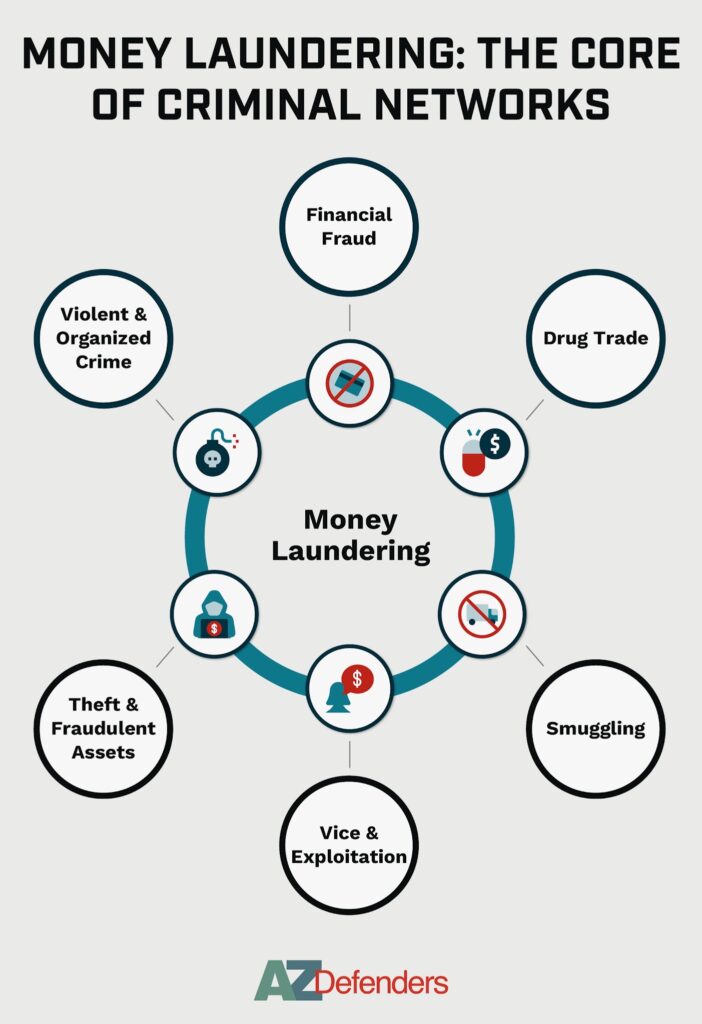
Examples of organized crime activities that can have a connection with money laundering include:
Serious or violent crimes that can be linked to money laundering when they have a financial motive include:
A separate Arizona statute, ARS 13-2312, applies to enterprise-based crimes. For example, if a person uses racketeering or proceeds from racketeering activity to acquire or maintain control of an enterprise, like a corporation, limited liability company, partnership, or nonprofit company or association, this can qualify as an illegal enterprise.
It is possible to face charges for acquiring or controlling an illegal enterprise, racketeering, and money laundering as separate offenses in the same prosecution.
Under ARS 13-2317(A), first‑degree money laundering applies to anyone who organizes, manages, supervises, or is in the business of money laundering, or who commits money laundering to facilitate terrorism or murder.
Under ARS 13-2317(B), second-degree money laundering occurs when a person:
As you can see, second-degree money laundering can cover a broad and complex assortment of activities. An experienced Arizona money laundering attorney can help you understand the prosecution’s case if it charges you with this level of money laundering and assist in preparing your defense.
Under ARS 13-2317(C), third-degree money laundering occurs when a person intentionally or knowingly, in the course of a transaction, transmits money:
In simple terms, third-degree money laundering targets bribery and corruption within the money transmission industry — paying off or accepting payments to bypass Arizona’s money transmitter reporting and compliance laws.
Here are some examples of money laundering taken from Arizona court cases.
Arizona’s money laundering law exists in parallel with the federal money laundering law. Depending on the circumstances, a person may face charges under either, or sometimes both, of these legal frameworks under the dual sovereignty doctrine.
The main distinction between the federal government’s and Arizona’s money laundering laws is that federal laws have a broader scope of potential application than Arizona’s law does. ARS 13-2317 applies to money laundering allegations that occur within Arizona’s borders. Federal laws apply to interstate and international money laundering.
So, for example, if a money laundering activity takes place in Arizona but involves laundering activities in other states or other countries, then to the extent that the money laundering violates Arizona’s law a person can be charged under ARS 13-2317 and can also be charged under federal laws like 18 U.S.C. § 1956 (laundering of monetary instruments) or 18 U.S.C. § 1957 (engaging in monetary transactions in property derived from specified unlawful activity).
Federal money laundering investigations are conducted by federal law enforcement agencies, including the Federal Bureau of Investigation (FBI) and the Internal Revenue Service (IRS) Criminal Investigation Division. Factors that can influence whether federal authorities will bring charges can include:
The applicable money laundering penalty under ARS 13-2317 depends on the degree of the charged offense. The legal consequences of a money laundering conviction can be severe, including prison time, significant fines, and the forfeiture of assets.
A conviction for first-degree money laundering under Arizona law is a Class 2 felony. The applicable sentence will depend on factors including whether mitigating or aggravating considerations apply, and whether the conviction is a first or subsequent offense.
For example, aggravating factors include:
The court must find that at least two aggravating factors exist to exceed the presumptive sentence.
For a first‑time, felony offender, the sentencing range is as follows:
| Sentence type | Prison term |
|---|---|
| Mitigated | 3 years |
| Minimum | 4 years |
| Presumptive | 5 years |
| Maximum | 10 years |
| Aggravated | 12.5 years |
If you have one historical prior felony conviction, the maximum sentence can be up to 23 years; if you have two or more historical prior felony convictions, the maximum sentence can be up to 35 years.
A conviction for second-degree money laundering under Arizona law is a Class 3 felony. For a first‑time felony offender, the sentencing range is:
| Sentence type | Prison term |
|---|---|
| Mitigated | 2 years |
| Minimum | 2.5 years |
| Presumptive | 3.5 years |
| Maximum | 7 years |
| Aggravated | 8.75 years |
If you have an historical prior felony conviction, the maximum sentence increases to up to 16.25 years. If you have two or more historical prior felony convictions, the maximum prison time is up to 25 years.
Penalties For Third-Degree Money Laundering
A conviction for third-degree money laundering under Arizona law is a Class 6 felony. For a first-time felony offender, the sentencing range is:
| Sentence type | Prison term |
| Mitigated | 4 months |
| Minimum | 6 months |
| Presumptive | 1 year |
| Maximum | 1.5 years |
| Aggravated | 2 years |
Prison time is only part of the legal consequences you can face if you are convicted of a Class 2, Class 3, or Class 6 felony for money laundering. Here are some of the other possible penalties that may apply.
Probation eligibility depends on the offense, whether it is designated dangerous, statutory exclusions, and a defendant’s criminal history.
Each count of a felony conviction, regardless of class, can result in a fine of up to $150,000, plus possible probation fees and surcharges.
A conviction for money laundering often results in forfeiture proceedings. These can include cash, bank accounts, vehicles, real estate, and other property that were involved in or derived from the money laundering activity.
By comparison, a conviction for money laundering as a federal offense can result in a sentence from 3 to 15 or more years, depending on the statute involved:
| Statute | Statutory maximum | Typical guideline reality |
|---|---|---|
| 18 U.S.C. § 1956 | Up to 20 years per count | Often 5–15+ years |
| 18 U.S.C. § 1957 | Up to 10 years per count | Often 3–10 years |
Actual federal sentences depend on the U.S. Sentencing Guidelines, offense level calculations, and judicial discretion.
Factors a federal court will consider in sentencing include:
Fines in a federal money laundering case can be up to $500,000, or twice the value of the property involved in the money laundering activity.
Depending on the circumstances involved in the government’s case, the following defenses may be available.
Money laundering requires proof that the defendant acted knowingly or intentionally, as defined by Arizona law, with respect to the property’s criminal origin or intended use. If you did not have this requisite knowledge, this can be an effective defense.
A money laundering defense lawyer will scrutinize whether the prosecution’s evidence actually demonstrates the required mental state or merely shows that you were associated with individuals or transactions later found to be criminal.
This is a variation of the lack-of-requisite-mental-state defense. It is not a crime to be around someone who is engaged in money laundering, or to work for or be associated with a business that is connected with such activity, if you are not personally involved in it. This is also a possible defense to charges of racketeering or illegal enterprise activity.
The money involved must be the proceeds of criminal activity. If you can show that the alleged funds were lawfully originated, this is a valid defense.
Money laundering requires that the transactions involved were made with the intent to conceal or disguise the source, ownership, or control of the money. If you can show that these transactions were, in fact, open, ordinary, and transparent, with no effort to hide, falsify, or misrepresent involved, then you have a strong defense. Your defense attorney will work to present bank statements, transaction records, and other documentation showing the legitimate business explanation for the financial activity.
Especially in cases where the prosecution relies on circumstantial evidence to prove its case, if you can show that the financial activity was consistent with normal business operations, this may cast reasonable doubt on the prosecution’s evidence. A money laundering attorney experienced in navigating the legal process involved in these cases can develop a strong defense strategy tailored to the specific facts of your situation.
Sometimes it may be possible that the prosecution has charged you for first-degree money laundering when the offense is better categorized as second-degree, such as in cases in which you were not involved in organizing, leading, or managing the alleged criminal activities. This can result in reduced charges.
If the prosecution has insufficient evidence to establish that you knew the funds were connected to underlying criminal activity, this may form the basis for a strong defense. Prosecutors must prove their case beyond a reasonable doubt, and a skilled defense attorney will investigate the government’s evidence and identify weaknesses in the prosecution’s case. Challenging the prosecution’s evidence through independent forensic analysis of financial records is a common and effective defense strategy.
Money laundering charges often stem from searches and seizures of evidence, such as cash or financial records. If police do not follow proper procedures in seizing evidence, such as a lack of reasonable suspicion, probable cause, or having obtained a search warrant when necessary, this can all result in violations of your civil rights that can lead to the government’s evidence becoming “fruit of the poisonous tree” and being excluded from court.
Although ARS 13‑107 generally provides a seven‑year statute of limitations for Class 2–6 felonies, money laundering offenses connected to racketeering activity may not be subject to any statute of limitations under ARS 13‑107(E).
The statute of limitations can be tolled under circumstances such as the accused’s absence from Arizona or, in some cases, when the accused’s identity is unknown. Still, generally, any money laundering charge that falls outside the statute of limitations cannot be charged against you.
Because people who engage in it often go to considerable lengths to hide their financial transactions, money laundering can be a complex activity that results in overlapping charges, including racketeering, illegal enterprise activity, and even dual federal and state prosecutions.
Defending against a money laundering charge can be correspondingly complex, requiring analysis of the charges and the evidence and the preparation of the strongest possible legal defense. Both Arizona and federal prosecutors can be aggressive in pursuing a conviction against you, and they can call on considerable government resources to aid them in that effort.
If you are facing this charge in Arizona, you need legal counsel from a law firm experienced in financial criminal cases. This is where AZ Defenders can help you.
Our attorneys have decades of combined experience defending Arizona residents in financial and white-collar crime cases. We understand the relevant laws and how they apply to a wide range of unique factual circumstances. We know how to navigate complex criminal defense litigation and can negotiate with prosecutors to build a strong defense strategy for our clients.
To speak with an experienced money laundering attorney, call AZ Defenders at (480) 456-6400 day or night to schedule a free consultation and case evaluation. You can also use our online contact form if you choose.