
available 24/7
Free Consultation

Posted on January 31, 2026 in Assault & Violent Crimes
Armed robbery is a more serious form of the crime of robbery. It involves the possession, use, or threatened use of a deadly weapon or a simulated deadly weapon, or in some cases a dangerous instrument, during the commission of a robbery.
Armed robbery is a Class 2 felony under Arizona law, the second-most severe category of crime in the state.
In this article, we discuss the details of armed robbery in Arizona, including:
If you are facing an armed robbery charge in Arizona, call AZ Defenders at (480) 456-6400 or use our contact form to speak with an experienced criminal defense attorney during a free consultation.
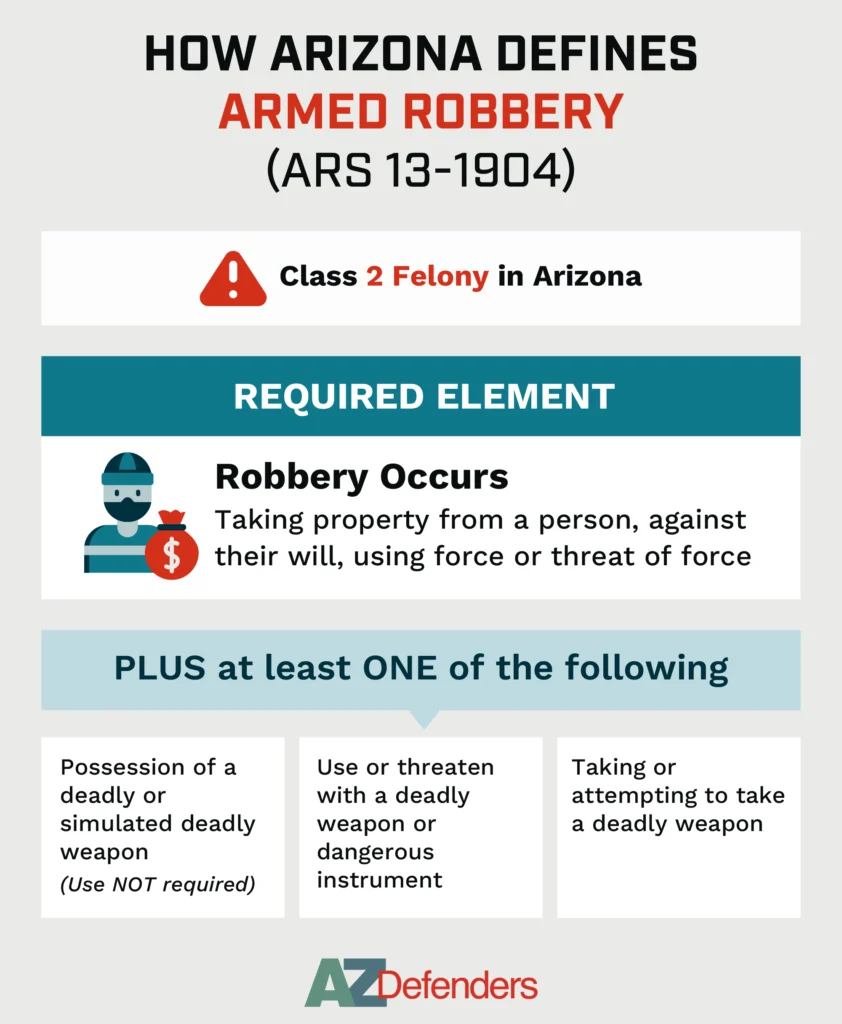
Arizona Revised Statutes (ARS)Section 13-1904 is the state’s armed robbery law. It is a short statute, so we reproduce it here in full:
Armed robbery; classification
A. A person commits armed robbery if, in the course of committing robbery as proscribed in section 13-1902, the person or an accomplice does any of the following:
1. Is armed with a deadly weapon or a simulated deadly weapon.
2. Uses or threatens to use a deadly weapon or dangerous instrument or a simulated deadly weapon.
3. Takes possession of or attempts to take possession of a deadly weapon.
B. Armed robbery is a class 2 felony.
The elements that the prosecution’s case must prove to obtain an armed robbery conviction are:
ARS 13-3101 defines a deadly weapon as “anything that is designed for lethal use.” Examples of deadly weapons include:
Note that it is not necessary to use a deadly weapon during a robbery to make it an armed robbery; simply having it in your possession will suffice. The same is true if you do not have a deadly weapon on you, but an accomplice does.
A simulated deadly weapon can be a replica, like a model of a gun or a knife made of a material other than metal. Having your hand concealed in a jacket pocket in a way that suggests you are holding a pistol in it might qualify as a simulated deadly weapon if the victim of the robbery believes it to be so.
The definition of a dangerous instrument is broader than a deadly weapon.
Under ARS 13-105(12), a dangerous instrument is “anything that under the circumstances in which it is used, attempted to be used or threatened to be used is readily capable of causing death or serious physical injury.”
Examples of dangerous instruments include:
What a dangerous instrument may be is a question of fact that depends on the circumstances of each case. The key question is whether, under the circumstances at the time, the person who uses or threatens to use the item is able to use it or credibly threaten to use it to cause serious physical injury.
A robbery can become an armed robbery if, during its commission, the robber or an accomplice picks up a deadly weapon or tries to do so. This can include, for example, a robbery during which the object of the robbery is to steal a gun or a knife from the victim’s possession.
Armed robbery is a Class 2 felony in Arizona. The penalties you could face for an armed robbery conviction is subject to sentencing enhancement as a “dangerous offense” under ARS 13-105(13).
Under ARS 13-702, the incarceration penalty for a first-time armed robbery conviction can be 3 to 12.5 years in prison.
Repeat offenders under ARS 13-703 can be subject to longer prison terms, up to 35 years.
Arizona law does not categorically bar probation for armed robbery for first time felony offenders, but many prosecutors and judges treat Class 2 armed robbery as violent offenses and, as such, avoiding jail time is very challenging.
What can make armed robbery a dangerous offense is if the robbery involves “the discharge, use or threatening exhibition of a deadly weapon or dangerous instrument.”
Although armed robberies involve deadly weapons or dangerous instruments, this by itself does not automatically make armed robbery a “dangerous” offense.
Consider, for example, a case in which a robber is carrying a knife in a backpack he is wearing at the time of the robbery, but does not take it out. Here, the possession of a deadly weapon may qualify as being armed with it for armed robbery purposes, but this does not necessarily rise to the level of a “dangerous” offense if the knife is not used or displayed to the victim.
A “dangerous” offense sentence carries a longer prison sentence. For a first offense, the range is between 7 and 21 years.
| Sentencing Category | Governing Law | Minimum Sentence | Presumptive Sentence | Maximum Sentence | Probation Eligible? |
| Non-Dangerous Armed Robbery (First Offense) | ARS § 13-702 | 3 years (mitigated) | 5 years | 12.5 years (aggravated) | Yes |
| Non-Dangerous Armed Robbery (Repetitive Offender) | ARS § 13-703 | Varies by prior felony count | Varies | Up to 35 years (worst case) | No |
| Dangerous Armed Robbery (First Dangerous Offense) | ARS § 13-704(A) | 7 years | 10.5 years | 21 years | No |
| Dangerous Armed Robbery (Prior Dangerous Felony Conviction) | ARS § 13-704(B)–(D) | 14 years | 15.75 years | 28 years | No |
| Dangerous Armed Robbery (Two or More Prior Dangerous Felonies) | ARS § 13-704(E) | 21 years | 28 years | 35 years | No |
A felony conviction in Arizona can result in a fine ranging from $4,000 to $150,000.
Additionally, an armed robbery sentence may include a restitution requirement to the victim. You can also lose certain civil rights, like the right to possess a firearm and other “deadly weapons”.
Finally, a felony conviction on your public record can complicate your life for years after you complete any prison sentence and pay any associated financial penalties. For example, you can find it harder to find a job or a place to live, or to gain admission to higher education or qualify for a student loan.
An armed robbery can occur independently, but prosecutors often include additional criminal charges if the circumstances warrant them.
Examples of related offenses include second-degree burglary and aggravated assault.
The main defenses to an armed robbery charge are to challenge specific elements of the crime, or to claim that you have been mistakenly identified as the robber, or defenses based on violations of your Constitutional rights.
To obtain a conviction for armed robbery, the prosecution must prove each of the elements of the crime beyond a reasonable doubt. It follows that if you can cast reasonable doubt on any one element of the charge, you may be able to at least have the armed robbery charge reduced to a lesser offense or even acquitted at trial.
Consider the following example: A robber possesses a tire iron, which can be a dangerous instrument, during the commission of a robbery. But he does not use it on the victim or threaten to use it. In this case, a robbery may not rise to the level of an armed robbery under ARS 13-1904(A)(2) because although the tire iron is a dangerous instrument, it is not a deadly weapon, and more than possessing a dangerous instrument is required to trigger the armed robbery threshold.
People who commit robbery often do so while attempting to conceal their identity, such as by wearing a mask or by committing the crime during hours of darkness.
This makes it possible that the victim or any witnesses to the incident may have mistakenly identified you as the perpetrator.
It is not necessary for you to prove that someone else committed the armed robbery; it is only necessary to cast a reasonable doubt that you were the person who did it.
Law enforcement officials, like police officers, can violate your civil rights in a number of ways when making an arrest for an armed robbery. Examples include:
Given the grave circumstances of possessing or using a deadly weapon or a dangerous instrument during the commission of the already serious crime of robbery, the possible consequences for a Class 2 felony conviction are hard to understate.
If you are convicted of armed robbery in Arizona, then you could face several years in state prison, be subject to crushing fines, and have a black mark on your record that could follow you the rest of your life.
Because of these high stakes, if you have been accused of armed robbery in Arizona, you need a skilled criminal defense law firm to stand between you and the prosecution.
That is what we do at AZ Defenders.
We represent clients accused of all kinds of theft crimes, including armed robbery charges.
Our experienced criminal defense lawyers are skilled negotiators who carefully investigate the facts to uncover every possible defense and possible mitigating factor for you. If we cannot secure an acquittal for you, we will seek the best possible outcome, which may include a plea negotiation to a lesser charge, a reduced sentence, or both.
If plea negotiations are unsuccessful, we aggressively represent our clients at trial, challenging the prosecution’s case to the point of reasonable doubt.
You cannot afford to represent yourself against an armed robbery charge. Nor can you afford to put your fate into the hands of an inexperienced attorney. When you have AZ Defenders on your side, you will have board-certified criminal defense attorneys to represent you.
Contact us at (480) 456-6400 or use our contact form to speak with a skilled defense attorney during a free case evaluation.