available 24/7
Free Consultation
ARS 13-3407 prohibits several kinds of conduct involving a dangerous drug, including possession or use, possession for sale, manufacturing, administering and transporting for sale. A simple possession allegation is not the same charge as possession for sale or manufacturing, and the potential classifications and sentences differ substantially.
For personal possession or use, the state generally must prove that the accused knowingly possessed or used a substance that Arizona law classifies as a dangerous drug. The type of drug, alleged purpose, quantity, criminal history and available probation statutes can all affect the case.
If you have been charged with possession of a dangerous drug, please call AZ Defenders at (480) 456-6400 or use our contact form.
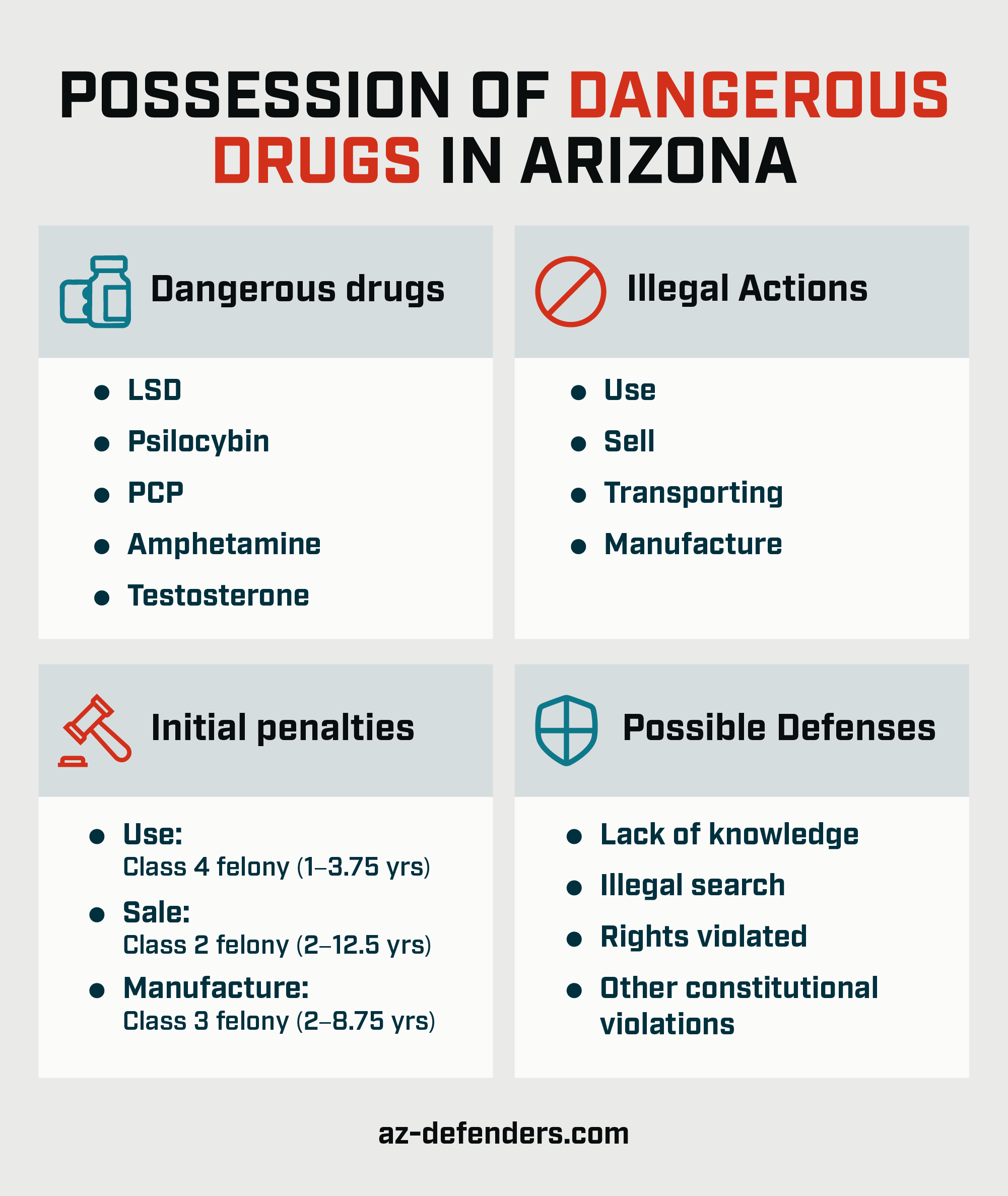
ARS 13-3401 contains the statutory definition and a long list of substances. Examples include methamphetamine, amphetamine, LSD, psilocybin, PCP, MDMA, and certain prescription medications when possessed without lawful authority.
Arizona separately defines narcotic drugs. Heroin, fentanyl, and cocaine are generally prosecuted under the narcotic drug statute rather than ARS 13-3407. Marijuana also has a separate statutory framework. Identifying the substance correctly is the first step in evaluating a charge.
Possession of a prescription medication is not automatically unlawful. ARS 13-3412 addresses exceptions and exemptions and assigns the burden of proving them to the defendant. Bring relevant prescription and authorization records to counsel for assessment.
For a personal possession charge under ARS 13-3407 A 1, prosecutors generally must establish:
Possession can be actual or constructive. Actual possession generally involves a substance found on the person. Constructive possession is an allegation that the person exercised dominion or control over the substance even though it was not physically on the person.
Mere proximity does not automatically prove knowing possession. When drugs are found in a shared vehicle, bedroom, house or container, the state must connect the accused to the substance with evidence beyond simple presence.
Personal possession or use under ARS 13-3407 A 1 is a class 4 felony. In limited qualifying circumstances, the statute permits the court, on motion of the state, to enter a class 1 misdemeanor judgment or leave the offense undesignated during probation. It excludes LSD, methamphetamine, amphetamine and PCP, as well as the prior-conviction histories stated in subsection B(1). Under this provision, an undesignated offense remains a felony for all purposes until the court designates it a misdemeanor.
Possession of a dangerous drug for sale under ARS 13-3407 A 2 is a class 2 felony. Quantity may be evidence of purpose, but it is not the only factor. Packaging, scales, communications, cash, statements and observed transactions may also be relevant.
The statutory threshold affects probation eligibility for certain sale, administration and transportation offenses. Exceeding a threshold does not by itself rewrite the elements or automatically prove every possession-for-sale allegation.
Possessing equipment or chemicals for the purpose of manufacturing a dangerous drug is generally a class 3 felony, except the statute classifies the conduct as a class 2 felony when methamphetamine is involved. Manufacturing, administering and transporting or selling dangerous drugs have separate class 2 or class 3 classifications under ARS 13-3407.
Methamphetamine allegations receive special treatment. ARS 13-3407 provides specific sentencing ranges for designated sale, equipment, manufacturing and transportation conduct involving methamphetamine and limits probation and release.
For a first non-dangerous felony prison sentence governed by ARS 13-702, the following benchmarks apply when no more specific sentencing provision controls. Terms are years. Mitigated and aggravated endpoints require statutory findings; prior convictions, dangerousness and drug-specific rules can change the result.
| Offense | Class | Mitigated | Minimum | Presumptive | Maximum | Aggravated |
| Personal possession or use | 4 | 1 | 1.5 | 2.5 | 3 | 3.75 |
| Possession for sale, excluding a controlling special range | 2 | 3 | 4 | 5 | 10 | 12.5 |
| Manufacturing equipment or chemicals, other than methamphetamine | 3 | 2 | 2.5 | 3.5 | 7 | 8.75 |
ARS 13-3407(E) has a separate 5-year minimum, 10-year presumptive, and 15-year maximum for methamphetamine offenses under A(2), A(3), A(4), or A(7). With a qualifying prior conviction specified there, the range is 10, 15, and 20 years. These provisions concern sale, manufacturing, and related conduct, not every allegation of personal methamphetamine possession.
ARS 13-3407(H) requires at least $1,000 or three times the court-determined drug value, whichever is greater, capped by the applicable statutory maximum. The judge cannot suspend this required fine. ARS 13-801 generally caps an individual’s felony fine at $150,000; surcharges and other obligations can be additional.
ARS 13-901.01 generally requires probation and drug treatment or education for a qualifying conviction for personal possession or use. Important exceptions apply. The statute excludes people convicted of or indicted for a defined violent crime and does not treat possession for sale, production, manufacturing or transportation for sale as personal possession.
Repeated possession convictions, treatment refusal, rejection of probation, and methamphetamine can affect eligibility under ARS 13-901.01. Subsection I preserves possible probation under ARS 13-901 for otherwise qualifying defendants affected by subsections G or H. Exclusion from Proposition 200, therefore, does not by itself establish mandatory prison in every case.
A felony conviction can suspend voting, jury service, and firearm rights under ARS 13-904. A drug record may affect employment, licensing, and housing decisions. A treatment or probation disposition should not be described as erasing the conviction; record relief is a separate question.
For noncitizens, a controlled substance case can create immigration issues separate from the Arizona sentence. Ask counsel to evaluate the precise substance, conviction record, and proposed plea before accepting an offer. Immigration law uses its own definitions and exceptions.
Potential defense issues include:
Counsel may seek suppression of unlawfully obtained evidence, challenge laboratory or possession proof, negotiate for treatment or a reduced classification, or prepare the case for trial.
After filing, counsel reviews the charging subsection, lab identification, quantity, search records and any sale allegation. A felony case may involve an initial appearance, preliminary hearing or indictment, arraignment, disclosure, motions and plea discussions or trial. The immediate tasks are to follow release orders and identify deadlines for addressing the evidence.
Probation is a sentencing disposition. Diversion is a different process whose availability and completion requirements depend on the prosecutor’s program and the case. Do not assume that being eligible for one establishes eligibility for the other. See the Arizona Judicial Branch’s criminal case overview.
Being charged with possessing dangerous drugs is a serious matter; even if you are not accused of being a dealer or drug manufacturer, simple possession can still be a Class 4 felony offense.
A felony conviction follows you on your public record long after you complete any jail time and sentencing requirements a court may impose on you under the legal system:
At AZ Defenders, we have the experienced criminal defense attorneys you need if you are facing a dangerous drug offense. Our experienced legal team has more than 200 years of combined experience successfully defending clients charged with drug possession and other criminal offenses.
Call us at (480) 456-6400 or use our online contact form to speak with one of our drug possession attorneys and schedule a free consultation today.