
available 24/7
Free Consultation
A criminal conviction can continue affecting your life long after you have completed your sentence. Even years later, a conviction may appear in background checks and create obstacles when applying for jobs, housing, professional licenses, or educational opportunities.
Fortunately, Arizona law provides a way for many individuals to obtain relief through the Arizona set-aside process. While a conviction is not erased from your record, a court order setting aside the conviction can demonstrate that you fulfilled the court’s requirements and have moved forward with your life in a positive manner.
If you are interested in pursuing an Arizona set-aside of a criminal conviction, AZ Defenders can help.
Call (480) 456-6400 to speak with an experienced criminal defense attorney about your eligibility and the application process.
Arizona’s set-aside law is codified at ARS 13-905, which allows a convicted person to apply to the court to have their judgment of guilt set aside after successfully completing the terms of their sentence.
An Arizona set-aside is a court order that sets aside the judgment of guilt and conviction entered against a person following a criminal conviction. When a conviction is set aside, the court dismisses the accusations or information and releases the individual from many of the penalties and disabilities resulting from the conviction (with a few exceptions, however).
A set-aside does not erase the conviction from the record. The criminal case remains visible, but the record will show that the court set aside the conviction after the sentence was completed.
Many people pursue a set-aside because it can improve employment, housing, licensing, and educational opportunities while demonstrating rehabilitation and compliance with court-ordered requirements.
Eligibility depends on the offense and whether all sentencing requirements have been fulfilled.
In general, a person may be eligible to apply if they have:
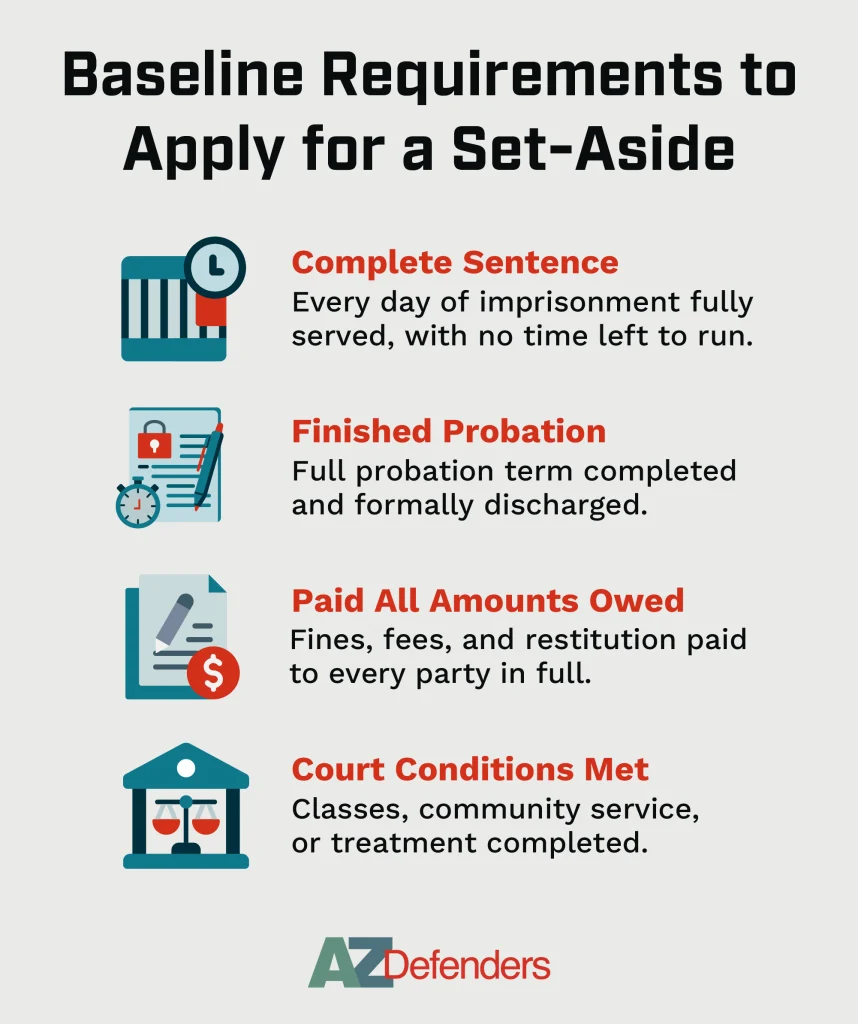
Both misdemeanor and felony convictions may qualify in many situations.
An Arizona misdemeanor set-aside may be available for many misdemeanor offenses, and numerous felony convictions may also qualify after sentence completion.
However, certain offenses are not eligible for a set-aside. Arizona law excludes a number of serious offenses, including dangerous offenses, offenses requiring sex offender registration, offenses for which there has been a finding of sexual motivation, and felony offenses involving victims under 15 years of age.
Eligibility depends on the specific conviction and circumstances of the case.
An experienced attorney can review your record and determine whether a set-aside is available.
The process begins by filing an Application to Set Aside Conviction with the clerk of the court where the conviction occurred.
The application typically includes information regarding:
After the application is filed, notice must be provided to the prosecutor and victim(s) associated with the case.
The court will review the request and determine whether granting the application serves the interests of justice and public safety.
Factors a court may consider include:
Some cases are decided based on the written filing, while others may involve a hearing before the court.
If granted, the court issues an order setting aside the judgment of guilt.
When a conviction is set aside, the judgment of guilt is set aside, and the case is updated to reflect that the conviction has been set-aside by a judge.
This can provide important benefits for individuals seeking a second chance after completing their sentence. Employers, landlords, licensing boards, and other decision-makers may see that the person successfully completed all court requirements and obtained a set aside.
However, a conviction that is set aside is not treated as though it never occurred. Arizona courts may still consider the conviction in certain circumstances. For example, a conviction that has been set aside can still be used as a prior conviction for sentencing purposes if the individual is later convicted of another offense.
Many individuals pursue a set-aside in Arizona because it can reduce some of the practical consequences associated with a criminal conviction, even though the conviction remains part of the public record.
A set-aside may also restore certain rights that were lost because of the conviction.
Depending on the circumstances, restoration may include:
In Arizona, a felony conviction suspends these civil rights, and a set-aside can support their restoration. For a first felony offense, civil rights other than firearm rights are typically restored automatically upon completion of the sentence. Misdemeanor convictions generally do not result in the loss of civil rights unless it involves an act of domestic violence – in which case you lose your right to possess firearms.
Firearm rights are more complicated. For many felony convictions, a set-aside can restore the right to possess a firearm, but convictions for serious or dangerous offenses are excluded and may require a separate restoration proceeding, sometimes only after an additional waiting period.
Even when Arizona restores firearm rights, a set-aside does not automatically restore federal firearm rights for a person convicted of a felony, and federal law may continue to prohibit firearm possession despite a state court order.
Because restoration of firearm rights depends on the offense and the person’s history, it is important to discuss your situation with a criminal defense attorney before filing.
Arizona law allows certain individuals to receive a Certificate of Second Chance when a conviction is set aside.
A certificate of second chance can provide additional benefits in employment and housing situations. The certificate is intended to encourage rehabilitation while providing certain legal protections to employers, landlords, and others who offer opportunities to individuals with prior convictions.
Not every case qualifies automatically, but a certificate of second chance can be an important form of relief available through the set-aside process.
Many people confuse a set-aside with expungement, but they are not the same.
A set-aside leaves the criminal record intact. The conviction remains visible, but the record reflects that the judgment of guilt was set aside after the person completed the sentence and satisfied the court’s requirements.
Law enforcement agencies can still see a set-aside conviction on criminal history records maintained by the Arizona Department of Public Safety. Courts, prosecutors, licensing agencies, and other government entities may also continue to access the record.
Expungement and record sealing are different. Under ARS 36-2862, enacted through Proposition 207, individuals may petition to expunge certain marijuana-related convictions that would no longer be illegal under current Arizona law.
Separately, ARS 13-911, which took effect on January 1, 2023, allows eligible individuals to seal a broad range of criminal records from public view. Both forms of relief go further than a set-aside: rather than leaving the conviction visible with a notation, they can remove (expungement) or seal the record from background checks.
Although a set-aside is not a true expungement or a sealing of the record, it can still provide meaningful benefits and improve future opportunities.
Many individuals seek relief after DUI convictions. An application to set-aside a DUI conviction in Arizona may be available in many cases once all sentencing requirements have been completed.
This can include completion of probation, payment of fines, participation in required programs, and satisfaction of other court-ordered conditions.
Because DUI cases often involve unique issues, it is important to review the specific facts of the case before filing.
The Arizona set-aside process may appear straightforward, but eligibility questions, filing requirements, and restoration-of-rights issues can create complications.
Our criminal defense team can:
Whether you are seeking relief from a misdemeanor conviction, felony conviction, or DUI offense, our attorneys can guide you through every stage of the process.
If you have completed your sentence and want to move forward with your life, a set-aside may help reduce the long-term impact of a criminal conviction.
AZ Defenders helps clients throughout Arizona pursue set-asides, restoration of rights, certificates of second chance, and other forms of post-conviction relief.
Call (480) 456-6400 today to speak with an experienced criminal defense attorney and learn whether you may qualify for an Arizona set-aside.