
available 24/7
Free Consultation
Expungement in Arizona is limited to certain marijuana offenses. However, there are other ways to seal criminal records or set aside convictions to remove them from public access.
AZ Defenders helps individuals throughout Arizona evaluate their eligibility for expungement, record sealing, and set-asides.
Call (480) 456-6400 to speak with an experienced criminal defense attorney about your options.
Expungement is a legal process that removes qualifying criminal records from public access. When an expungement is granted, eligible arrests, charges, adjudications, convictions, and/or sentences are no longer available through ordinary public background searches.
The goal of expungement is to reduce the long-term consequences of a criminal record and allow individuals to move forward with greater opportunities for employment, housing, education, and professional licensing.
Not all states offer true expungement. Some states, including Arizona, use a process called setting aside a conviction or sealing of a conviction, which provides meaningful relief but does not have the same legal effect as a true expungement.
Because different forms of record-clearing relief exist, it is important to understand exactly what remedy may be available in your case.
Arizona does not have a traditional expungement statute for most adult criminal convictions.
Instead, Arizona law allows eligible individuals to petition to have a conviction set aside under ARS 13-905. Under ARS 13-905, when a conviction is set aside, the court sets aside the judgment of guilt and releases the defendant from most penalties and disabilities resulting from the conviction.
Although a set-aside provides important benefits, the conviction is not erased. The criminal record remains visible and reflects that the conviction was later set aside by the court.
Arizona does allow true expungement in one narrow area. Under ARS 36-2862, enacted through Proposition 207 and effective July 12, 2021, eligible individuals may petition to have arrest records, charges, adjudications, or convictions involving certain marijuana-related offenses expunged.
Separately, Arizona enacted its first record-sealing law, ARS 13-911, which became effective on January 1, 2023. Record sealing is broader than marijuana expungement and applies to many different offenses, but it seals a record from public view rather than erasing it.
As a result, whether someone qualifies for expungement, record sealing, or a set aside depends largely on the nature of the offense and the applicable law.
Many people use these terms interchangeably, but they describe different forms of legal relief.
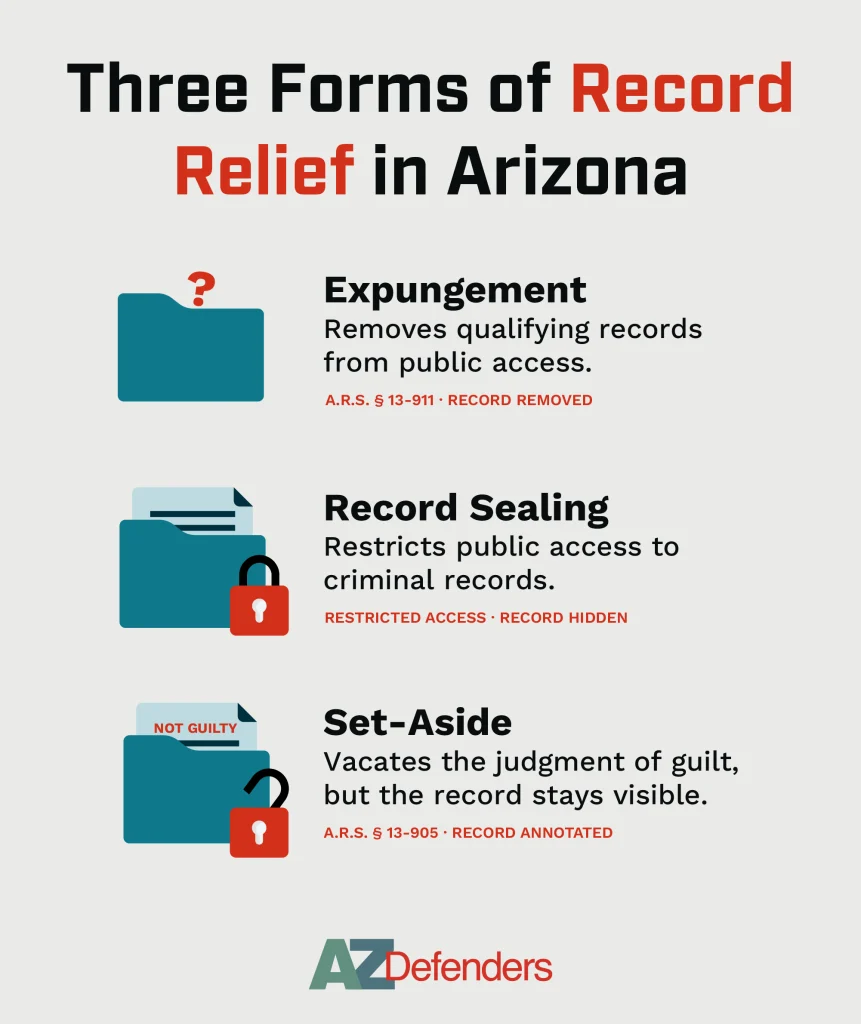
Expungement removes qualifying records from public access. In Arizona, true expungement currently applies primarily to certain marijuana-related offenses authorized by ARS 36-2862.
Record sealing restricts public access to criminal records. Although sealed records generally cannot be viewed by most members of the public, certain government agencies and law enforcement entities may still access the information under circumstances authorized by law.
In Arizona, record sealing is governed by ARS 13-911.
A set-aside is Arizona’s primary form of post-conviction relief for most adult convictions. A conviction that is set aside remains part of the criminal record, but the court formally recognizes that the person completed the sentence and qualifies for relief under ARS 13-905.
Understanding which form of relief applies to your circumstances is critical when evaluating your legal options.
The offenses that qualify for expungement or record clearing vary from state to state.
Across the country, common offenses that may be eligible for expungement or record-clearing relief include:
Arizona’s expungement statute is more limited and focuses primarily on qualifying marijuana-related offenses.
Individuals who do not qualify for expungement may still be eligible for record sealing and/or a set-aside, depending on the circumstances of the case.
Eligibility for expungement depends on whether the offense falls within the marijuana-related categories covered by ARS 36-2862. Individuals whose offenses fall outside those categories may instead qualify for record sealing under ARS 13-911, and/or for a set-aside under ARS 13-905.
In general, individuals may qualify if they were:
Eligibility depends on the specific offense, criminal history, and facts of the case.
An attorney can review court records and determine whether a petition may be filed.
The process generally begins by filing a petition with the court that handled the original case.
The petition typically identifies:
After the petition is filed, notice must be provided to the prosecuting agency.
The court reviews the filing and determines whether the offense qualifies for expungement under Arizona law.
Some cases may be resolved through written filings alone. Others may require a hearing before the court makes a final decision.
If the petition is granted, the court issues an order directing eligible records to be expunged.
Many states require a waiting period before a person becomes eligible to seek expungement.
Most expungement laws require a waiting period after completion of a sentence, including incarceration, probation, parole, fines, restitution, and other court-ordered obligations. These waiting periods are intended to demonstrate rehabilitation and compliance with the law before relief is granted.
Arizona’s requirements vary depending on the form of relief. Marijuana expungement under ARS 36-2862 has no waiting period.
For record sealing under ARS 13-911, the waiting period after completing your sentence generally depends on the offense class: 10 years for class 2 and 3 felonies, 5 years for class 4, 5, and 6 felonies, 3 years for class 1 misdemeanors, and 2 years for lower-level misdemeanors.
Charges dismissed with prejudice and charges that resulted in acquittal may be sealed without a waiting period. As of a 2024 change to the law (SB 1639), a prior felony conviction no longer extends these waiting periods.
Before filing a petition, it is important to determine whether all eligibility requirements have been satisfied.
Juvenile criminal records are often treated differently from adult criminal records.
Many states have policies that favor rehabilitation for juvenile offenders and provide broader opportunities for sealing or expungement. As a result, juvenile criminal records are often more readily eligible for expungement or sealing than adult records.
The reasoning is straightforward: mistakes made during childhood should not necessarily create lifelong barriers to education, employment, housing, and other opportunities.
Whether a juvenile record qualifies for relief depends on the offense, the individual’s age, and the applicable law.
A criminal record can create challenges in many areas of life.
Successfully obtaining expungement or other record-clearing relief may help improve future opportunities.
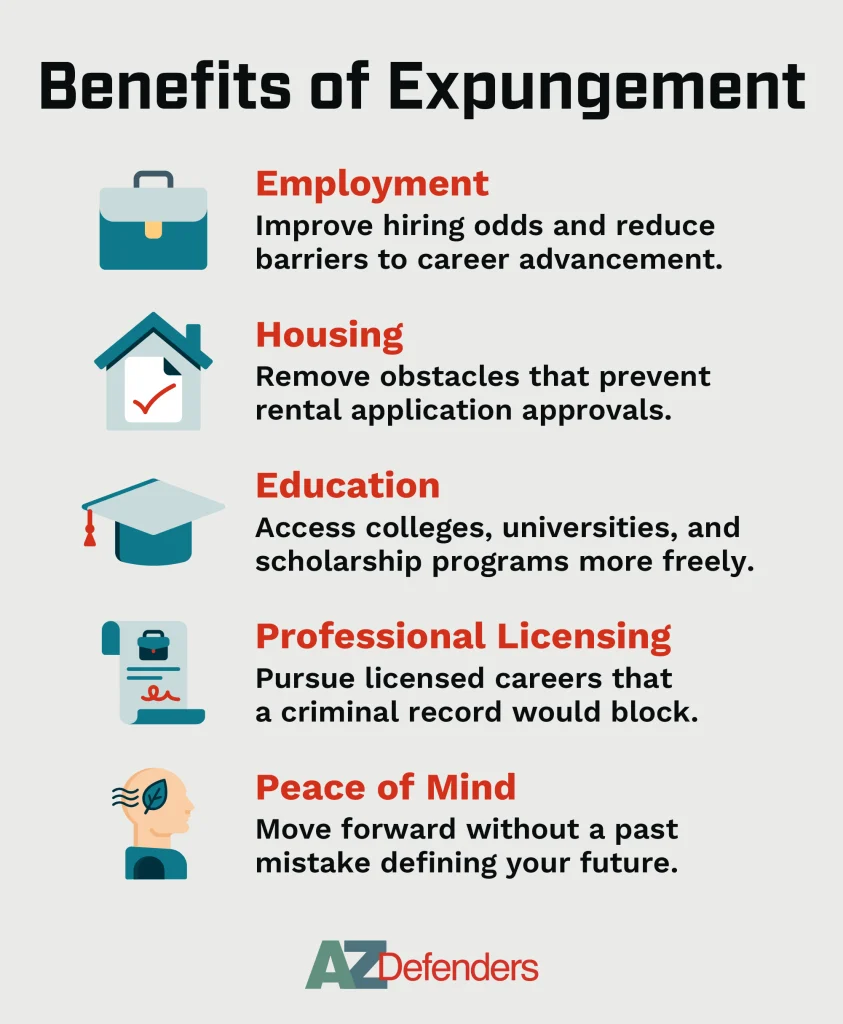
Employers frequently conduct background checks before making hiring decisions.
A criminal record may affect hiring, promotions, professional licensing, and career advancement. Clearing a record can improve employment opportunities and reduce concerns that may arise during the hiring process.
Many landlords review criminal records before approving rental applications.
Expungement may help reduce barriers that could otherwise affect housing opportunities.
Schools, colleges, universities, and scholarship programs sometimes consider criminal history during admissions decisions.
Record-clearing relief may improve access to educational opportunities and professional training programs.
Many licensing boards evaluate criminal records when reviewing applications.
Removing or limiting access to criminal records can help individuals pursue careers that may otherwise be difficult to obtain.
For many people, one of the most important benefits is the ability to move forward without a past mistake continuing to define their future.
One of the most common questions people ask concerns employment applications.
After a successful expungement, individuals can often legally answer “no” to most job applications when asked whether they have been convicted of a crime, depending on state law and the circumstances of the expungement.
The rules governing disclosure vary depending on the type of relief obtained.
A set-aside does not necessarily provide the same protection because the conviction remains part of the criminal public record. Understanding the difference between expungement and a set aside is important when responding to questions about criminal history.
Record-clearing laws can be complicated, and eligibility often depends on detailed statutory requirements.
An experienced attorney can:
Proper legal guidance can help avoid delays, mistakes, and unnecessary denials.
A criminal record can continue affecting employment opportunities, housing applications, professional licenses, and other important aspects of life. Depending on your circumstances, relief may be available through expungement, record sealing, or Arizona’s set-aside process.
AZ Defenders helps individuals throughout Arizona pursue available record-clearing remedies and move forward with confidence.
Call (480) 456-6400 today to speak with an experienced criminal defense attorney and learn whether you may qualify for relief.