
available 24/7
Free Consultation
A criminal record can follow you long after a case ends. Even if charges were dismissed or years have passed since a conviction, criminal records may still appear during background checks conducted by employers, landlords, schools, and licensing boards.
Arizona law now allows many individuals to seek record sealing, which can limit public access to criminal records and provide an opportunity to move forward without a past case creating the same obstacles.
If you are interested in record sealing, an experienced criminal defense attorney can help determine whether you are eligible and help you through the filing process.
Call AZ Defenders at (480) 456-6400 to discuss your options for sealing a criminal record in Arizona.
Record sealing is a legal process that restricts public access to certain criminal records. When a court grants an order to seal, many records related to an arrest, criminal charge, and/or conviction are removed from public view.
Unlike publicly accessible records, sealed records generally do not appear in most background checks conducted by employers, landlords, or members of the public.
However, record sealing does not completely erase the existence of a case. Certain government agencies, courts, and law enforcement entities may still access sealed records under circumstances authorized by law.
For many people, record sealing provides a meaningful opportunity to reduce the long-term consequences of a criminal record.
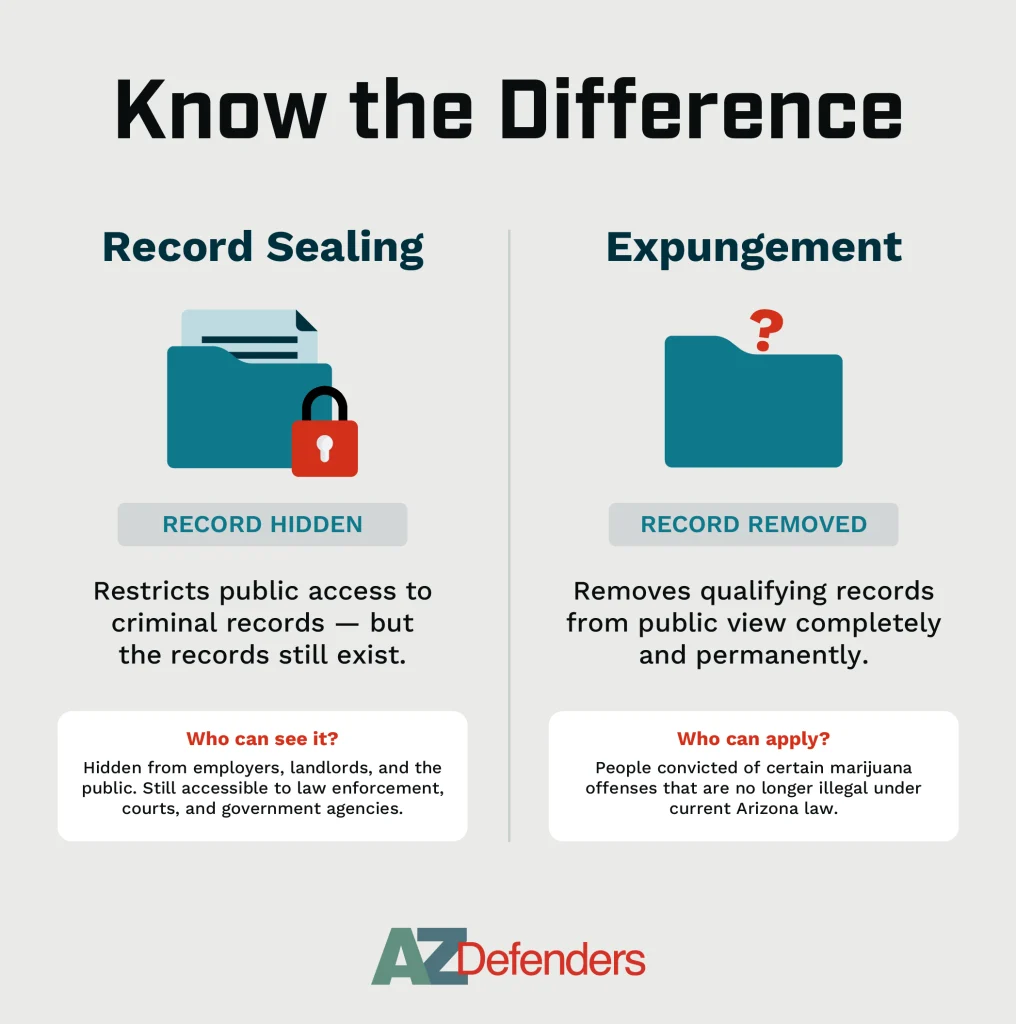
Many people use the terms “record sealing” and “expungement” interchangeably, but they are not the same.
Expungement generally refers to the destruction or complete removal of records. Arizona offers true expungement only in limited situations involving certain marijuana-related offenses.
Arizona also offers a set-aside, which doesn’t seal or destroy the record but adds a notation that the conviction has been set aside by the judge after the sentence was completed.
Record sealing works differently. Rather than destroying records, the court issues an order that limits who can view them.
A sealed record continues to exist, but public access is restricted.
Understanding the difference between sealing and expungement is important when evaluating post-conviction relief options.
Arizona’s record-sealing law is found in A.R.S. § 13-911.
The statute allows eligible individuals to file a petition asking the court to seal records relating to:
The law applies to many types of criminal records, although eligibility requirements vary depending on the case and the nature of the offense.
Not every offense qualifies. Under A.R.S. § 13-911, records of certain serious offenses cannot be sealed, generally including:
Eligibility depends on several factors, including the offense(s) involved, the outcome of the case, and the amount of time that has passed.
Individuals may be eligible if:
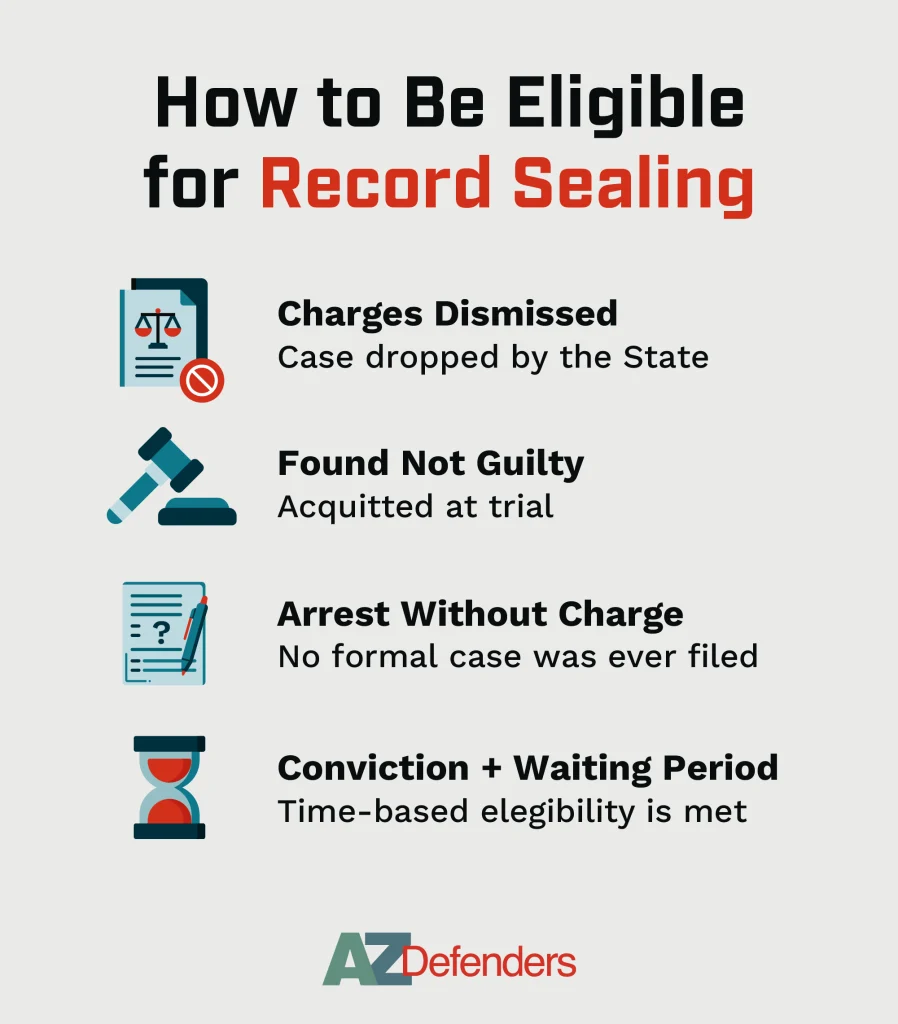
The waiting period depends on the classification of the offense. It is measured from the date you complete all terms of your sentence, including probation, incarceration, and payment of fines and restitution:
The court will review the specific circumstances of the case before deciding whether to seal the record.
Because eligibility rules can be complex, consulting with an attorney before filing a petition is often beneficial.
Depending on the circumstances, record sealing may apply to a variety of records associated with a criminal case.
These records may include:
When an order to seal is granted, agencies that possess sealed records must restrict public access consistent with Arizona law.
The process begins by filing a petition with the court that handled the criminal case.
The petition typically includes information regarding:
After the petition is filed, notice must be provided to the prosecutor.
The court will then review the request and determine whether the petitioner is eligible under Arizona’s record-sealing laws.
In some cases, the court may decide the matter based on the written filing. Other cases may require a hearing before a judge.
If the court grants the request, it will issue an order directing the appropriate agencies to seal the covered records.
When evaluating a petition, the court considers whether the applicant meets the statutory requirements.
The court will review:
A judge will also consider information submitted by the defendant demonstrating rehabilitation and compliance with court requirements.
The burden is generally on the petitioner to establish eligibility under the statute.
A sealed record can provide significant benefits for individuals trying to move forward after involvement with the criminal justice system.
Potential benefits include:
Many employers conduct background checks during the hiring process.
Because sealed records are generally unavailable to the public, record sealing may reduce barriers when seeking employment.
Landlords frequently review criminal records when evaluating rental applications.
Limiting public access to records may improve housing opportunities that could otherwise be affected by a prior arrest, charge, or conviction.
Record sealing limits public access to sensitive information contained in criminal records.
This can help individuals avoid having past criminal matters repeatedly appear in public searches.
Certain educational institutions, licensing boards, and professional organizations consider criminal history during the application process.
Although record sealing does not guarantee approval, it can help reduce the impact of older criminal cases.
Yes.
Even after record sealing, certain government entities may continue to access sealed records under circumstances authorized by law.
Law enforcement agencies, prosecutors, courts, and other authorized entities may still have access when necessary to perform official duties.
Record sealing restricts public access, but it does not eliminate the records’ existence.
Arizona law also provides opportunities to seal certain juvenile records.
Because juvenile cases involve different statutes and procedures, eligibility requirements may differ from those that apply to adult criminal records.
Individuals seeking relief involving juvenile matters should consult an attorney to determine what options may be available.
Although Arizona’s record-sealing laws provide an important opportunity for relief, the process involves statutory requirements, filing procedures, forms, waiting periods, and legal analysis.
An attorney can help:
Proper preparation can help avoid delays and improve the likelihood of a successful outcome.
A criminal record does not have to define your future. If you are interested in record sealing, understanding your eligibility and the filing process is the first step.
AZ Defenders helps individuals throughout Arizona pursue record sealing, post-conviction relief, and other legal remedies designed to reduce the long-term impact of criminal cases.
Call (480) 456-6400 today to speak with an experienced criminal defense attorney and learn whether record sealing may be available in your situation.