available 24/7
Free Consultation
Trespassing can be a felony in Arizona. Certain first-degree offenses are class 5 or class 6 felonies; other first-degree offenses and all second- and third-degree trespass offenses are misdemeanors. The charge depends on the property, conduct, and required state of mind.
Whether your case is a misdemeanor or a felony depends on where the alleged trespass happened, what you were doing there, and what the prosecution can prove about your state of mind. If you are facing a trespassing charge in Arizona, knowing that distinction is critical because the charge level can affect jail or prison exposure, long-term record consequences, and how you should respond.
The experienced Arizona trespassing defense attorneys with AZ Defenders break down Arizona’s trespass statutes, the penalties you could face, the key legal elements that prosecutors must prove, the defenses that often make the difference, and when legal representation may be essential.
Most forms of Arizona criminal trespass require knowingly entering or remaining unlawfully. The first-degree residential-yard privacy provision instead addresses knowingly entering a yard and, without lawful authority, looking into the home in reckless disregard of the occupant’s privacy. Understanding this phrase is essential because it is often where the strongest defenses are found.
Under A.R.S. § 13-1501, to “enter or remain unlawfully” means to enter or stay on premises when your presence is not licensed, authorized, or otherwise privileged. In plain terms, you had no permission or legal right to be there, including no express permission from the property owner or someone with lawful control, or you had permission, and it was withdrawn.
The statute defines “entry” broadly. Intruding with any part of your body, or any instrument, past the boundary of a structure or property counts. Reaching an arm through a window can qualify.
The word “knowingly” matters just as much. The prosecution must prove you were aware that you were entering or remaining without permission. Intent also helps distinguish a civil boundary dispute from a criminal trespass case in Arizona.
Accidentally wandering onto unmarked land, or honestly believing you were allowed to be somewhere, is not the same as knowing your presence was unlawful.
Note that “remaining” is its own path to liability. A person who enters lawfully, such as a guest or a customer, can still commit trespass by refusing to leave after permission is revoked, which is one way a person can commit criminal trespass once that permission ends.
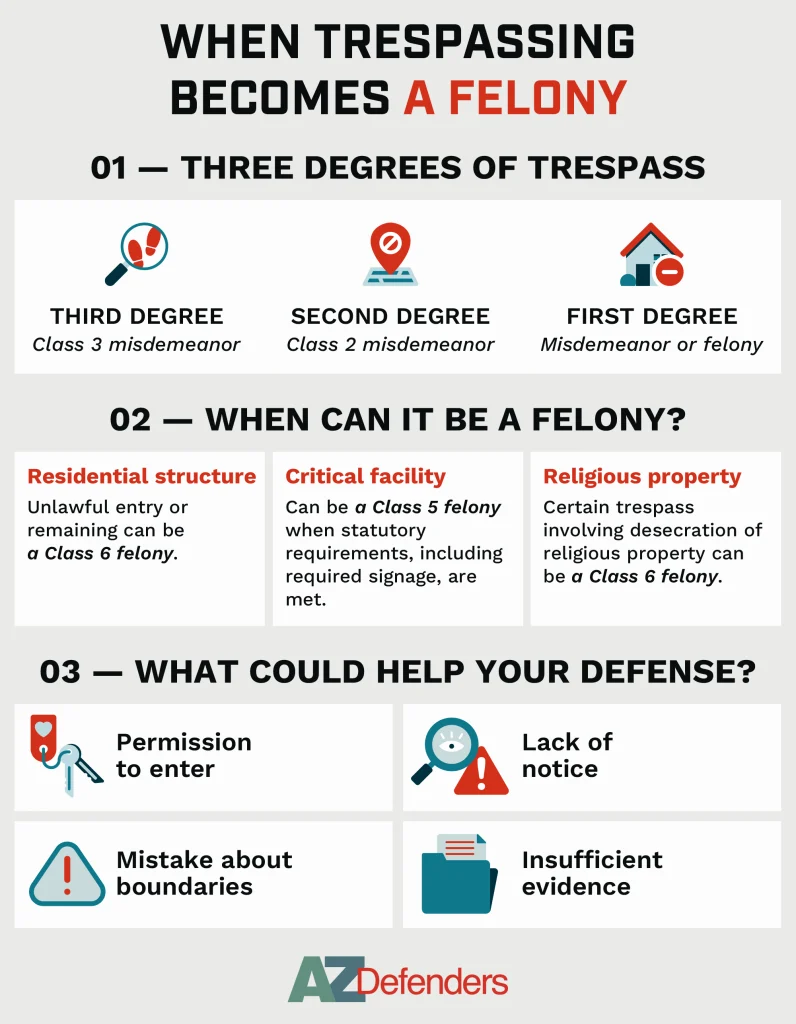
Third-degree criminal trespass is the least serious form of the offense. Under A.R.S. § 13-1502, a person commits it by knowingly entering or remaining unlawfully on any real property:
A request to leave from a police officer acting at the owner’s request carries the same legal weight as a request from the owner – the key here is “acting at the owner’s request”. Third-degree trespass is a class 3 misdemeanor. People charged with criminal trespass often dispute whether notice was actually given or understood.
Second-degree trespass under A.R.S. § 13-1503, often called second-degree criminal trespass under Arizona law, involves knowingly entering or remaining unlawfully in or on a nonresidential structure or in a fenced commercial yard.
A nonresidential structure is any structure not adapted for human residence, including retail stores, offices, warehouses, and sheds. A fenced commercial yard is a property completely enclosed by fences, walls, buildings, or similar barriers that is zoned for business or holds livestock, produce, or other commercial items.
This section describes the unlawful entry of nonresidential structures or fenced commercial yards. Unlike third-degree trespass, no prior warning or posted sign is required. This second-degree criminal offense is a class 2 misdemeanor.
First-degree trespass can be either a misdemeanor or a felony in Arizona. The Arizona Revised Statutes, A.R.S. § 13-1504, list six ways to commit the offense, and first-degree criminal trespass can be a Class 1 misdemeanor or Class 6 felony, with some conduct charged more severely as shown below. These are one of the three classifications of criminal trespassing in Arizona, and first-degree cases can lead to different outcomes depending on certain circumstances:
| Conduct (knowingly…) | Classification |
|---|---|
| Entering or remaining unlawfully in or on a critical public service facility | Class 5 felony |
| Entering or remaining unlawfully in or on a residential structure | Class 6 felony |
| Entering or remaining unlawfully on another’s property and burning, defacing, or desecrating a religious symbol or religious property or other religious property without the owner’s permission | Class 6 felony |
| Entering or remaining unlawfully in a fenced residential yard | Class 1 misdemeanor |
| Entering any residential yard and, without lawful authority, looking into the home in reckless disregard of the occupant’s privacy | Class 1 misdemeanor |
| Entering unlawfully on land subject to a valid mineral claim or lease, intending to hold, work, take, or explore for minerals | Class 1 misdemeanor |
Class 5 felony. A “critical public service facility” includes structures, fenced yards, and certain equipment used by utilities, transit providers, telecommunications carriers, law enforcement, fire departments, and EMS providers, or used to produce, move, or store gas, oil, electricity, water, or hazardous materials. Critically, the site must be posted with signage stating that trespass is a felony or warning of high voltage or high pressure. Retail-only facilities are excluded.
Class 6 felony. First-degree criminal trespass becomes a class 6 felony when someone unlawfully enters or remains in a home. A “residential structure” is any structure adapted for human residence and lodging, whether or not anyone is living there. That can include a house, an apartment, an RV, or a vacant rental. Desecrating religious property while trespassing is also a class 6 felony.
Misdemeanor first-degree trespass. Entering a fenced backyard, including a fenced yard case, peering into a home from a yard, or trespassing on an active mining claim remains a class 1 misdemeanor, the most serious misdemeanor level in Arizona.
One important distinction: trespass becomes burglary when the person enters or remains unlawfully with the intent to commit theft or a felony once inside. Prosecutors sometimes overcharge burglary when the evidence supports only trespass, and that gap can be a powerful negotiating point.
The potential sentence depends on the offense class and your criminal history; criminal trespass charges can carry serious consequences, especially at higher degrees and with prior criminal history. For a first-time offender, Arizona law sets these ranges (A.R.S. § 13-702, § 13-707, § 13-802, § 13-801):
| Offense class | Possible incarceration (first offense) | Maximum fine |
|---|---|---|
| Class 5 felony | 0.5 to 2.5 years in prison (1.5 years presumptive) | $150,000 |
| Class 6 felony | 0.33 to 2 years in prison (1 year presumptive) | $150,000 |
| Class 1 misdemeanor | Up to 6 months in jail (that is, up to six months for a first offense) | $2,500 |
| Class 2 misdemeanor | Up to 4 months in jail | $750 |
| Class 3 misdemeanor | Up to 30 days in jail | $500 |
Fines are also subject to substantial state statutory surcharges and assessments, and first-degree criminal trespass fines can reach up to $150,000 in felony cases. Prior felony convictions significantly raise the felony ranges. And under § 13-707, a repeat misdemeanor conviction for the same offense within two years is sentenced one class higher.
There is good news for many first-time defendants. If you are convicted, the sentence imposed still depends on the charge level and your record. Probation is often available for non-dangerous class 5 and class 6 felonies, and a judge may designate a class 6 felony as a misdemeanor, either at sentencing or after probation is completed. Securing that outcome often depends on early, strategic advocacy.
A trespass conviction can follow you long after the sentence ends, especially a felony. Possible consequences include:
Arizona offers post-conviction relief, such as setting aside a judgment or sealing a record, but eligibility rules and waiting periods apply. Avoiding a conviction in the first place is always the better path.
Because the State must prove the elements of the particular trespass offense charged, people facing criminal trespass charges often have several avenues for defense. The right strategy depends on the specific facts, but common defenses include:
Permission or lawful authority. If the owner, a tenant, or someone with authority over the property invited you or allowed you to be there, or you had proper authorization to enter, your presence was not unlawful. Text messages, a lease, a key, or witness testimony can establish consent. Co-tenants and family members frequently have a legal right to be in a residence, and that consent can defeat criminal trespass charges.
Lack of notice. The general real-property form of third-degree trespass requires a reasonable request to leave or reasonable notice prohibiting entry; the separate railroad-property provision does not. If no one asked you to leave, or signs were missing, hidden, or unclear, the charge may fail for lack of proof of unlawful entry. For felony trespass at a critical public service facility, the required warning signage is part of the definition itself.
Mistake of fact. An honest belief that you were allowed to be somewhere, such as following a confusing property line or relying on someone who appeared to have authority, can negate the “intentionally” or “knowingly” element.
Insufficient proof of knowledge. Prosecutors must prove your state of mind beyond a reasonable doubt. Ambiguous circumstances, conflicting witness accounts, or a lack of reliable evidence about what you knew can create reasonable doubt.
Challenging the property classification. Whether a structure is “residential,” whether a yard is fully “fenced,” or whether a site qualifies as a “critical public service facility” can determine whether you face a felony or a misdemeanor. Close examination of these definitions can lead to a reduced charge.
Duress or necessity. In emergencies, trespass may be justified if you entered to avoid immediate harm or respond to a pressing safety need.
Constitutional and procedural issues. Unlawful searches, unreliable identifications, and statements taken in violation of your rights may be suppressed.
So, is trespassing a felony in Arizona? It depends. Being charged with criminal trespass in Arizona can result in either a misdemeanor or a felony, depending on the facts. Even a misdemeanor trespass conviction can carry jail time, fines, and a lasting record.
At AZ Defenders, we provide experienced, white-glove criminal defense representation to clients across Arizona. Our team of skilled trespassing defense lawyers in Arizona can review your specific case, gather the facts, build as strong a defense as possible, and stand by your side throughout the criminal trial process.
If you are facing criminal trespass charges, speak with a criminal defense attorney promptly. Contact AZ Defenders today by calling (480) 456-6400 or by filling out an online form to schedule a free, confidential consultation.