
available 24/7
Free Consultation
Unlawful detention means a person is held, stopped, or restrained against their will without lawful authority. In criminal defense cases, the issue often involves police detaining someone without reasonable suspicion, arresting someone without probable cause, or extending a stop beyond the time permitted by case law.
AZ Defenders helps Arizona defendants review cases involving unlawful detention, false arrest, false imprisonment, and any other criminal defense issues.
Call AZ Defenders at (480) 456-6400 for a free consultation with a criminal defense attorney.
Unlawful detention by police occurs when officers hold a person against their will without lawful authority. A person can also be detained by another government officer, a private security guard, a business employee, or a private citizen, but most unlawful detention claims involve law enforcement.
In a police encounter, detention usually means the person is not free to leave. The person may be stopped on the street, held during a traffic stop, placed in handcuffs, kept in a patrol car, or otherwise restrained by law enforcement.
The detention becomes unlawful when the officer lacks the legal authority required for that level of detention. The key question is whether the officer had reasonable suspicion, probable cause, a warrant, or another lawful basis.
Unlawful detainment is another term for being detained without legal authority. The term is often used in the same way as unlawful detention.
A person may describe unlawful detainment after a traffic stop, street stop, store stop, arrest, or police investigation. The legal analysis depends on who detained the person, why the person was detained, how long the detention lasted, and what level of force or restraint was used.
The fact that someone was eventually released does not always mean the detainment was lawful. Police must have a valid basis for the stop when it occurs and must keep the detention time frame within limits.
The Fourth Amendment protects people from unreasonable searches and seizures. A detention is a type of seizure because it restricts a person’s freedom of movement.
The 4th Amendment does not prohibit every police stop. It prohibits unreasonable seizure.
Whether a seizure is reasonable depends on the facts. Courts may look at what the officer knew, what the officer observed, how the stop began, how long the detention lasted, whether the officer used force, and whether the officer had reasonable suspicion.
Not every police encounter is a detention. Some encounters are considered legally as voluntary, which means a person is legally free to leave or decline to answer questions.
A consensual encounter may become a detention if the officer’s words, conduct, positioning, commands, or show of authority would make a reasonable person believe they are not free to leave. Poisonous tree
The line between voluntary contact and detention matters in a criminal case. If the encounter became a seizure without lawful authority, evidence obtained afterward may be suppressed as “fruit-of-the-poisonous-tree”.
A Terry stop is a brief investigative detention based on reasonable suspicion. Police do not need probable cause for a Terry stop, but they do need specific, articulable facts suggesting criminal activity is or may be happening.
Reasonable suspicion requires more than a hunch. An officer must be able to articulate specific facts that support the Terry stop.
For example, police may have reasonable suspicion based on a reliable report, observed conduct, location, timing, witness information, or other circumstances. A Terry stop must still be limited in scope and duration to be lawful.
An arrest is a much greater restraint than a Terry stop. Police need probable cause to make an arrest, not merely reasonable suspicion.
Probable cause means some specific and articulable facts would lead a reasonable officer to believe a person committed, is committing, or is about to commit a crime. A warrant issued and signed by a judge also provides probable cause for arrest, but some warrantless arrests are also allowed in certain specific circumstances when the law permits, these are commonly referred to as exceptions to the 4th Amendment warrant requirement.
If police arrest someone without probable cause, the arrest may be unlawful. A false arrest claim or criminal defense challenge may depend on whether probable cause existed at the time of the arrest.
Unlawful detention often refers to a police stop, arrest, or other form of restraint without lawful authority.
False imprisonment is a civil tort — a claim based on intentionally restraining someone against their will without legal justification. Like other torts, it can support a civil lawsuit for money damages. It may involve police, private security, a business, or a private citizen.
In Arizona, unlawful imprisonment is also a criminal offense under state law when a person knowingly restrains another person under circumstances that violate the Arizona Revised Statute. False imprisonment, false arrest, and unlawful detention may involve different legal theories even when the facts are similar.
Unlawful imprisonment is a class 6 felony in Arizona unless the person is released voluntarily and unharmed in a safe place prior to being arrested – in which case it is a class 1 misdemeanor.
When a Lawful Detention Becomes Unlawful
A detention may begin lawfully but become unlawful if police extend it beyond its original purpose without a new legal justification. For example, a traffic stop may be valid at first and due to the prolonged nature of it may become unlawful. If the officer completes the traffic-related tasks for which you were stopped and keeps the driver detained without reasonable suspicion of another crime, the continued detention may violate the Fourth Amendment.
The same issue can arise during street stops (Terry stops), questioning, searches, or other investigative detentions. The longer the detention lasts, the more important the officer’s factual and legal basis become.
If police detain a person without reasonable suspicion or arrest a person without probable cause, the defense may challenge the admissibility of any and all evidence obtained as a result of the wrongful detention and/or arrest. In a criminal case, that may mean asking the court to suppress evidence connected to the unlawful detention. In a civil case, the detained person may consider moving forward with a civil lawsuit to recover monetary damages that resulted from an unlawful detention.
A police mistake does not automatically give rise to a civil lawsuit. The facts, officer conduct, qualified immunity issues, damages, and available evidence must be carefully considered.
Unlawful detention can happen in many different settings. The facts matter, and not every uncomfortable police encounter is illegal.
Possible examples include:
These situations may raise criminal defense issues, civil rights concerns, and/or false imprisonment claims.
Section 1983 of the United States Code may allow a lawsuit when a government officer violates a person’s constitutional rights while acting under color of law. An unlawful detention by police may give rise to a Section 1983 claim if it violates the Fourth Amendment.
1983 claims can often be extremely complex. A person bringing the lawsuit often needs to prove the officer lacked reasonable suspicion, lacked probable cause, or otherwise violated clearly established constitutional rights.
A civil rights claim may seek damages for harm caused by the unlawful detention. However, a criminal defense attorney may focus first on protecting the defendant in the criminal case.
If you decide to bring an unlawful detention lawsuit, the damages available depend on the facts and the legal claims involved. Possible damages may include emotional distress, lost wages, medical costs, physical injury, reputational harm, attorney’s fees, and other losses.
False imprisonment or false arrest claims may involve damages for the time a person was detained, the manner of detention, and the consequences that followed. Civil rights claims may allow additional remedies in some cases.
Not every unlawful stop leads to significant damages. The strength of a lawsuit depends on evidence, actual harm, officer conduct, qualified immunity issues, and whether the detention caused measurable and quantifiable losses.
Unlawful detention can affect a criminal case when police obtain evidence because of an illegal stop or arrest. The defense may ask the court to suppress that evidence.
A suppression motion may challenge the stop, detention, search, arrest, statements, and/or seizure. If the judge agrees, the prosecutor may be precluded from introducing important evidence it has obtained against you in violation of your constitutional rights.
Suppression does not automatically result in dismissal of the criminal case. However, if the remaining admissible evidence is weak, the prosecutor may reduce charges, offer a better plea, or dismiss the case.
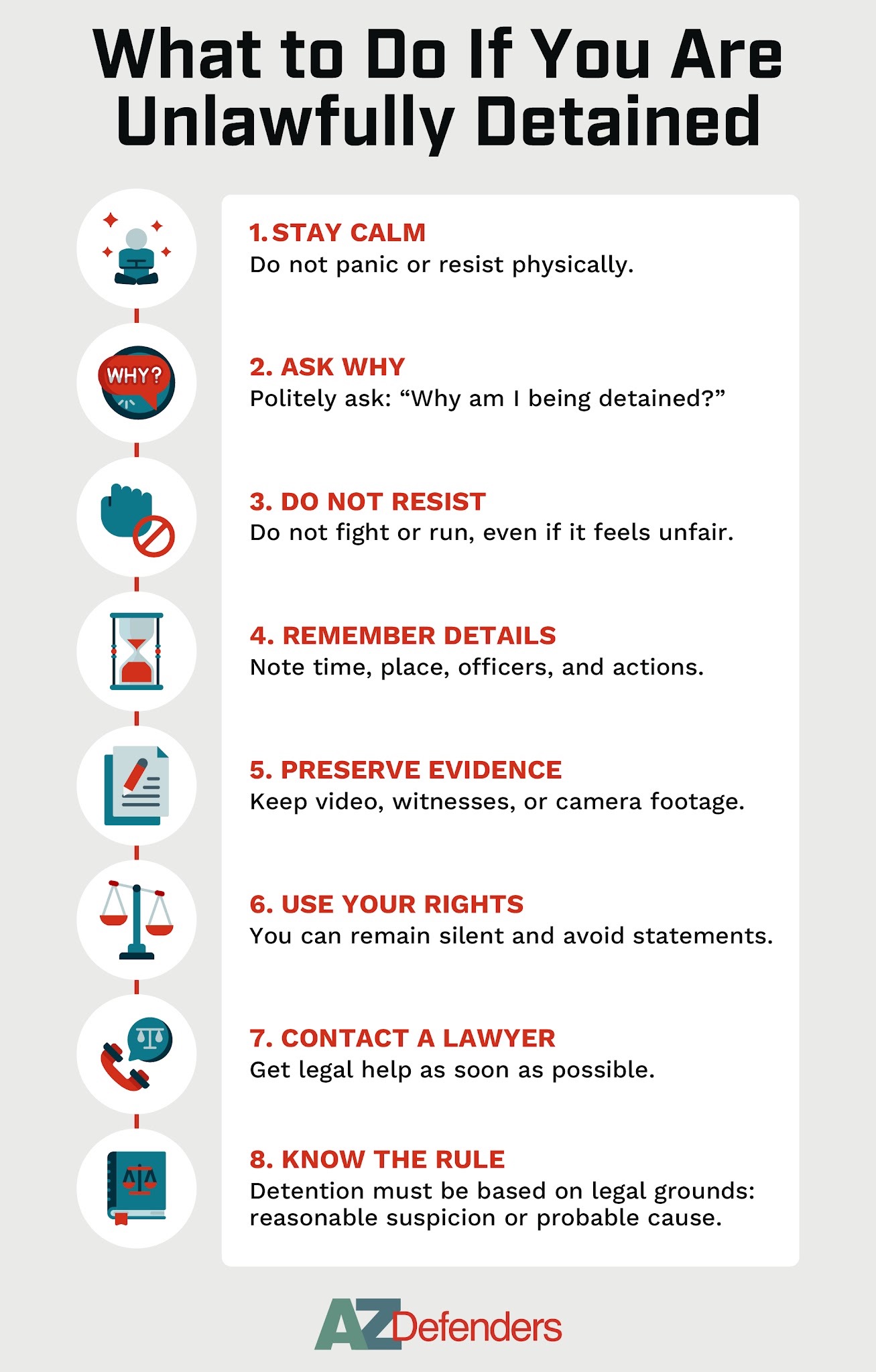
If you believe you were unlawfully detained, focus on preserving evidence. Details matter in both a criminal case and a potential civil lawsuit.
Helpful steps may include:
If criminal charges are pending, the defense strategy should come first in most circumstances as statements made in a civil complaint or public post may directly and adversely affect the criminal case.
Unlawful detention occurs when a person is held against their will without lawful authority. In police cases, the issue often turns on the Fourth Amendment, reasonable suspicion, probable cause, the existence of issued warrants, and whether the officer exceeded the limits of a lawful stop.
AZ Defenders helps Arizona defendants protect their constitutional rights, challenge unlawful detainment, suppress evidence, and respond to criminal charges. If you were detained, arrested, or charged after a questionable police encounter, a criminal defense attorney can review what happened and discuss the options available to you.
Call AZ Defenders today at (480) 456-6400 for a free consultation.