
available 24/7
Free Consultation

Posted on January 31, 2026 in Assault & Violent Crimes
Hazing is an activity that traditionally has taken place among college students in fraternity hazing cases, but it is not limited to them. Hazing became a criminal offense in Arizona effective with the 2022 enactment of Arizona Revised Statutes (ARS) Sections 13-1215 and 13-1216. A conviction for hazing under Arizona law can be a misdemeanor or a felony, depending on the physical harm done.
In this blog post, we discuss what constitutes hazing and the applicable penalties for a conviction of hazing.
If you have been accused of participating in a hazing incident in Arizona ,AZ Defenders law firm can represent you.
Call us at (480) 456-6400 or use our contact form to speak with an experienced Arizona criminal defense lawyer in a free consultation.
ARS 13-1215 defines hazing. We unpack this statute here.
A person commits hazing only when they intentionally, knowingly, or recklessly, for organizational membership purposes, cause, coerce, or force hazing conduct.
The statute protects a minor or student in relation to membership activities with an organization.
Hazing activity involves acts connected with a minor or a student’s membership in an organization, such as joining it, continuing or reinstating membership in it, or enhancing one’s status within the organization.
Under the law an “organization” is any official fraternity, sorority, association, corporation, order, society, corps, cooperative, club, service group, social group, band, spirit group, athletic team, or similar group whose members are primarily students at, or former students of, a high school or postsecondary institution.
This includes high school students, as well as college and university students.
Hazing consists of acts of hazing, as well as planning or organizing hazing.
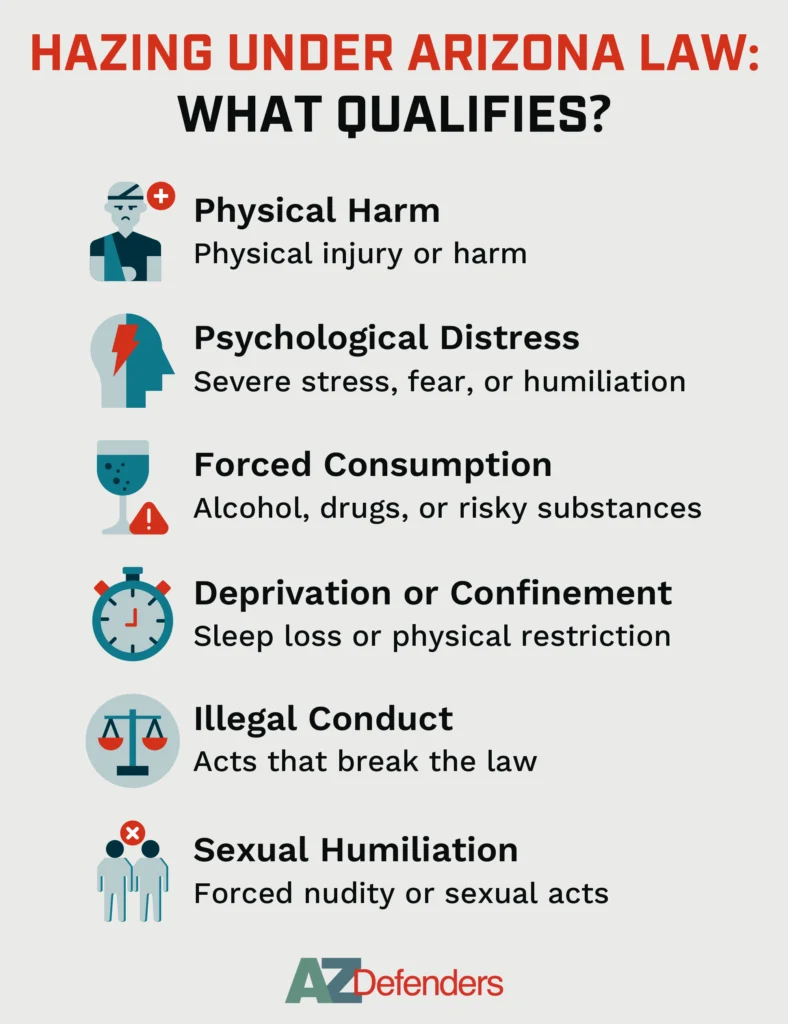
ARS 13-1215(A) identifies six kinds of actual hazing activity:
1. Sexual humiliation or brutality, including forced nudity or an act of sexual penetration, or both.
2. Conduct or conditions, including physical or psychological tactics, that are reasonably calculated to cause severe mental distress to the minor or student, including activities that are reasonably calculated to cause the minor or student to harm themselves or others.
3. The consumption of any food, nonalcoholic liquid, alcoholic liquid, drug, or other substance that poses a substantial risk of death, physical injury, or emotional harm.
4. An act of restraint, confinement in a small space, or significant sleep deprivation.
5. Conduct or conditions that violate a federal or state criminal law and that pose a substantial risk of death or physical injury.
6. Physical brutality or any other conduct or conditions that pose a substantial risk of death or physical injury, including whipping, beating, paddling, branding, electric shocking, placing harmful substances on the body, excessive exercise or calisthenics, or unhealthy exposure to the elements.
ARS 13-1216 makes it illegal to engage in acts that are connected with planning or organizing hazing. Specifically, the law prohibits anyone from the following:
Although the emphasis of this blog post is on Arizona laws that make it a criminal to engage in, plan, or organize hazing, other anti-hazing laws apply to the schools that students attend.
Under ARS 15-2301, colleges and universities are legally required to enforce anti-hazing policies.
For the purposes of this statute, hazing is any intentional, knowing or reckless act committed by a student against another student, individually or in concert with others, when the act was committed in connection with an initiation into, an affiliation with or the maintenance of membership in any organization that is affiliated with the educational institution and it contributes to a substantial risk of potential physical injury, mental harm or degradation or causes physical injury, mental harm or personal degradation.
The federal Stop Campus Hazing Act requires Arizona universities to publish a Campus Hazing Transparency Report that names organizations found to have violated hazing policies.
Hazing itself is either a Class 1 misdemeanor or a Class 4 felony in Arizona. The difference is whether the hazing activity results in death.
Conviction for a Class 1 misdemeanor can include:
Conviction for a Class 4 felony can include:
Organizing or planning hazing is a Class 2 misdemeanor upon conviction.
If you are convicted of a Class 2 misdemeanor, then you may face the following penalties:
A conviction for hazing or planning or organizing hazing can have the following additional negative effects on you:
If you are a student and are convicted of hazing, you could face expulsion and lose any scholarships you may have received.
The main defenses to a hazing charge are to qualify for one of the statutory exceptions to hazing under Arizona law. These include reasonable and customary athletic, law enforcement or military training, contests, competitions, or events.
The law also provides for a “Good Samaritan” exception to encourage people to seek help for hazing victims without fear of being prosecuted themselves for hazing. Examples of this exception include:
Note, however, that if law enforcement obtains evidence of hazing before you report the incident, then the above exception does not necessarily apply, and you might still be charged with hazing.
Also note that it is no defense to a statutory hazing charge that the minor or student consented to the hazing activity.
It is a defense to a charge of planning or organizing a hazing activity if you communicate to the others involved in the planning, organizing, or hazing incident that you are voluntarily renouncing your intent to participate, and you take active steps to prevent the planned hazing from happening.
Hazing incidents can lead to serious bodily injury and even cause death. ARS 13-1215 is informally known as “Jack’s Law,” after a student who died because of an alcohol consumption hazing incident.
If you are facing criminal charges connected with causing a hazing injury, then you could be facing a significant amount of incarceration time, hefty fines, and the lingering effects on your academic, professional, and personal life from having a conviction on your record.
Call AZ Defenders to speak with a skilled Arizona defense attorney when you need to defend yourself against a hazing charge. You can reach us any time at (480) 456-6400 or use our online contact form.