
available 24/7
Free Consultation
If you have been convicted of a criminal charge in Arizona, a criminal appeals lawyer can help you evaluate whether you have grounds to seek higher-level judicial review of your case. AZ Defenders has experienced criminal appeals lawyers who can help you through this process.
Here, we examine how the criminal defense appeals process works in Arizona.
If you have already lost your case at the trial court level, then the importance of having the best possible legal counsel on appeal becomes paramount.
Appeals cases in Arizona involve tight deadlines and a detailed understanding of which path of appeal to take: direct appeal and/or post-conviction relief (PCR). Each is a distinct path with its own set of rules.
There is no jury, and your lawyer must make the most effective possible use of the existing trial court record in an appeal. In post-conviction relief, your attorney can add documents from outside the record to support certain claims.
You have very little room for error at this level.
AZ Defenders criminal appeals attorneys are not just skilled trial defense lawyers; we also have extensive experience providing legal representation to clients at the appellate level in the Arizona judicial system, and presenting persuasive arguments to appeals court jurists to establish a case for reversible error that can give you a new trial or even vacate a conviction.
If you have been found guilty of a crime in Arizona or need more information on this topic, call AZ Defenders at (480) 456-6400 or use our online contact form to reach out to one of our criminal appeal attorneys.
A criminal direct appeals lawyer is different from the trial lawyer who represented you in the courtroom. Instead of calling witnesses or arguing to a jury, an appeals lawyer works from the record of what already happened at trial.
Here are some of the things a criminal appeals lawyer does for you:
As well as the work a criminal appeals lawyer does in a direct appeal, in a post-conviction relief petition, a criminal appeals lawyer does additional things for you, if warranted:
Because direct appeals are decided almost entirely on written briefs and the trial record, appellate work is very different from trial work. Post-Conviction Relief petitions tend to include a trial hybrid for developing facts outside the record. In both cases, the presumption of innocence disappears, and your appellate lawyer has the burden of proof. Hiring an appellate lawyer who understands this distinction can make a real difference in your criminal case.
A trial, an appeal, and a petition for post-conviction relief are three very different proceedings, and confusing them can lead to unrealistic expectations about what an appeal or PCR can accomplish.
A trial is where your guilt or innocence is decided in the first place. At trial:
An appeal is not a second chance to fight the facts of your case. At an appeal:
Put simply, trials decide facts, while appeals review the law. A criminal appeals lawyer focuses on that second question.
A PCR allows only certain claims for relief, but it is the only route to challenge a conviction by plea agreement, constitutional claims that need further development of the record, and ineffective assistance of counsel.
Generally, you may only file a direct appeal after a trial conviction. However, you may file a PCR if further issues remain outside the trial record that entitle you to relief, if your conviction is the result of a plea bargain, and certain other reasons.
If you have been sentenced to death, then your appeal goes straight to the Arizona Supreme Court.
This requirement for a conviction is an important consideration, because many criminal convictions result from plea deals in which the accused pleads guilty to a lesser charge and waives the right to appeal.
You must file a notice of appeal within 20 days after entry of judgment and sentence in a felony case, but you only have 14 days to file a notice of appeal in misdemeanor cases. There are some narrowly defined exceptions, so you should talk to an experienced criminal appeals lawyer even if you have missed your filing deadline.
Not all mistakes made during your trial are legal issues that justify an appeal. If a mistake was what courts refer to as a “harmless error,” this is not usually something that an appeals court will accept.
Examples of harmless errors include minor comments by prosecutors, accidental exposure to a document not admitted as evidence, minor evidentiary mistakes, small procedural missteps, or errors in jury instructions that do not misstate the law or shift the burden of proof.
To be reversible, an error must have affected the verdict. The exact prejudice standard varies depending on the type of error.
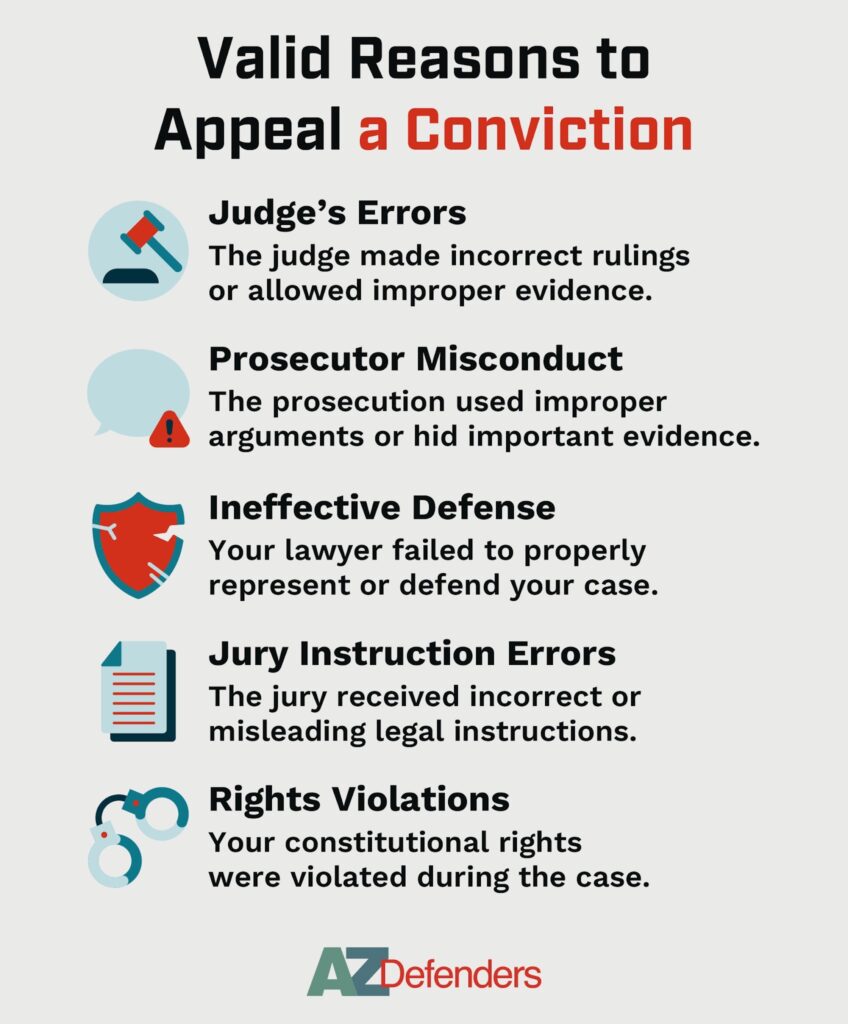
Here are some kinds of trial court errors that can have a prejudicial effect on you:
The appeals court does not accept new evidence when it considers your appeal. Nor can it reweigh the evidence, or retry the case. Instead, the appeals court must take the trial court’s record as the sole basis for its review. This record includes:
Your trial court criminal defense attorney must also preserve issues for the appeals court to review. What this means is that your lawyer must raise the issue during your trial and make a timely objection.
If your attorney does not do this, then the appeals court can still consider your appeal under what is known as a “fundamental error review,” but this is a harder standard to win your appeal under.
If the appeals court considers your appeal, then it may reach any of the following rulings:
As we mentioned above, a criminal appeals case depends on you being convicted at trial. But what if instead you reached a plea deal or otherwise pled guilty? In these situations, post-conviction relief may be available to you.
The reason why Arizona allows for post-conviction relief is that although a trial conviction produces a full record for appellate review, a guilty plea waives most of your trial-related rights, including the right to appeal. Post-conviction relief allows you to still challenge your conviction under certain circumstances, including:
There are two main paths to request post-conviction relief, depending on how your case ended:
Compared to a criminal appeal, you have more time to seek post-conviction relief. Most post-conviction relief notices must be filed within 30 or 90 days, but certain claims, like newly discovered evidence or significant changes in the law, may be filed at any time.
Even if you have missed the deadline to file, you need to talk to an experienced appeals attorney who can tell you if it is possible to succeed on an untimely petition for post-conviction relief. Recent case law has made it easier to get the court to consider untimely or successive petitions for post-conviction relief.
After you file your notice, you then file the petition for post-conviction relief. In your petition, you must include all the grounds for which you seek relief, facts that support each claim for relief, evidence like transcripts, affidavits, and court records, and a legal memorandum that explains how your facts support your relief claims.
People who hire a seasoned PCR lawyer are far more successful in their PCRs than those who try to navigate it on their own. Your PCR lawyer can explore issues with you and even investigate things your trial or plea attorney did not.
Generally, you cannot re‑raise the same issue in a later post-conviction relief petition, but certain types of claims may be raised in successive petitions.
The trial court will review your petition to see if it makes a “colorable claim” for relief. What this means is that if the claims you make are true, they would undermine confidence in the conviction. The court will then hold an evidentiary hearing to test the truth of the claims. If the claimed facts hold up, the court may:
If the trial court denies you relief, then you may still seek review by the Arizona Court of Appeals.
The table below compares criminal appeals with post-conviction relief in key respects.
| Feature | Direct Appeal | Post‑Conviction Relief (PCR) |
| Who Can File | You were convicted at trial | You pled guilty, or have already completed a direct appeal from your conviction at trial |
| Deadline to File | 20 days after sentencing to file Notice of Appeal in a felony14 days after sentencing to file Notice of Appeal in a misdemeanor | 90 days after sentencing (plea cases) or 30 days after mandate (post‑appeal cases) |
| Purpose | Review legal errors made during trial | Challenge constitutional violations, ineffective assistance, newly discovered evidence, illegal sentences, or develop additional evidence |
| What the Court Reviews | Only the trial record (transcripts, motions, exhibits) | Can consider new evidence, affidavits, expert reports, etc. |
| Can Raise Ineffective Assistance of Counsel? | No, must be raised in post-conviction relief | Yes, the primary vehicle for ineffective assistance of counsel claims |
| Can Raise New Evidence? | No | Yes |
| Standard of Review | Abuse of discretion, harmless error, fundamental error, structural error | Abuse of discretion or error plus prejudice |
| Outcome Possibilities | Affirm, reverse, remand, modify sentence | Dismissal of petition, vacate conviction, new trial, resentencing, or other relief |
| Typical Issues Raised | Improper jury instructions Evidentiary errors Prosecutorial misconduct Constitutional violations Sentencing errors | Ineffective assistance of counsel Newly discovered evidenceActual innocenceIllegal sentenceLack of jurisdictionSignificant change in the law |
| Who Hears the Case | Arizona Court of Appeals (or Arizona Supreme Court for death penalty cases) | Trial court (Superior Court), with possible petition for review to the Court of Appeals |
| Record Expansion Allowed? | No | Yes |
| Availability After Plea Deal | No direct appeal after a guilty plea | Post-conviction relief is the only avenue after a plea deal |
AZ Defenders has experienced criminal appeal attorneys who can help you seek review of any conviction in the criminal justice system, including trial convictions or plea deals, through the formal appellate court process or post-conviction relief.
If you were wrongfully convicted of a criminal offense, an AZ Defenders appellate lawyer can take your case. Call our law offices at (480) 456-6400 to discuss your appeal options with one of our appellate lawyers in Phoenix, Scottsdale, Tempe, or Show Low, or reach us online to schedule a free consultation at our law offices.