
available 24/7
Free Consultation
If a misdemeanor appears on your public record, there is no automatic expiration date. Court retention schedules determine how long records are kept, but the misdemeanor itself does not go away on its own.
In this article, we discuss how long a misdemeanor for a past mistake remains on your record, and what you may be able to do to keep one from public visibility (sealing a record) or to set aside a misdemeanor conviction.
Sealing a misdemeanor conviction or getting one set aside does not happen automatically. You must take specific action to request either of these remedies, and if you do not follow proper procedures while doing so you may be denied the relief you seek.
At AZ Defenders, our experienced Arizona criminal defense lawyers have many years of combined practice experience in helping our clients to clear their criminal records through sealing and setting aside misdemeanor charges and convictions. We can make sure that your petition for record sealing or application for a set aside is prepared properly, presents your case effectively, and is submitted to the proper court for consideration.
To get started with a free initial consultation, call us at (480) 456-6400 to speak with one of our criminal law attorneys. You can also use our online contact form to schedule a free consultation.
If it is visible to the public, a misdemeanor on your record can carry several negative effects on you that are collateral to any court sentence you may have received because they will show up on background checks.
For example, if you are looking for a place to rent, prospective landlords can find out about your misdemeanor. Others include potential employers conducting background checks, members of professional licensing boards, lenders, and immigration officials.
Although not all of these people may hold a misdemeanor on your record against you, the possibility remains that some of them will, and this can make it harder for you to find a place to live, to get a job, to qualify for a loan, to obtain a professional license, and more.
Arizona law does not allow for automatic expungement, sealing, or set asides of criminal records, including misdemeanors. Arizona court records are generally presumed to be open unless they are closed by law, by court rule, or by court order.
How long a misdemeanor remains on your record depends in part on the nature of the charge or conviction.
There is a difference between misdemeanor criminal convictions that are on your public record and those that are maintained in the central state repository for Arizona criminal records, which the Arizona Department of Public Safety (DPS) maintains under Arizona Revised Statutes (ARS) 41-1750.
Under Arizona’s public record law, ARS 39-121, public records are open to inspection during office hours. Criminal-history repository records, however, are different from ordinary court records. The DPS restricts access to records in its custody to authorized individuals and agencies.
So for example, under ARS 41-1750(G), the DPS cannot release criminal history to private citizens or private companies unless a statute authorizes the request. Instead, private screening companies often rely on court data, public records, vendor databases, and purchased court information.
Private background check companies in Arizona follow the federal Fair Credit Reporting Act (FCRA) for reporting limits. Under FCRA §605(a), non‑conviction information like arrests, dismissed charges, and other adverse records that did not result in conviction cannot be reported if more than seven years old.
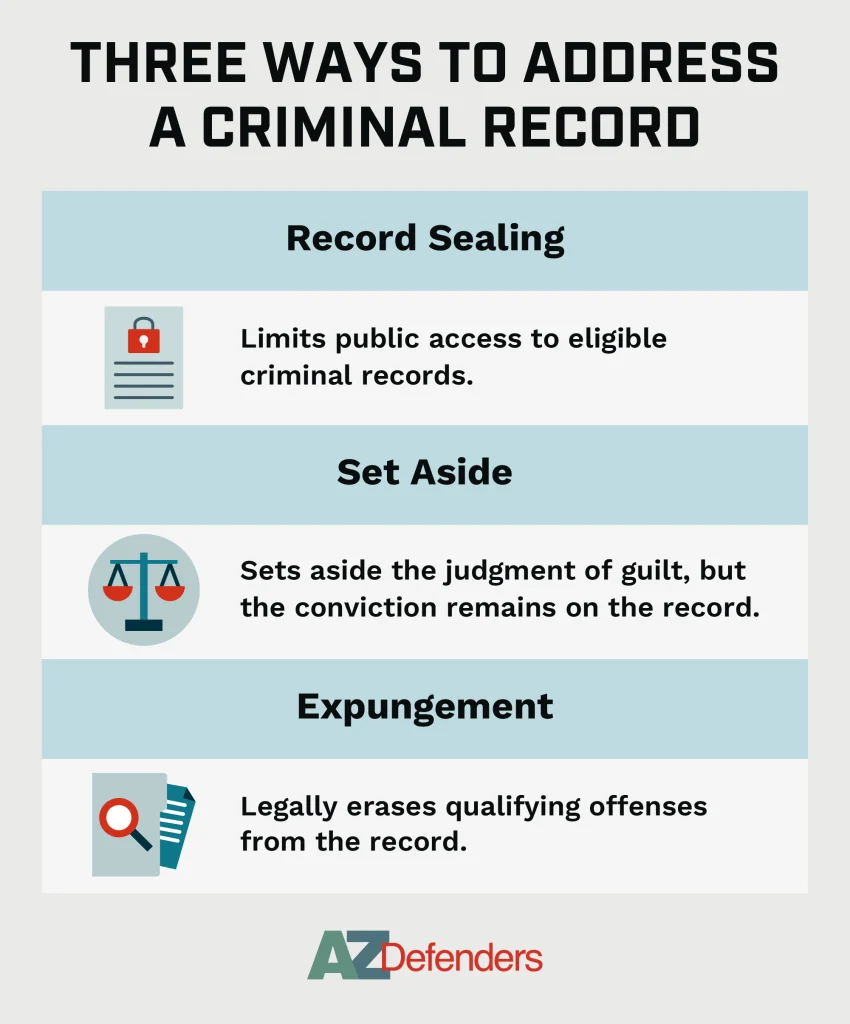
The two most common ways to address a misdemeanor on your public record are record sealing and set asides.
ARS 13-911 provides for sealing case records related to a criminal offense. Depending on the circumstances, to qualify to petition to seal a misdemeanor offense, you must meet one of the following:
Under Arizona Rule of Criminal Procedure 36.1, you are not eligible to file if a court denied a previous petition to seal within the past three years.
If you were convicted of a misdemeanor, then you are also subject to a waiting period before you can petition for a misdemeanor record sealing, counted from when you completed your sentence and were discharged by the court:
For dismissed charges, not-guilty verdicts, and no-charge arrests, ARS 13-911 does not require you to meet the conviction waiting-period schedule above however, misdemeanor charges can be filed within 12 months from the date of the alleged offense, so you should wait this period as charges can be filed or refiled for a case that was dismissed without prejudice. For cases that resulted in not-guilty verdicts, there is no waiting period.
Where you file the petition varies:
If the court to which you submitted your record sealing petition grants your petition, then the court will seal the records that relate to your arrest, conviction, and sentence as applicable. The DPS, arresting and prosecuting agencies will also designate the criminal records sealed.
What this means to you is that for purposes of seeking employment, housing, financial aid, or loans, then with a few exceptions we list below you can generally say that you have never been arrested for, charged with, or convicted of the sealed offense.
Sealed records will remain available for some specific purposes:
Sealing applies only to records under the control of criminal-justice entities like courts, the DPS, prosecutors, and law enforcement. Case records that were published or distributed before sealing may still be accessible and may not be affected by a sealing order.
ARS 13-905 provides the procedure for applying for a set aside of a criminal record. A set-aside is available, except for excluded offenses, after you fulfill all probation or sentence conditions and the court has discharged the case.
You, your attorney, or your probation officer can apply for the set aside. When the court considers your application, it will consider factors including:
If the court grants your application, then it will set aside the judgment of guilt, dismiss the complaint, information, or indictment, and release you from penalties and disabilities resulting from the conviction (except for certain Department of Transportation consequences, Game and Fish consequences, and lifetime injunctions).
Unlike with a record sealing, a set aside does not redact or remove any part of your conviction from the public record. Instead, the DPS will annotate the conviction on your criminal history.
For misdemeanor convictions, a set-aside order must also include a Certificate of Second Chance when the conviction qualifies under ARS 13‑905(K). This certificate can release certain occupational-license barriers under Title 32 of the Arizona Revised Statutes, provide employer protections, and provide certain housing provider protections.
Expungement of a criminal record has the effect of legally erasing that conviction. This means that you can legally deny the offense in all situations, and the offense is not accessible by law enforcement agencies, courts, or background checks. As far as the expunged offense is concerned, you will have a clean record again.
Under ARS 36-2862, Arizona offers expungement only for select marijuana-related offenses, based on conduct that occurred before the law took effect, including:
Whether a misdemeanor-related record sealing, set aside, or expungement is best for you is a question that requires careful analysis of the facts of your situation, including whether you were convicted, whether you have completed all the terms of your sentence and probation, and whether you have satisfied any required waiting period before you can seek relief.
The table below summarizes some of the common situations we have helped our clients with at AZ Defenders.
| Your misdemeanor record status | Public record visibility in Arizona | Main relief available to you |
| Arrest, no charges filed | Records can exist in law enforcement and DPS systems.ARS 13-911 allows sealing petitions for arrests where no charges were filed. | Record sealing under ARS 13-911.Possible wrongful arrest clearance notation under ARS 13-4051 if you were wrongfully arrested/charged. |
| Charge dismissed, or you were acquitted or found not guilty | The court case can remain public unless sealed.ARS 13-911 covers charges later dismissed or resulting in a not-guilty verdict. | Record sealing under ARS 13-911.No conviction waiting period is required for not guilty verdicts, for charges that were dismissed without prejudice you must wait the applicable statute of limitations before being eligible. |
| Diversion or deferred prosecution | Visibility depends on the result.If diversion ends in dismissal, then it is treated like a dismissed charge for ARS 13-911.If no charge was filed, then it fits the no-charge pathway; if a conviction remains, conviction rules apply. | Usually sealing after the dismissal or no-charge outcome.Set-aside is available only if there was a conviction.Marijuana cases may qualify for expungement if statutory criteria are met. |
| Misdemeanor conviction, unsealed | Public unless sealed or otherwise restricted.Limited jurisdiction misdemeanor or criminal-traffic records have court and public-website retention period that varies by jurisdiction. | Set-aside under ARS 13-905 after your sentence or probation fulfillment and discharge.Record sealing under ARS 13-911 after waiting period.Marijuana expungement only if eligible offense. |
| Set aside misdemeanor conviction | Still visible unless separately sealed.The DPS annotates the set aside but does not redact the record. | Consider sealing later if and when eligible.A set-aside includes a Certificate of Second Chance for misdemeanors. |
| Sealed record | Sealed from ordinary public access.Sealed cases are excluded from public case lookup, and court clerks and the DPS may disclose only as Arizona law allows. | The record is already sealed.You may need to dispute private reports if old data remains. |
| Expunged marijuana record | Court, DPS, arresting, and prosecuting records are expunged.You may say you were never arrested, charged, convicted, adjudicated, or sentenced for the misdemeanor expunged marijuana offense. | Marijuana expungement under ARS 36-2862 only for qualifying offenses. |
When you hire AZ Defenders to review your case for record sealing, set aside, or expungement, in a free initial consultation one of our quality criminal defense lawyers will gather information about your unique situation and offer guidance on which legal options may be available to you.
If you choose to proceed with a sealing, set aside, or expungement process, then we can prepare your petition and/or application to present the facts in the most favorable light with the appropriate court. We will also represent you through the entire process through a final decision by the court.
A successful record sealing, set aside, or expungement can make a meaningful difference in your ability to find the kind of place you want to live in, or to get the job you really want, or to qualify for a student loan or financing, among other benefits. But you must take informed and effective legal action to make it happen.
Call AZ Defenders today at (480) 456-6400 to get the process started. Or reach out to us online to schedule a free consultation with our legal team.