
available 24/7
Free Consultation
Hearing a judge say the words “case dismissed” is one of the best moments a person can have in a criminal courtroom. But if you are asking how long do dismissed charges stay on record in Arizona, the short answer is this: they can remain on your record indefinitely unless you take legal action to seal them. A dismissal ends the prosecution. It does not, on its own, remove the charge from your criminal record, court records, or the public databases that show up on background checks.
That is why people with dismissed charges in Arizona still run into job offers getting pulled, rental applications denied, or questions from professional licensing boards months or years later. The case may be over, but the record can still affect employment, housing, licensing, and other opportunities.
This is one of the most misunderstood areas of Arizona criminal law. If your charges were dismissed and you want to know what still appears on your record, what shows up in background checks, whether you qualify to seal the case under Arizona’s record-sealing law, A.R.S. § 13-911, and how the petition process works, we walk you through those issues and explain why legal help can matter.
If you are looking for immediate help to seal your record, then contact AZ Defenders to schedule a no-cost consultation with a knowledgeable Arizona criminal defense attorney. Contact our firm by phone at (480) 456-6400. Our team is available 24/7.
When a charge is dismissed in Arizona, the court is disposing of the case. A prosecutor may move to dismiss because they are still investigating the facts, a key witness became unavailable, because a suppression ruling gutted the State’s evidence, or because the case simply should never have been filed. A judge may dismiss for a speedy trial violation or a defect in the charging document. In every one of these situations, the outcome is the same in one crucial respect: you were never convicted.
But a criminal case generates paperwork at every stage, and dismissal does not reach backward to undo any of it. The arrest still happened. The booking still happened. The case was still filed, assigned a number, and docketed. Those entries remain exactly where they were created.
It also matters how the case was dismissed. A dismissal without prejudice leaves the State free to refile the charge, subject to the applicable statute of limitations. A dismissal with prejudice bars refiling permanently. Either way, the record of what happened stays intact until someone takes affirmative legal action to seal it.
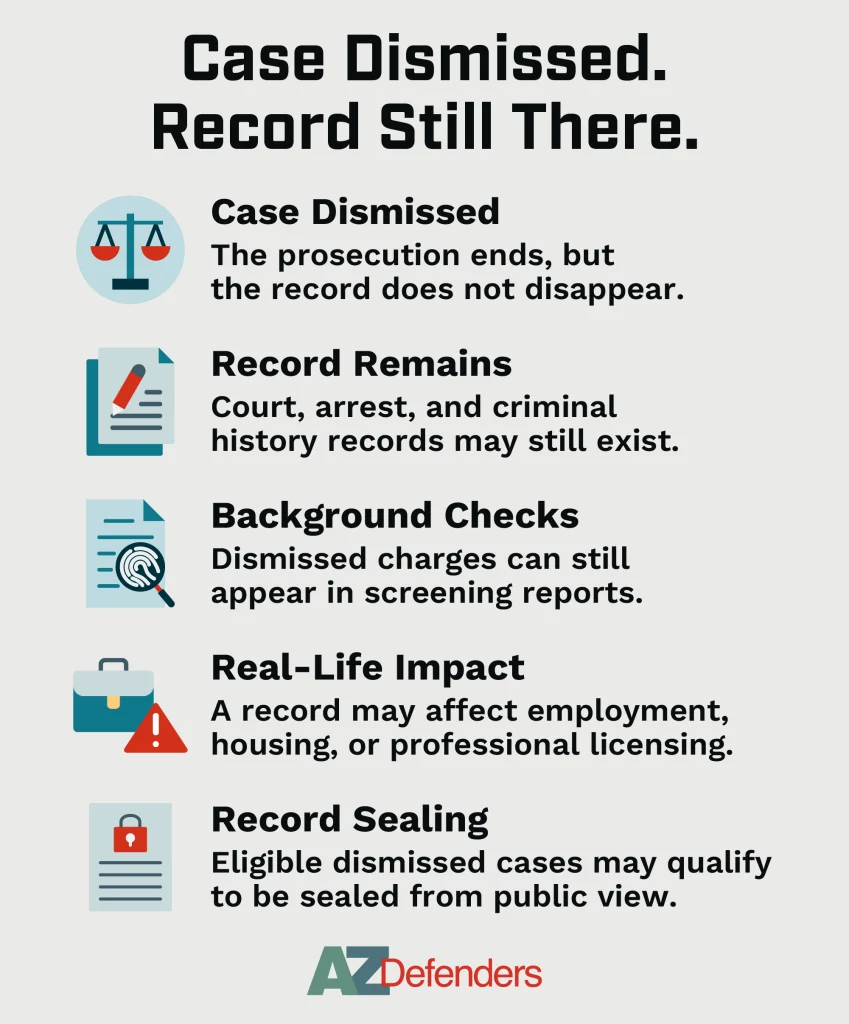
Arizona also distinguishes record sealing from two related remedies people often confuse it with. A set-aside under A.R.S. § 13-905 releases a person from many penalties of a conviction, but the conviction remains publicly visible. Expungement in Arizona is narrow and applies almost exclusively to certain marijuana offenses under A.R.S. § 36-2862. Sealing under A.R.S. § 13-911 is the remedy that actually seals a case from public view and it is the one that applies to dismissed charges.
After a dismissal, the same event typically exists in several places at once, each maintained by a different agency with its own rules.
The clerk of the court maintains the case docket. In many Arizona courts, basic case information, including your name, the charge, the case number, and the disposition, is searchable through public access portals. Anyone with your name can find it.
The Arizona Department of Public Safety maintains a statewide criminal history repository built on fingerprint submissions. When you are booked, your prints and the associated charge go into that system. A dismissal is recorded as a disposition; the underlying arrest entry does not disappear.
Police departments maintain the arrest record in their internal files, and the prosecuting agency keeps its case file. These are internal records, but they exist indefinitely and can surface in later proceedings.
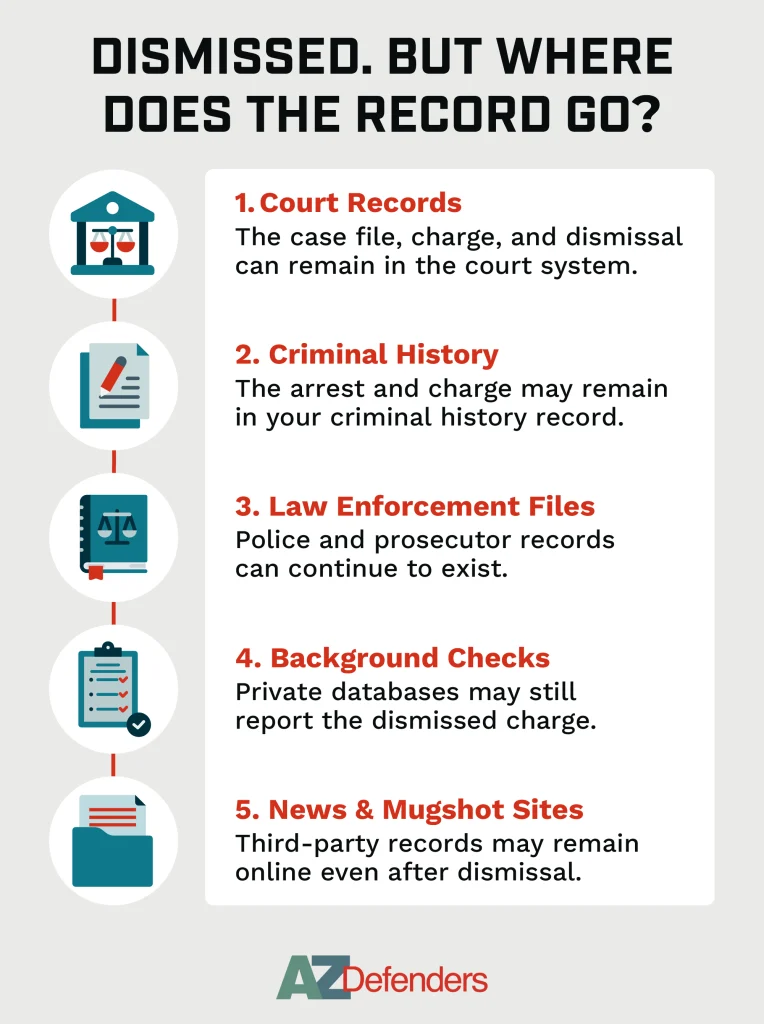
This is where the real damage usually happens. Commercial screening companies are private companies that harvest court and arrest data in bulk from public records and official records, then resell it. Once a record has been scraped, it lives in private hands. Even after a court record is later restricted, stale copies can persist in these databases for years, because the vendor has no automatic obligation to notice that something changed, and sealing or having the record expunged does not always update third-party copies right away.
Booking photos and local news coverage of an arrest are not court records at all. They are third-party publications, and they are notoriously durable.
Background check reports frequently list charges without making the disposition obvious. Employers may still see a dismissed charge or arrest record if the report is outdated or incomplete. A hiring manager scanning fifty applications does not stop to parse the distinction between an accusation and a conviction. The application typically winds up in the rejection pile.
The consequences reach further than most people expect:
The unfair reality is that an accusation you successfully defeated can cost you an opportunity, and you often will never learn that it did.
Effective January 1, 2023, Arizona created a comprehensive record sealing statute. A.R.S. § 13-911 allows eligible individuals to petition a court to seal all case records relating to an arrest, charge, conviction, and sentence. It is the strongest record relief Arizona has ever offered, and it is particularly favorable to people whose charges were dismissed.
Subsection A of the statute identifies three categories of people who may petition:
If your case was dismissed with prejudice, you fall squarely within the second category. That means you were charged with a crime but did not end up with a final conviction. Eligibility can be more complicated with deferred adjudication or another non-Arizona disposition, so a criminal defense attorney or lawyer should determine the best options.
Arizona’s sealing statute imposes tiered waiting periods, but read the statute carefully and you will see that those periods apply only to people who were convicted. Subsection E sets out the timelines that a person “who was convicted of any eligible offense” must satisfy before petitioning: ten years for a class 2 or 3 felony, five years for a class 4, 5, or 6 felony, three years for a class 1 misdemeanor, and two years for a class 2 or 3 misdemeanor. Each clock starts running only after the person completes the non-monetary conditions of the sentence, has been discharged from probation, and is discharged by the court.
None of that applies to a dismissed charge. There is no conviction, no sentence to complete, and no discharge date to measure from. A person whose charge was dismissed with prejudice is not required to wait years to seek relief.
The statute treats dismissed cases favorably in another way as well. Subsection H authorizes the Department of Public Safety to charge an investigation fee for the criminal history report the court requests, but expressly exempts petitioners who are indigent, who were found not guilty, or whose case was dismissed or not prosecuted and who file under the applicable subsections. Subsection I contains a parallel exemption for the fee DPS may charge to correct a criminal history record.
Subsection C directs where to file. For a dismissed case, the petition goes to the court where the indictment, information, criminal citation, or complaint was filed. There is an important wrinkle: if the complaint was filed in a justice court and a subsequent information was filed, the petition must be filed in superior court. Filing in the wrong court is an avoidable way to lose time.
Subsection O excludes certain offenses entirely, including dangerous offenses, dangerous crimes against children, serious offenses, violent or aggravated felonies, offenses involving the discharge, use, or threatening exhibition of a deadly weapon or dangerous instrument, offenses involving the knowing infliction of serious physical injury, sex trafficking, and certain class 2 through 5 felonies from the sexual offense and sexual exploitation of children chapters. Whether a particular criminal offense can be sealed often turns on technical limits in Arizona law, so a criminal defense lawyer should review the exact offense before filing.
Subsection D governs the court’s handling of the petition, and it sets the timeline you should expect.
The court generally may not grant or deny a petition until sixty calendar days after receiving it. The one exception is when the court receives notice that both the prosecutor and all victims who have requested post-conviction notice affirmatively do not object. That window exists so the prosecutor can review the petition and respond, and so victims who have exercised their rights receive notice and an opportunity to be heard.
A hearing is not automatic. Unless the petitioner, the prosecutor, or a victim requests one, the court may rule on the paper pleadings. The court may also dismiss a petition that does not meet the statutory requirements without a hearing at all. The governing standard is whether granting the petition is in the best interests of the petitioner and serves the interests in promoting public safety.
Sixty days is the statutory floor, but it is not a guarantee. Court calendars, the DPS report, and any objection filed by the prosecutor can extend the real-world timeline considerably beyond this period.
If the petition is granted, the court orders the records sealed and directs the clerk to notify DPS and the prosecutor. Sealed records are removed from public access, and a person whose records are sealed may lawfully state that they were never arrested for, charged with, or convicted of the offense, including on employment, housing, financial aid, and loan applications, with several limited exceptions, such as applications that require a fingerprint clearance card and jobs with law enforcement agencies, prosecutors, or courts.
If the petition is denied, subsection L bars filing a new one for three years. That single provision is the strongest argument for getting the petition right the first time.
A dismissed case should not cost you a job, an apartment, or a license years later. Arizona law now gives you a way to close that chapter.
The attorneys at AZ Defenders are adept at handling record sealing petitions. They can confirm your eligibility and guide the entire process, from filing in the correct court through any response from the prosecution.
Take action now and contact AZ Defenders to schedule a free, confidential consultation with an experienced Arizona criminal defense attorney. During the consultation, you will find out what it will take to seal your record. Contact our firm by phone at (480) 456-6400. Our team is available 24/7.