
available 24/7
Free Consultation
In Arizona, committing forgery can be as simple as mimicking someone else’s signature on a check and presenting it to a bank to be cashed. In other cases, though, forgery methods can be more complex, involving a variety of tools specifically designed or adapted to forge written instruments. Possessing these kinds of tools with the intent to use them to commit forgery is a crime under Arizona law.
A conviction for criminal possession of a forgery device is a Class 5 or a Class 6 felony offense in Arizona.
At AZ Defenders, we defend clients accused of forgery-related crimes, including possession of a forgery device. In this blog post, we examine the particulars of what this offense involves, including:
If you are facing a charge of criminal possession of a forgery device in Arizona, then call AZ Defenders at (480) 456-6400 or contact us online to speak with an experienced Arizona forgery attorney in a free case evaluation.
The Arizona law that makes possession of a forgery device criminal in some circumstances is Arizona Revised Statutes (ARS) Section 13-2003. Here is the text of this statute in its entirety:
Criminal possession of a forgery device; classification
A. A person commits criminal possession of a forgery device if the person either:
1. Makes or possesses with knowledge of its character and with intent to commit fraud any plate, die, or other device, apparatus, equipment, software, access device, article, material, good, property or supply specifically designed or adapted for use in forging written instruments.
2. Makes or possesses any device, apparatus, equipment, software, access device, article, material, good, property or supply adaptable for use in forging written instruments with intent to use it or to aid or permit another to use it for purposes of forgery.
B. Subsection A, paragraph 1 does not apply to peace officers or prosecutors in the performance of their duties.
C. A violation of subsection A, paragraph 1 is a class 6 felony. A violation of subsection A, paragraph 2 is a class 5 felony.
Forgery devices take various forms. These include:
Some items that can be used as forgery devices, like high-quality printers and scanners, can have legitimate uses, just like certain items that can be considered “burglary tools” under ARS 13-1505 also have legitimate purposes outside of that crime.
So, in many cases, what makes a device a forgery device is not the inherent nature of the device itself but the intention of the person who possesses or uses it.
Proving intent can depend on the circumstances under which you are discovered to be in possession of an alleged forgery device. For example, there was a recent case in Arizona where the underlying circumstances for the charge of possession of a forgery device were:
In this example, the combination of the forged license in the immediate presence of the technical means to forge it appears to have been the basis of the inference of intent to use the laptop and printer/scanners as forgery devices.
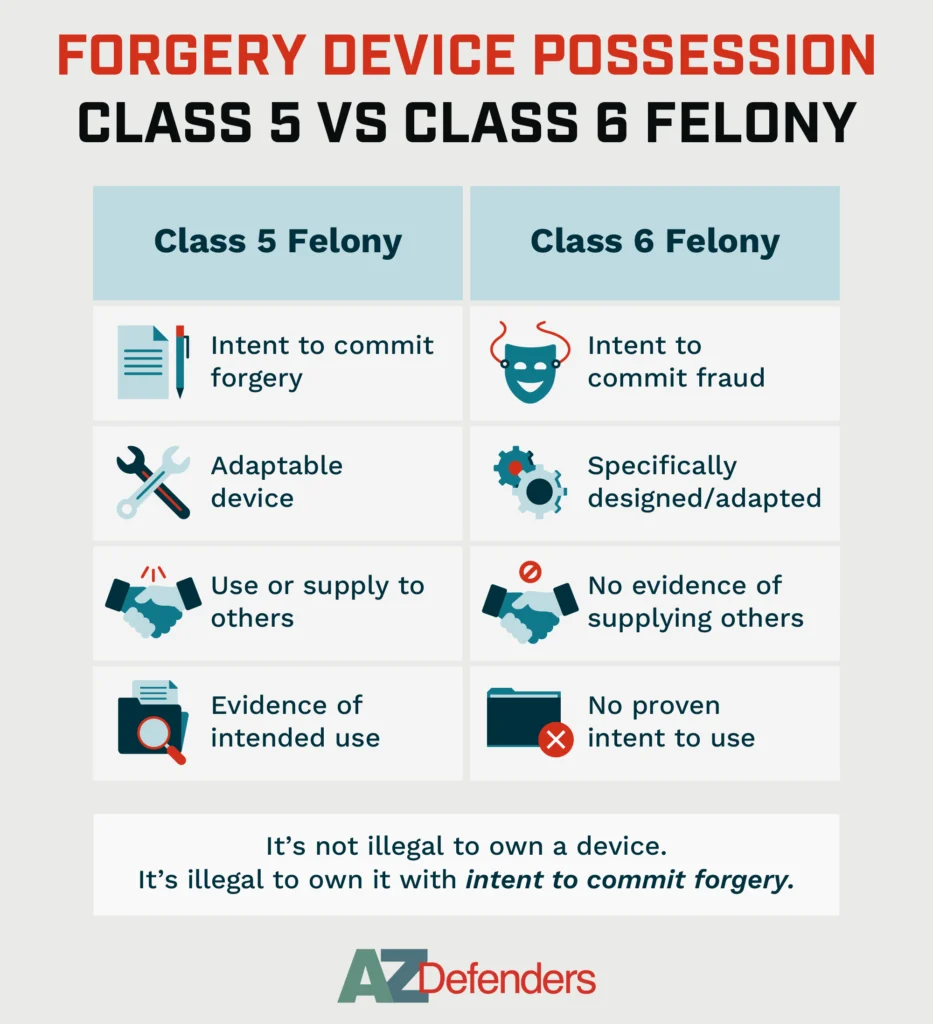
ARS 13-2003 is a fact-dependent statute, not only in determining what constitutes a forgery device, but also in deciding whether to charge an alleged violation of the law as a Class 6 or a Class 5 felony.
Considerable overlap exists between ARS 13-2003(A)(1) (Class 6 felony) and ARS 13-2003(A)(2) (Class 5 felony). Both of these subsections of the statute refer to a “device, apparatus, equipment, software, access device, article, material, good, property or supply.”
The difference appears to be the specific knowledge and intent that underlie the possession of the alleged forgery device.
An example of a Class 6 felony charge might be if you were arrested while in possession of dyes used in the making of currency, you know that these dyes are used for that purpose, and you have the intent to use them to commit fraud with the dyes.
But if evidence exists that you have used those same dyes to print counterfeit currency, or that you have provided those dyes to someone else who used them to commit forgery, then this can elevate the charge to a Class 5 felony.
The table below shows the penalties for Class 5 and Class 6 felony convictions in Arizona.
| Penalty | Class 5 Felony | Class 6 Felony |
| Prison sentence | For a first-time offense: 6 months up to 2.5 yearsWith one prior felony: 1 to 3.75 yearsWith two prior felonies: 3 to 7.5 years | For a first-time offense: 3 months up to 2 yearsWith one prior felony: 9 months to 2.75 yearsWith two prior felonies: 2.25 to 5.75 years |
A Class 5 or a Class 6 felony conviction in Arizona can also result in a fine between $4000 and $150,000.
First-time offenders may be eligible for probation in lieu of prison time.
A felony conviction generally results in loss of firearm rights and may affect other civil rights until formally restored.
The main defense to a charge of criminal possession of a forgery device is to challenge the knowledge and intent elements that the prosecution must prove beyond a reasonable doubt.
As we have discussed above, devices and tools that can supposedly be forgery devices can have a legitimate purpose. The prosecution must show a clear linkage between your making or possessing such an item to a fraudulent intent, the actual use of the item to commit forgery, or the intent to allow someone else to use it for that purpose.
As long as you can provide a reasonable explanation for making or having the device, this can undermine the prosecution’s case.
Secondary defenses can include pointing out technical weaknesses in the prosecution’s case, including:
Being convicted of making or possessing a forgery device in Arizona is a serious matter that can lead to a lengthy prison term, substantial fines, the loss of civil rights, and a lasting felony conviction on your public record.
However, proving that you have the state of mind necessary to be convicted of criminal possession of a forgery device can be a daunting task for the prosecution. A skilled criminal defense lawyer from AZ Defenders can look for every possible weakness in the prosecution’s case against you to cause a jury to reasonably doubt that the prosecution has proven each element of the charge.
AZ Defenders attorneys include board-certified criminal defense specialists. We have represented clients accused of forgery crimes and can represent you as well.If you are facing forgery charges or have been accused of making or possessing forgery devices, call our theft and forgery defense lawyers at (480) 456-6400 to speak in person with one of our Arizona criminal defense attorneys.