
available 24/7
Free Consultation
Habeas corpus is a judicial remedy through which, in some cases, you can challenge your confinement by the government.
To file a writ of habeas corpus, you submit a written petition to the appropriate court — usually a state court first, and then a federal district court once your state remedies are exhausted — that lays out the legal grounds your confinement is unlawful and asks the judge for relief.
You may already be familiar with the term. Still, many people are unclear about exactly what it means to seek habeas corpus relief, when it may apply, how to petition for habeas corpus, and what your possible habeas corpus remedies are.
In this post, we take a close look at habeas corpus and how it works under federal and Arizona law. Specifically, we consider:
In Arizona, you generally get only one full opportunity for post‑conviction relief, unless your claim fits into one of the limited exceptions for successive petitions, like newly discovered evidence or a significant change in the law.
You cannot afford to lose because of a mistake or an oversight on the part of your lawyer. That is why relevant experience with preparing, filing, and arguing habeas corpus petitions is essential for your choice of legal representation.
To speak with one of our skilled Arizona habeas corpus attorneys in Phoenix, Tempe, or Show Low, call AZ Defenders at (480) 456-6400 to schedule a confidential, free initial consultation with us. Or you can do the same via our online contact form.
A writ of habeas corpus challenges illegal confinement and demands the prisoner’s release. The writ petitions a judge to order the government to justify why you are being held, or to release you if your confinement is unlawful. The writ of habeas corpus is sometimes called the “Great Writ” because of this important protection.
Habeas corpus has a history that dates back to the Magna Carta in England in the 13th century. It is a fundamental right protected by the United States Constitution under Article I, Section 9 (the “Suspension Clause”), which guarantees that the federal government can suspend habeas corpus only in extreme emergencies, such as rebellion or foreign invasion.
Congress has authorized suspension of the federal writ only a handful of times in U.S. history — most notably during the Civil War under President Lincoln, in 1871 to combat the Ku Klux Klan in parts of South Carolina, in the Philippines in 1905, and in Hawaii in 1941 following the attack on Pearl Harbor.
The Hawaii suspension, which remained in effect until 1944, was the last time the writ was suspended on U.S. soil.
The Arizona Constitution also protects the writ of habeas corpus in Article II, Section 14. In fact, the Arizona provision is more absolute than the federal Suspension Clause — it categorically bars Arizona authorities from suspending the writ, with no rebellion-or-invasion exception.
It reads in full: “The privilege of the writ of habeas corpus shall not be suspended by the authorities of the state.”
You can categorize habeas corpus into two main areas: pre-trial and post-conviction remedies, and under federal and state habeas corpus relief.
You use a pre-trial writ of habeas corpus to challenge the grounds of your confinement before a trial takes place. This form of writ asserts that your detention is unlawful, and it seeks immediate relief or release.
Grounds for filing a pre-trial writ include, but are not limited to, violations of constitutional rights, lack of probable cause, and improper evidence collection or handling.
Some pre‑trial habeas claims, like constitutional violations affecting the fairness of a trial, require you to show that the irregularities would undermine a fair trial. Others, such as jurisdictional defects or excessive bail, do not.
The success of a pre-trial writ can lead to your release from custody, prevent the charges against you from proceeding to trial, or correct procedural errors early in the legal process.
A post-conviction writ of habeas corpus is a legal tool you use to challenge the legality or constitutionality of your confinement after you have been convicted and sentenced.
This type of writ focuses on errors that occurred during your trial or sentencing, such as ineffective assistance of counsel, jury misconduct, or newly discovered evidence that could potentially exonerate the defendant.
A successful post-conviction habeas petition may result in the vacating of a conviction or sentence, leading to a new trial, resentencing, or release.
People in Arizona or federal confinement may be able to use federal habeas corpus law, 28 U.S.C. § 2254, to challenge that confinement based on federal constitutional or legal violations, such as due process violations, prosecutorial misconduct, or ineffective legal counsel.
The petition goes before a federal district court only after exhausting all available Arizona state remedies, such as post-conviction relief and direct appeals. You must also comply with strict petition filing deadlines.
In practice, even if you meet all the exhaustion and deadline requirements, federal district courts give considerable deference to state court decisions. They only grant habeas relief in cases where the confinement was extremely unreasonable or contrary to clearly established federal law.
If you have been convicted of a federal crime, then you go to a federal prison. There are four main federal prisons in Arizona, and two satellite federal prison camps.
28 U.S.C. § 2255 is the federal law that applies to post-conviction remedies for federal prisoners. This is the law you would rely on to challenge your confinement if you are in federal custody, based on challenges such as lack of jurisdiction, an illegal sentence, ineffective counsel, or Constitutional errors.
Similar to federal habeas corpus for state confinement above, you still must satisfy some exhaustion requirements, most notably waiting until any direct appeal you have made in federal courts has been finally concluded. If you pleaded guilty, your ability to appeal may be limited, depending on the plea agreement and the issues preserved.
28 U.S.C. § 2241 is a habeas corpus law that applies if you are in state or federal custody. This law is often used when a problem arises in calculating sentencing credits or the conditions of parole or detention.
If you are a federal prisoner and relief under 28 U.S.C. § 2255 would be ineffective or inadequate, then 28 U.S.C. § 2241 may be an option, but it is ordinarily a fallback to 28 U.S.C. § 2255 and not a substitute for it. An experienced Arizona habeas corpus attorney can inform you if 28 U.S.C. § 2241 applies to your situation.
Arizona has its own habeas corpus laws. You can find them in Article 26 of Title 13 of Arizona’s Revised Statutes (ARS). This article has 26 statutory sections, from ARS 13-4121 through ARS 13-4147.
In practice, Rule 32 and Rule 33 of the Arizona Rules of Criminal Procedure provide for post-conviction relief, and these rules have largely supplanted the traditional state habeas corpus petition.
A post-conviction petition can include violations of Arizona law or constitutional rights. Still, it is often used to raise issues like new evidence or ineffective counsel that you have not raised on direct appeal.
Above, we have already touched on some common reasons for filing a habeas corpus petition. Here we summarize these grounds in one place.
Examples of constitutional rights violations that can be the basis for habeas relief include:
Examples of procedural problems at trial include:
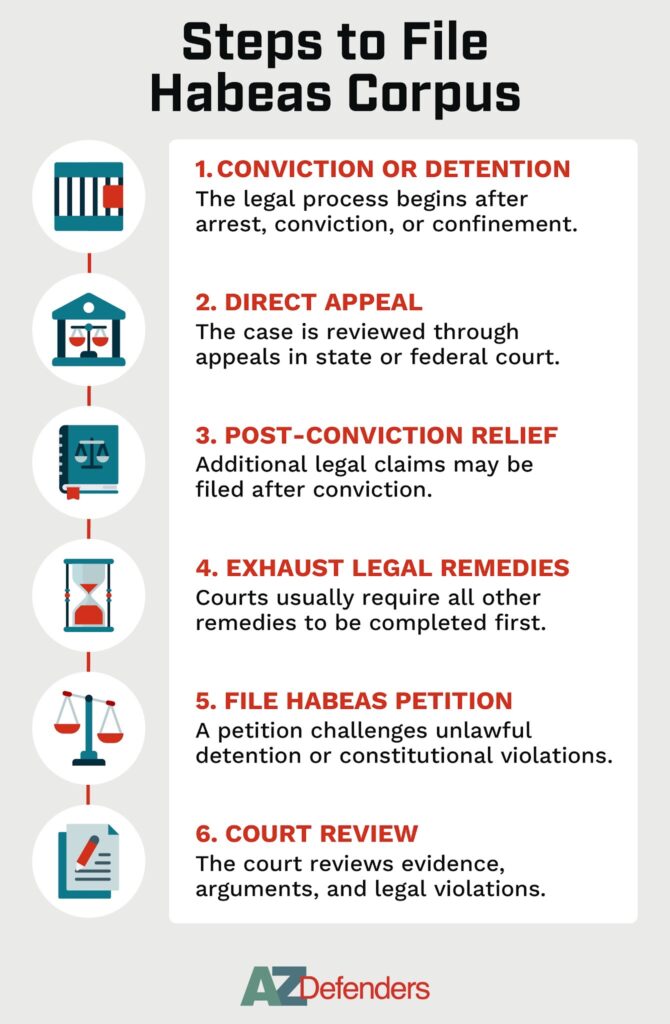
You have two main requirements to meet before you can seek a habeas corpus remedy. You must have gone through all your other judicial remedies before you can file a petition, and you must meet strict deadlines when you file your petition.
Federal and state courts treat habeas corpus as a “last resort” option. In simple terms, exhaustion means giving courts the first opportunity to correct any errors in your conviction, through either an appeal or through post-conviction relief.
This usually means that before trying habeas corpus, you must have appealed your conviction as far as you could in the state courts through the Arizona Court of Appeals, petitioned the Arizona Supreme Court, and filed for any required post-conviction relief petitions for issues like ineffective counsel that you have not raised on direct appeal.
If the court to which you submit a habeas corpus petition decides that you have not satisfied the exhaustion requirement, then it is likely to dismiss your petition.
In some very rare cases, if no Arizona state process is available to you or it would be ineffective, then the exhaustion requirement may be excused.
For example, if Arizona law does not allow any further review for a particular type of claim, then a federal court might consider your habeas claim directly. But these are exceptional situations, and you should assume you need to exhaust your state remedies before turning to a federal court.
Under the 1996 Antiterrorism and Effective Death Penalty Act (AEDPA), most federal habeas petitions have a strict one-year filing deadline.
Missing this deadline can forfeit your chance for relief, so it is important to understand how it works.
If you have exhausted your other judicial remedies, then seeking habeas corpus involves the following steps.
You need to back up your habeas corpus petition with relevant records. These include the original indictment, transcripts of the court proceedings, affidavits from witnesses, and any motions or briefs filed in the case. New evidence, if it exists, needs to be carefully organized.
Once you have all the supporting documentation and evidence you need, the next step is to incorporate it into a strong petition that presents your legal arguments and demonstrates how your detention violates your rights under the Constitution or federal or Arizona law.
To be effective, your petition must include a clear statement of the facts of the case, the grounds for relief, and your specific demands, such as an immediate release or a new trial.
Once your attorney completes the petition, the next step is to file it on time with the appropriate court. This is often a federal district court, but in some cases it can be an Arizona court.
Once you have filed your petition, the court’s review process begins. This often involves a preliminary assessment to ensure the petition meets basic legal standards before proceeding to a hearing.
During this hearing, both you through your attorney and the prosecution present arguments. As the petitioner, the burden of proof lies with you to convincingly demonstrate the existence of legal and constitutional violations that render your detention unlawful.
The prosecution will have the opportunity to argue the legality and propriety of your original detention. The thoroughness of the written petition and the persuasiveness of oral arguments will both play pivotal roles in influencing the court’s decision.
If the court finds in your favor, then it may order immediate release, a retrial, or other remedies. If the court denies the writ, then you may have the option to appeal to a higher court.
Filing a habeas corpus petition is often your last chance to overturn a conviction or reduce a sentence. Given the stringent requirements for preparing and filing your petition, and the deference that federal courts give to Arizona state court decisions, the odds of success are long, but having the right habeas corpus lawyer on your side can help.
Generally, there is no right to legal counsel in a habeas corpus proceeding. Many petitioners try to represent themselves, but given the stakes, if you can hire an experienced attorney, then we at AZ Defenders strongly suggest that you do.
When you hire us, you can be confident that we will:
If you have been subject to criminal detainment or confinement in Arizona, then call AZ Defenders at (480) 456-6400 to speak with one of our habeas corpus attorneys in a confidential, free consultation. Or you can reach us online; we will promptly reply to you any day, any time.