
available 24/7
Free Consultation
Although the terms “sealed” and “expunged” are sometimes used interchangeably, they are not the same thing. Understanding the distinction between a sealed and an expunged record is important because the legal effect, eligibility requirements, and long-term consequences can vary significantly.
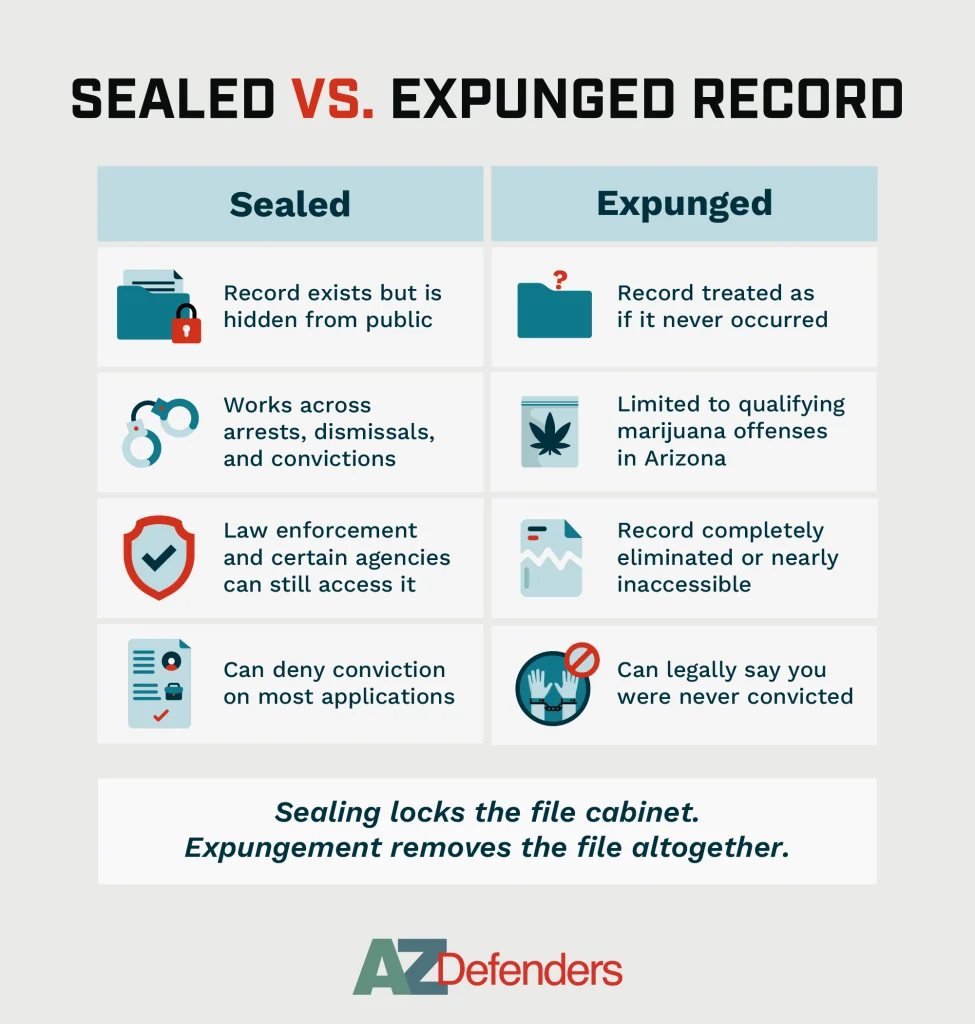
The key difference is access: a sealed record still exists but is hidden from the public (courts and law enforcement can still see it), while an expunged record is erased or treated as though the offense never happened.
If you want to clear or limit access to a criminal record in Arizona, an experienced criminal defense attorney can help evaluate your options and determine what relief may be available.
Call AZ Defenders (480) 456-6400 today to speak with an experienced Arizona criminal defense attorney about your options.
Record sealing limits public access to a criminal record.
When a court grants a record sealing, the record still exists but becomes unavailable to most members of the public. Employers, landlords, and others conducting ordinary background searches generally cannot view a sealed record.
However, a sealed record is not destroyed. Certain government agencies, courts, prosecutors, and law enforcement agencies may still access the information under circumstances permitted by law.
Record sealing can apply to arrests, dismissed charges, criminal convictions, and other criminal records when statutory requirements are satisfied.
For many individuals, record sealing provides an opportunity to move forward without a past mistake appearing during routine background checks.
Expungement is a broader form of relief.
In many states, expungement allows a criminal record to be removed, destroyed, or treated as though it never occurred. Depending on the jurisdiction, an expunged record may no longer be accessible to the public, employers, or even certain government entities.
Because expungement laws vary widely, the effect of an expungement is not identical in every state.
In some jurisdictions, a conviction is completely erased from public view. In others, limited records remain available for specific legal purposes.
Many people assume expungement is available for every criminal conviction, but that is not the case.
The primary difference between a sealed and an expunged record is accessibility.
A sealed record still exists, but access is restricted.
An expunged record is generally removed from public access to a much greater degree and, in some states, may be treated as though the arrest or conviction never occurred.
When comparing expunged vs. sealed records, it is helpful to think of sealing as locking a file cabinet, while expungement may remove the file altogether.
The exact legal effect depends on state law.
Arizona does not follow the same approach used in many states.
Historically, Arizona did not offer traditional expungement for most adult criminal convictions. Instead, Arizona law provided relief through a process known as setting aside a conviction under ARS § 13-905.
When a conviction is set aside, the court sets aside the judgment of guilt and releases the defendant from many penalties and disabilities resulting from the conviction. However, the criminal record itself remains visible.
Arizona later enacted additional record-clearing remedies: first, limited expungement for certain marijuana-related offenses in 2021, followed by record sealing, which took effect in 2023.
Arizona’s record-sealing law is codified at ARS § 13-911. It allows eligible individuals to petition the court to have certain records sealed from public access.
Depending on the circumstances, record sealing may apply to:
If granted, the court may order that the records be sealed and unavailable to the general public.
Even after criminal record sealing, law enforcement, prosecutors, courts, and other authorized agencies may still access the information when permitted by law.
Arizona also provides true expungement in a very limited category of cases.
Under ARS § 36-2862, individuals may petition to expunge certain marijuana-related arrests, charges, adjudications, and convictions that qualify under Arizona law.
This relief became available through the passage of Proposition 207 (the Smart and Safe Arizona Act), which took effect in 2021 and, for the first time, allowed true expungement of qualifying marijuana offenses.
For qualifying cases, expungement provides broader relief than record sealing or a set-aside.
However, expungement remains unavailable for most criminal convictions in Arizona.
Eligibility depends on the type of offense, the outcome of the case, and the applicable statute.
Common offenses that may qualify for record clearing include:
Not every conviction qualifies.
Violent crimes, certain felony convictions, and other serious offenses may be subject to restrictions or may be ineligible for sealing altogether.
An attorney can review a criminal record and determine what options may be available.
Many states require individuals to wait before seeking record-clearing relief.
Most expungement and sealing laws require that all sentencing requirements be completed before a petition may be filed. This often includes:
The required waiting period varies depending on the offense and the governing law.
Juvenile criminal records often receive different treatment than adult criminal records.
Many states recognize that youthful mistakes should not permanently interfere with education, employment, or future opportunities.
Whether a juvenile record qualifies depends on the specific circumstances and applicable law.
One of the most significant benefits of record sealing or expungement is its impact on background searches.
When records are sealed rather than expunged, employers and landlords may be unable to access information that would otherwise appear during a background check.
This can improve opportunities involving:
The practical impact varies depending on the type of relief granted and the entity being searched.
In Arizona, whether you can legally answer “no” when asked about a past criminal conviction depends on the specific type of relief granted in your case. Arizona law treats expunged and sealed records differently regarding mandatory disclosures.
If your record was expunged, which in Arizona is legally limited to specific marijuana offenses, the law treats the conviction as if it never occurred. In this scenario, you can legally state that you have never been arrested, charged, or convicted of that crime on any application.
For other eligible offenses, Arizona’s record-sealing law provides similar protections. If the court grants a petition to seal your record, you can legally deny the existence of the conviction on standard applications for employment, housing, and financial loans – subject to a few enumerated exceptions in circumstances when you still have to disclose the sealed record.
However, a sealed record does not provide total protection. Unlike an expungement, you must still disclose a sealed conviction when applying for:
Because disclosure requirements vary significantly based on who is asking, individuals must understand the legal limitations of their specific record clearance before completing official forms.
There is no universal answer to this because it depends on the individual circumstances of each case.
Generally, a sealed record is better than a conviction that has been set aside and may provide substantial benefits by removing public access to a criminal record while preserving information for authorized government purposes.
An expunged record generally provides the broadest relief but is available only in very limited situations.
The best option depends on the facts of the case, the offense involved, eligibility requirements, and the relief available under Arizona law.
Whether you are evaluating record sealing, a set-aside, or expungement, understanding your legal options is the first step toward moving forward.
AZ Defenders helps clients pursue record-clearing remedies throughout Arizona. Our criminal defense team can review your case, determine eligibility, prepare the necessary filings, and guide you through the process.
Call (480) 456-6400 today to speak with an experienced Arizona criminal defense attorney about your options for clearing or limiting access to your criminal record.