
available 24/7
Free Consultation
Under Arizona law, forgery involves altering a written document with the intent to defraud another person.
A common example of forgery is trying to cash a check with a forged signature. Other common examples include creating fake prescriptions for medications or filling out unauthorized applications for credit using another person’s personal information.
Depending on the circumstances, a conviction for forgery is classified as a Class 4 or Class 3 felony in Arizona.
In this blog post, we examine forgery crimes in Arizona. Specifically, we cover:
AZ Defenders represents clients charged with criminal law violations in Arizona, including non-violent offenses such as forgery charges.
To speak with a seasoned, experienced criminal defense trial lawyer in a free consultation, call us at (480) 456-6400 or use our contact form.
Arizona Revised Statutes (ARS) 13-2002 is the state law that defines the offense of forgery:
Forgery; classification; definitions
A. A person commits forgery if, with intent to defraud, the person:
1. Falsely makes, completes or alters a written instrument; or
2. Knowingly possesses a forged instrument; or
3. Offers or presents, whether accepted or not, a forged instrument or one that contains false information.
B. The possession of five or more forged instruments may give rise to an inference that the instruments are possessed with an intent to defraud.
C. Forgery is a class 4 felony, including if the forged instrument is a gift card, except that if the forged instrument is used in connection with the purchase, lease or renting of a dwelling that is used as a drop house it is a class 3 felony.
D. For the purposes of this section:
1. “Drop house” means property that is used to facilitate smuggling pursuant to section 13-2319.
2. “Gift card” has the same meaning prescribed in section 13-1813.
This base statute is subject to additional definitions contained in another statute, ARS 13-2001, which provides the following information:
Written instrument: A written instrument can be any paper, document, or other instrument containing written or printed matter, or any token, stamp, seal, badge, trademark, graphical image, access device, or other evidence or symbol of value, right, privilege, or identification.
Checks, deeds, bearer bank notes, paper currency, and contracts are examples of instruments.
A written instrument can be complete or incomplete.
Forged instrument: This is a written instrument that has been falsely made, completed, or altered.
Many times, people think of forgery as mimicking another person’s signature on a document, which is one form of the offense.
However, as these definitions demonstrate, the act of forgery can take many forms, including deleting information or fabricating a fake document based on existing documents. Even an instrument that has an authentic signature can still be considered a forgery if it has a forged amount or other alteration.
The key is the intent to defraud someone else, or knowingly being in possession of forged documents.
Possession of an altered or inauthentic document by itself is not forgery, as long as you do not attempt to pass it off on someone else as authentic with the intent to take advantage of that person.
For example, you can take a check from someone else’s checkbook and write it out for a million dollars, and even mimic that person’s signature on it; as long as you never try to cash it or otherwise exchange it, then it is hard to show beyond a reasonable doubt that you have the intent to defraud.
Nonetheless, the forgery statute does treat having multiple false instruments in a way similar to how some statutes treat possession of “distribution quantities” of illegal drugs: if you have five or more forged instruments, then the law allows an inference that your intent is to commit fraud with them.
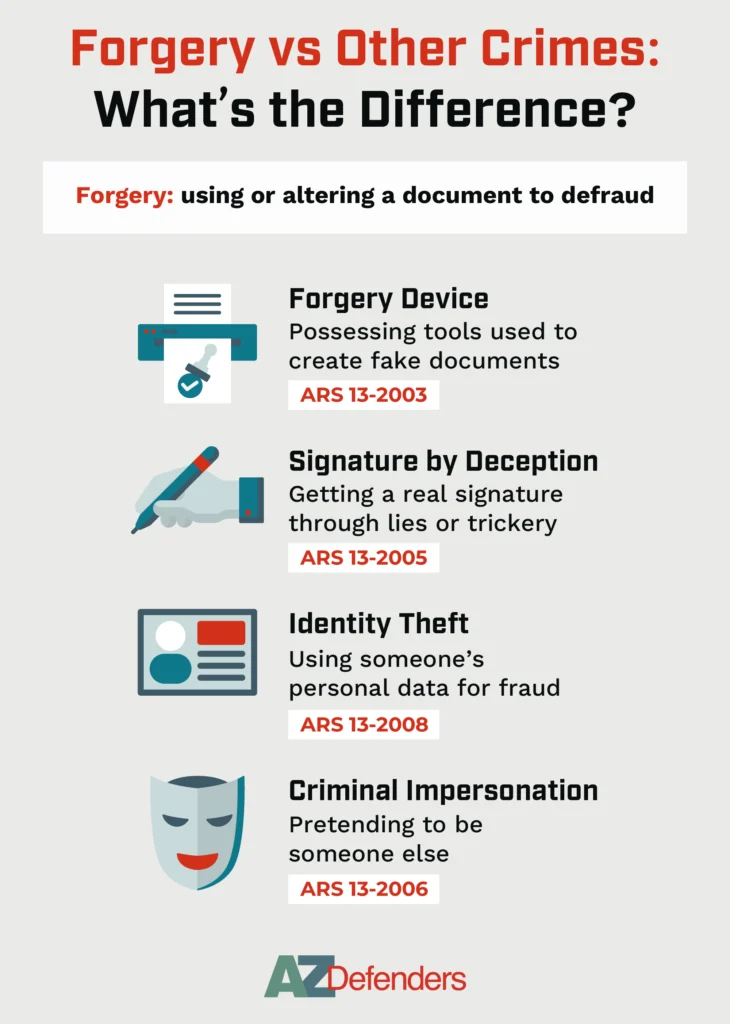
Some other crimes involve the use of false information and instruments, but they are distinct from the crime of forgery. Examples are:
The basic act of forgery—intending to and attempting to defraud another person with a forged instrument—is a Class 4 felony in Arizona. This is how most cases of forgery are prosecuted in Arizona. The penalties for this class of forgery include:
ARS 13-2002(C) makes it a Class 3 felony to engage in forgery related to “the purchase, lease or renting of a dwelling that is used as a drop house.” The statute defines a drop house as having a connection to “smuggling” pursuant to ARS 13-2319.
When we look at ARS 13-2319, it is clear that the kind of smuggling contemplated by Arizona’s forgery law is human smuggling, particularly the transportation into the United States of people who are not United States citizens, permanent resident aliens, or persons otherwise lawfully in Arizona or have attempted to enter, entered or remained in the United States in violation of law.
If you are found guilty of using forged documents to buy, lease, or rent a dwelling used as a drop house for human smuggling, this is a Class 3 felony charge with the following potential penalties:
First-time offenders of Class 4 or Class 3 felonies are eligible for probation in lieu of a prison sentence.
A felony conviction in Arizona can also result in a financial penalty, including a fine. This can be between $4,000 and $150,000. Victim restitution is another possible sentencing outcome.
In addition, any felony conviction stays on your public record regardless of your completion of a prison sentence and payment of fines and restitution. This can have the following long-term negative consequences for you:
The main defenses to forgery charges go to the intent and knowledge elements of the offense. You cannot unintentionally or unknowingly commit fraud.
Other defenses that may be available, depending on the factual circumstances surrounding the alleged act of forgery, are being falsely accused or technical violations. Examples include:
An experienced criminal defense attorney can help you understand your defense options to a forgery charge.
Despite being a nonviolent crime, the state of Arizona still considers forgery serious enough to make it a felony offense. If you are convicted of forgery, you could spend years in prison, be subject to fines that can be hard to pay off, and suffer the long-term consequences of having a felony conviction on your public record.
Presenting the most effective defense to a prosecution for forgery depends on your criminal defense lawyer having detailed knowledge of the facts of your case and an equally firm grounding in how Arizona’s theft and forgery crimes work.
When you hire AZ Defenders to represent you, you will have an experienced and skilled lawyer on your side.
We can explore all the available lack of intent to defraud and lack of knowledge approaches that may be available to you as a defendant in a forgery case, and investigate the facts of your case to look for any weakness in how the police conducted their procedures up to and including their decision to arrest you, and how they gathered evidence.
If you have been charged with forgery in Arizona, you can use our online contact form or call us at (480) 456-6400 to get a free consultation with an experienced Arizona forgery attorney.