
available 24/7
Free Consultation

Posted on January 23, 2026 in Assault & Violent Crimes
Under Arizona law, robbery can take different forms, including armed robbery and aggravated robbery. In this post, we focus on the basic offense of robbery, as it is defined under Arizona Revised Statutes Section 13-1902.
While theft and robbery involve taking someone else’s property without that person’s permission, an important difference between these two offenses is that robbery involves taking something from the victim directly in their presence with some kind of threat or force to coerce someone to surrender property.
If you have been accused of any kind of robbery charges in Arizona, call AZ Defenders at (480) 456-6400 to speak with one of our experienced Arizona criminal defense attorneys. You can also reach us online to schedule a free consultation with one of our criminal defense lawyers.
ARS 13-1902 is a brief statute. Here it is in its entirety:
Robbery; classification
A. A person commits robbery if in the course of taking any property of another from his person or immediate presence and against his will, such person threatens or uses force against any person with intent either to coerce surrender of property or to prevent resistance to such person taking or retaining property.
B. Robbery is a class 4 felony.
As we state in our introduction above, unlike theft, robbery is a crime that cannot go unnoticed by the victim at the time of its commission.
The robber is taking something from the victim’s person, such as a wallet, purse, or watch, or is taking some other item of the victim’s property while the victim is present to see it, as might happen in a home invasion robbery.
ARS 13-1902 contains some specific legal terms that are defined in ARS 13-1901. These include:
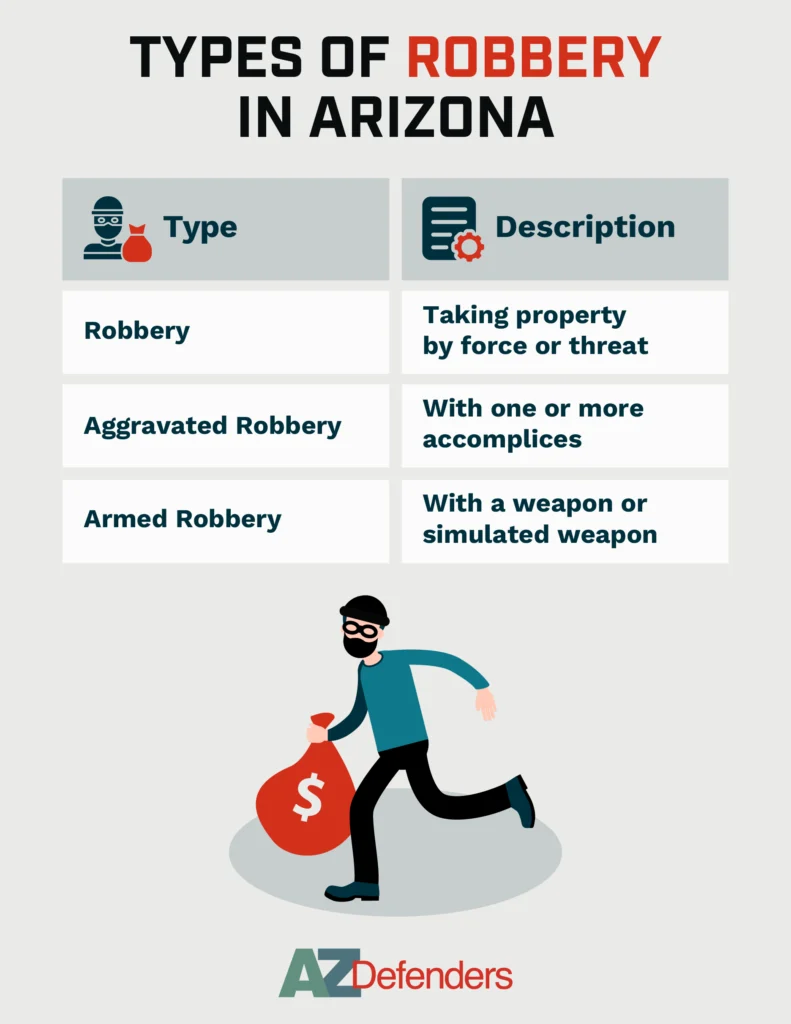
Arizona law recognizes three kinds of robbery charges. In addition to robbery under ARS 13-1902, two additional related offenses are:
Robbery can be a standalone charge, or in some cases, it can be combined or “stacked” with other charges.
A common example is if robbery happens in connection with a burglary, which is a crime that involves entering onto or into the property of another with the intent to commit a felony or theft. In this event, the prosecution will often charge you with both burglary and robbery.
Another possible example of a stackable offense is assault, which can mean putting another person in reasonable apprehension of imminent physical injury. Threatening another person with the use of force during the commission of a robbery could result in charges for both robbery and assault.
A conviction for robbery is a Class 4 felony under Arizona law. The potential punishments for robbery depend on how many “historical prior felony convictions” you have.
The actual sentence will be determined based on any aggravating and mitigating circumstances unique to each case.
A felony conviction for robbery can also carry a fine of up to $150,000, a restitution requirement to the victim, and possibly additional expenses like court costs.
Moreover, a felony conviction on your record can have significant additional consequences for you. These include the possible loss of certain rights, such as your right to vote, serve on a jury, possess a firearm, or join the armed forces of the United States. A felony can make it more difficult to secure employment and find a place to live.
In a robbery trial, the prosecution must prove all of the elements of a robbery charge beyond a reasonable doubt. So, if you can cast reasonable doubt on any element of the charge, you can possibly be acquitted of the crime or at least have it reduced to a lesser charge.
For example, in a stacked prosecution of robbery and assault, if you can cast reasonable doubt on whether you intended to take the victim’s property but still threatened the victim with the use of force, this can mean that you are only subject to an assault charge.
Other possible defenses to a charge of robbery can include:
Arizona’s criminal code makes robbery a serious charge with very serious consequences. You may face years of prison time, up to a six-figure fine, additional costs, a criminal record, and curtailment of some of your civil rights if you are found guilty of robbery.
Due to the potentially severe penalties associated with a robbery conviction, it is crucial to have premium legal representation in plea negotiations or in trial. This is what you will get when you retain AZ Defenders as your legal counsel.
Our criminal law defense attorneys have over a hundred and fifty years of combined experience defending clients against felony-level prosecutions, including robbery charges. We have a proven track record of winning cases and are known as some of the most aggressive criminal defense law firms in Arizona.
Give us a call today at (480) 456-6400 or use our contact form to schedule a free case evaluation.