
available 24/7
Free Consultation
In Arizona, trafficking in stolen property means knowingly or recklessly selling, transferring, distributing, dispensing, or otherwise disposing of stolen property. Trafficking in stolen property includes buying, receiving, possessing, or obtaining control of stolen property with the intent to sell, transfer, distribute, dispense, or otherwise dispose of the property.
The Arizona law that makes trafficking in stolen goods illegal is Arizona Revised Statutes (ARS) Section 13-2307. Depending on the circumstances, a conviction under this law is a Class 3 felony or a Class 2 felony.
If you have been charged with trafficking in stolen goods in Arizona, AZ Defenders can represent you. To speak with one of our experienced criminal defense attorneys, call us at (480) 456-6400 or contact us online.
In this post, we outline how Arizona law classifies the crime of trafficking in stolen property, the potential penalties for conviction, and some possible defense strategies for a charge of trafficking in stolen goods.
ARS 13-2307 is a short statute. We include all of it here:
Trafficking in stolen property; classification
A. A person who recklessly traffics in the property of another that has been stolen is guilty of trafficking in stolen property in the second degree.
B. A person who knowingly initiates, organizes, plans, finances, directs, manages or supervises the theft and trafficking in the property of another that has been stolen is guilty of trafficking in stolen property in the first degree.
C. Trafficking in stolen property in the second degree is a class 3 felony. Trafficking in stolen property in the first degree is a class 2 felony.
Trafficking in stolen property applies to buyers as well as sellers.
An important consideration in determining whether trafficking in stolen goods is a first-degree or a second-degree offense is whether you engage in reckless or knowing behavior.
Recklessness means that you are aware of, and consciously disregard, a substantial and unjustifiable risk that the property is stolen.
Reckless behavior often applies to people who buy stolen goods.
An example of reckless behavior in this context might be buying goods or other property at such a low price that it seems “Too good to be true,” and you do not follow up to find out how or why it is that you are being offered such an incredible bargain.
Knowing behavior occurs when a person engages in purposeful conduct with regard to planning, organizing, conducting, managing, or directing the trafficking behavior.
Examples of knowing conduct include reselling a stolen motor vehicle, buying or otherwise obtaining control over items that were stolen from a retail establishment, or acting as a “fence” to sell other stolen property, like items taken during a residential or commercial burglary.
Historically, organizers of operations selling to pawnshops exemplified knowing trafficking in stolen property, though stricter laws requiring pawnshop owners to verify sources and check for theft have made this harder.
The penalty you may face for trafficking in stolen property in Arizona depends on whether you are charged with second-degree trafficking (reckless standard of behavior) or first-degree trafficking (knowing behavior).
The sentence you might receive can be influenced by factors like whether you have a prior criminal history, the value and type of the stolen property, and other circumstances of the offense.
Second-degree trafficking in stolen property is a Class 3 felony.
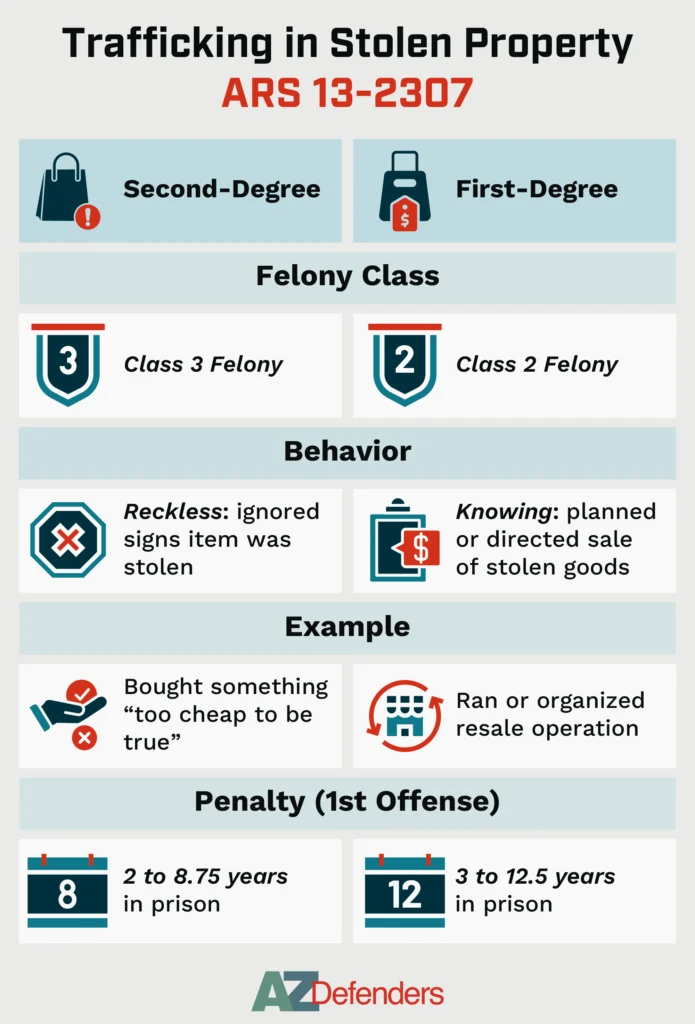
First-degree trafficking in stolen property is a Class 2 felony.
For a first-time offense, a conviction for first- or second-degree trafficking may be probation-eligible, depending on judicial discretion and the specific circumstances of the case.
For any class of felony conviction, you can be subject to a fine of up to $150,000.
You may also be subject to a restitution requirement as part of a first- or second-degree trafficking in stolen property conviction. This can include the value of the stolen property, any related damages, and court costs.
A felony conviction in Arizona results in a permanent mark on your criminal record.
Some specific consequences you may face after a felony conviction include:
Several defenses exist to a charge of trafficking in stolen property. The defenses that may be available to you depend on the facts of your specific case, and your success in employing them will depend at least in part on the experience and capabilities of your defense lawyer.
Here are some common defenses that you may be able to use.
To obtain a conviction, the prosecution must prove beyond a reasonable doubt that your behavior was at least reckless, or knowing in nature. If you can persuade a jury that you were perhaps negligent but not reckless in buying stolen property, this can be an effective defense.
One of the most common defenses is that a person who bought stolen property did not know and had no reasonable way to know that it was stolen. The success of this defense depends on the totality of the circumstances. For example, you might buy something at what you believe is a garage sale, moving sale, estate sale, or on an e-commerce site for what you believe is a liquidation price and have no idea that it was stolen.
Sometimes you may be subject to a false accusation based on mistaken identity. In other cases, the police may have conducted an improper search and seizure of the evidence it has against you, or have failed to maintain proper custody of that evidence, which might make the evidence inadmissible in court.
If the police do not observe your rights while you are in custody, like violating your “Miranda” rights or your right to have a lawyer present during questioning, this can be a valid defense.
If you have been charged with a theft crime, including trafficking in stolen property, then contact our Phoenix criminal defense lawyers at AZ Defenders for a free consultation today. Your case will be in the hands of experienced trial lawyers who you can trust to fight hard for your defense, from start to finish.
Call our Phoenix theft crime defense attorneys today if you are facing criminal law charges for domestic violence, sexual assault, drug offenses, vehicular crimes, or are currently under investigation in a criminal case. Never agree to an interview with law enforcement without speaking with a criminal defense attorney.
Call our criminal defense team today at (480) 456-6400 or contact us online to communicate with an experienced criminal defense attorney.