
available 24/7
Free Consultation
Most Arizona domestic violence allegations pair an underlying crime with a domestic violence designation; aggravated domestic violence is a separate offense. ARS 13-3601 identifies a list of underlying offenses that receive a domestic violence designation when the accused and alleged victim have a qualifying relationship.
The prosecution therefore generally must prove the elements of the underlying offense and the relationship that makes the allegation a domestic violence matter. The misdemeanor or felony classification ordinarily comes from the underlying offense.
If you have been charged with domestic violence in Arizona, AZ Defenders can represent you in negotiations with prosecutors and/or in a criminal trial. Contact us at (480) 456-6400 to speak with an experienced criminal defense attorney in a free consultation.
ARS 13-3601 applies when the relationship between the accused and alleged victim falls within a listed category, including:
For a disputed romantic or sexual relationship, the court may consider its type, length, frequency of interaction and the time since it ended.
The statute lists many possible underlying crimes. Common examples include assault, aggravated assault, threatening or intimidating, disorderly conduct, criminal damage, trespass, unlawful imprisonment, kidnapping, harassment, stalking and interfering with judicial proceedings.
The label does not replace the underlying charge. For example, a case may be filed as assault per domestic violence or criminal damage per domestic violence. The prosecution still must establish the elements of assault or criminal damage in addition to the qualifying relationship.
It can be either. ARS 13-3601 states that the offense carries the classification assigned by the statute defining the underlying crime. A misdemeanor assault does not become a felony solely because it receives a domestic violence designation. An underlying felony remains a felony.
The facts can also affect the classification. Injury, use of a weapon, the value of damaged property, a violated protection order and a person’s criminal history may change the possible charges or penalties.
Arizona law allows an officer to arrest a person, with or without a warrant, when the officer has probable cause to believe domestic violence occurred and that the person committed it. For a person at least 15, cases involving physical injury or the discharge, use or threatening exhibition of a deadly weapon or dangerous instrument fall under a mandatory-arrest provision when probable cause exists, subject to the statute’s exception concerning protection from further injury.
An officer responding to the call may ask about firearms. Under the conditions in ARS 13-3601, an officer may temporarily seize a firearm believed to create a risk of serious bodily injury or death. The statute establishes notice and hearing procedures if the government seeks to retain it longer.
After an arrest, the court sets release conditions intended to protect the alleged victim and other designated people. The conditions may restrict contact, locations, firearms, or other conduct. A person must follow the written order even if the alleged victim initiates contact or says the case should be dismissed.
There is no single domestic violence sentencing range. For example, ordinary assault under ARS 13-1203 can be a class 1, 2 or 3 misdemeanor depending on the conduct and mental state. The ordinary maximum jail terms under ARS 13-707 are six months, four months, and 30 days, respectively; repeat-offense provisions may change the result.
For a first non-dangerous aggravated domestic violence felony governed by ARS 13-702, the class 5 prison range is 0.5 to 2.5 years, with a 1.5-year presumptive term. The special minimum jail requirements discussed below still matter if their conditions apply. A different underlying felony, dangerousness allegation or qualifying prior history requires a different range.
The potential jail or prison range depends on the underlying offense, criminal history, and any applicable enhancement. A domestic violence designation can also add requirements beyond the ordinary sentence for the underlying crime.
Under ARS 13-3601.01, a misdemeanor domestic violence conviction generally requires an approved offender treatment program. If treatment was previously ordered, the judge may select alternative sanctions when more appropriate. The person generally pays the program cost. A qualifying prior conviction within 60 months can affect probation and incarceration decisions.
ARS 13-3601(L) requires pregnancy to be considered at sentencing. Under subsection M, a felony listed in subsection A committed against a victim known to be pregnant, or a felony causing physical injury to a victim known to be pregnant, increases the otherwise authorized maximum by up to two years. This is not an automatic two-year addition to every domestic violence sentence.
ARS 13-3601.02 creates the separate offense of aggravated domestic violence. Its repeat-offense provisions include a third or subsequent domestic violence violation within 84 months. Offense dates, qualifying prior convictions, and qualifying out-of-state, federal, or tribal acts must be evaluated under the statute; multiple counts from the same series of acts cannot simply be counted as separate qualifying repeats.
Aggravated domestic violence is a class 5 felony. A person with two qualifying prior violations within the period must serve at least four months in jail before becoming eligible for the forms of release listed in the statute. Three or more qualifying prior violations increase that minimum to at least eight months.
Prior-offense calculations can be complicated when convictions arose in other jurisdictions or from the same series of acts. They require a case-specific review.
A domestic violence case may affect more than just the immediate criminal sentence. A felony conviction can suspend voting, jury service, and firearm rights under ARS 13-904. A record can also affect employment, housing, and occupational-license decisions, depending on the job, licensing rules, and disposition. Domestic violence findings can be relevant to parenting decisions under ARS 25-403.03.
Orders of protection and criminal release conditions are separate orders. The existence or dismissal of one does not automatically resolve the other. Violating either can create additional exposure.
Federal law generally bars firearm and ammunition possession after a qualifying misdemeanor crime of domestic violence, as the ATF explains. Whether a conviction qualifies depends on the federal elements, relationship and other requirements; the Arizona DV label alone does not settle it. Noncitizens should have the particular charge and proposed plea evaluated for immigration consequences before accepting a disposition.
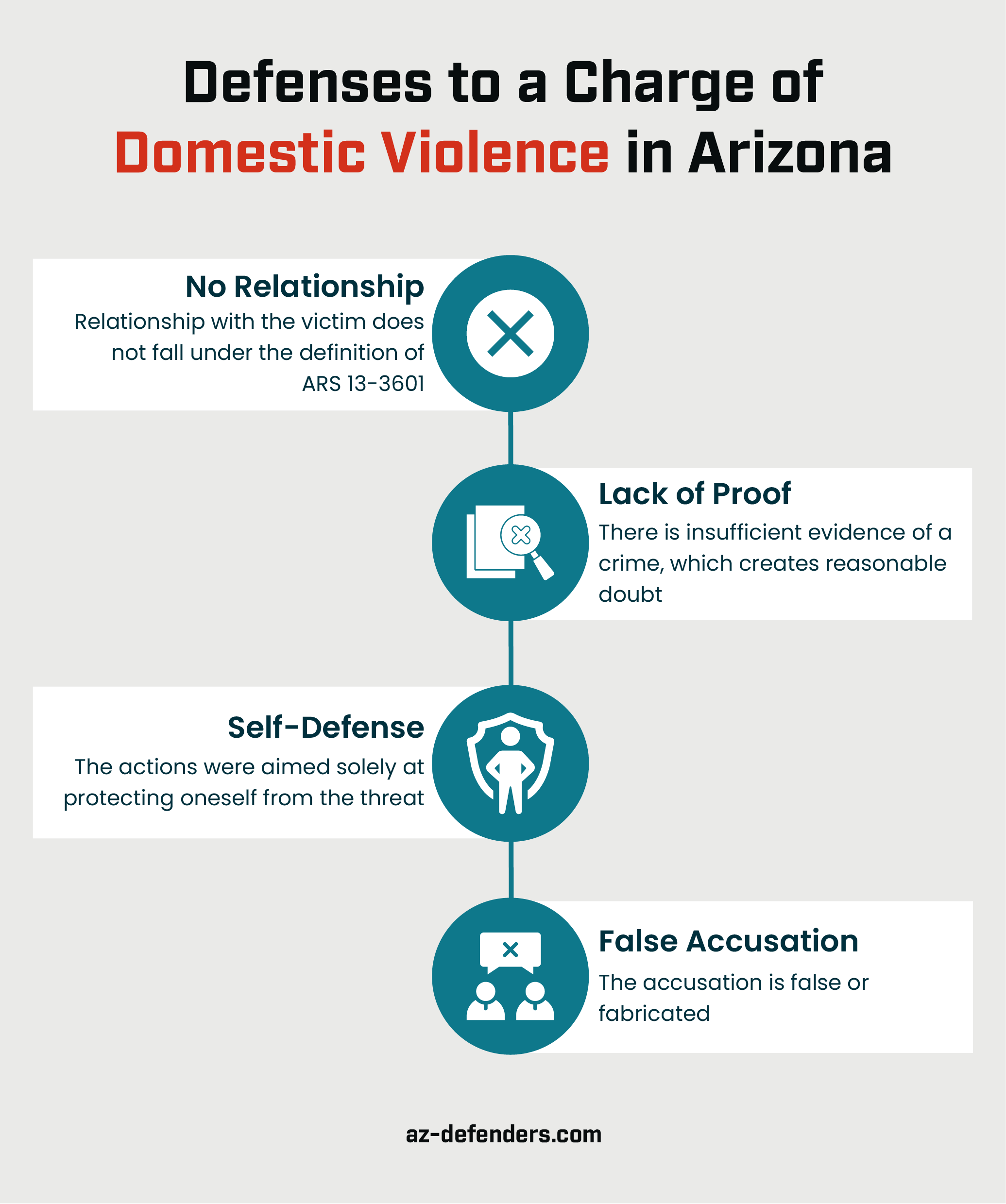
The available defense depends first on the underlying offense. Potential issues may include:
Arizona law specifically states that justified self-defense is not an act of domestic violence. A defense should be developed from the evidence rather than from assumptions about how domestic disputes usually occur.
The consequences of a domestic violence conviction can be serious, especially if the underlying criminal charge is a felony or if you are being charged with aggravated domestic violence. In addition to jail or prison time, you may be subject to criminal fines, which, for a felony conviction, can amount to up to $150,000.
Contact counsel promptly after an arrest, citation, police interview request or protection order. Preserve messages, photographs, call logs, location records and potential witness information. Do not delete evidence or contact a protected person in violation of an order.
Contact AZ Defenders to discuss an Arizona domestic-violence case. Have your case number and court papers available if a case has been filed.