
available 24/7
Free Consultation
Under Arizona’s Rules of Criminal Procedure, you generally have a limited timeframe to file an appeal after being convicted after trial of a criminal offense. For a direct appeal, this is usually only 20 days (for felony cases, 14 for misdemeanor cases) after the trial court enters the judgment and sentence.
But what happens if you miss this deadline? What happens if you discover, years later after your conviction, that evidence exists that could lead to the conviction being vacated, being able to have a new trial, or having your sentence reduced? How long do you have to appeal a criminal conviction if your circumstances change?
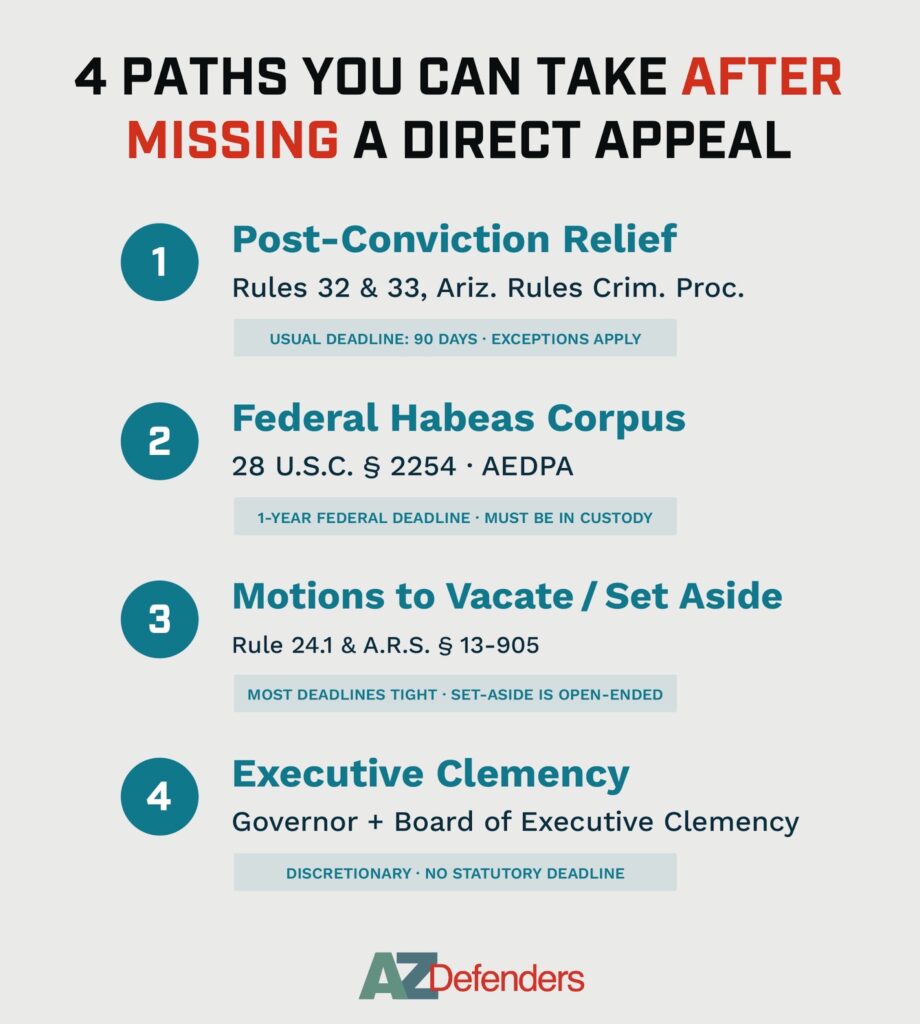
In this article, we examine some possible ways that you may be able to secure an appeal of your Arizona criminal conviction even if a long time has passed since the trial court entered judgment. In particular, we cover four possible means of relief, including:
Each of these options has its own eligibility criteria, timing rules, and procedural requirements. Here, we provide a general step-by-step overview of these post-conviction remedies and the key factors, such as newly discovered evidence, changes in the law, ineffective assistance of counsel (IEAC), and DNA evidence, that can keep these options available years after conviction.
To speak with one of our Arizona appeals lawyers in a free consultation, you can call our law offices at (480) 456-6400 or use our online contact form.
If you miss the deadline after the trial court issues its judgment and sentence, then chances are good you will lose your right to make a direct appeal of that decision. But this does not mean that you have no choice but to accept a criminal conviction. Below, we cover the four possible courses of action you can take, even if you cannot file an appeal.
The purpose of post-conviction relief is to re-examine your case for fundamental errors and new developments. Through PCR, you may be able to have your conviction or sentence vacated or modified.
Under the Arizona Rules of Criminal Procedure, Rule 32 and Rule 33 establish procedures through which you can petition the trial court for PCR.
Both rules create similar post-conviction processes. The key point is that you can file a PCR petition long after your conviction if you meet the necessary criteria to use it.
Rules 32.1 and 33.1 list eight categories of claims, though the availability of each category differs depending on whether the conviction followed a trial or a guilty plea. These include:
An example of this last category is fresh DNA evidence analysis from older cases. Arizona has a separate statute for post-conviction DNA testing (A.R.S. § 13-4240). Under this law, if you have been convicted, you can at any time request DNA testing of evidence that could prove your innocence.
If the testing yields exculpatory (favorable) results, then the court must hold a hearing and may then grant appropriate relief without regard to usual time limits. In rare instances, newly discovered evidence has been used to exonerate defendants years after trial — a critical safeguard against wrongful conviction.
Ordinarily, PCR petitions are time-sensitive. Usually, you must file a Notice of Post-Conviction Relief with the trial court within 90 days after a final judgment and sentence, or within 30 days after the final decision in the direct appeal, whichever is later.
If you miss your direct appeal and more than 90 days have passed since your sentencing, then your PCR filing is considered untimely.
But Arizona provides important exceptions that permit late or successive PCR petitions on specific grounds. Some claims are not subject to preclusion or time-bar, even if you raise them years afterward. These include:
A retroactive change in law is especially powerful here. When the U.S. Supreme Court or Arizona Supreme Court announces a new constitutional rule that applies retroactively, defendants whose convictions or sentences depended on the old rule may have a fresh opening for PCR — even decades later.
A change in law that is not retroactive, by contrast, generally cannot revive a time-barred claim.
If you raise one of these excepted grounds, then the court will permit a late or successive PCR if you state a sufficient reason why the claim was not raised earlier, and the claim itself is meritorious (has factual substance).
If you have exhausted your possible remedies under PCR, then you may be able to resort to federal habeas corpus under 28 U.S.C. § 2254 to challenge the legality of your detention as violating federal law or the United States Constitution.
Federal habeas is not a substitute for a direct appeal or PCR. It is a last-resort review after you have given Arizona state courts the opportunity to correct any constitutional errors. Federal law requires that you exhaust your state remedies before a federal court will entertain a § 2254 petition.
What this means is that you must have already presented your federal constitutional claims through the state courts, all the way up to the state supreme court, by raising them in a direct appeal or PCR petition.
If you skip Arizona PCR and go straight to federal court, your petition will likely be dismissed for non-exhaustion unless you show that no state process was available or that it would be ineffective. Also, if you have fully served your sentence and only face collateral consequences, like difficulty finding employment, then you are generally ineligible for federal habeas relief.
Another prerequisite is the custody requirement. Federal habeas is only available if you are “in custody” under the conviction or sentence you are challenging. “Custody” includes being in prison or jail, on probation, or otherwise restrained because of the conviction when you file your habeas petition.
The federal Antiterrorism and Effective Death Penalty Act (AEDPA) imposes a one-year deadline on state prisoners for filing federal habeas petitions.
This one-year clock typically starts running when your conviction becomes “final,” which is usually the date when your time to seek direct review in state court expires or, if you filed an appeal, when your appeal and any available higher review concludes.
This one-year calculation is subject to some qualifications, though, so it is a good idea to consult with a criminal appeals attorney to make sure you know exactly how much time you have under the AEDPA.
Federal habeas corpus is not a second appeal. A federal court will intervene only for serious federal rights violations and will be deferential to the state court’s prior decisions. This means you typically must show not just that the state court was wrong, but that it was unreasonably wrong under U.S. Supreme Court precedents.
Successful federal habeas petitions often involve egregious constitutional issues such as serious ineffective assistance of counsel, lack of a fair trial, or your actual innocence supported by new evidence.
If you receive federal habeas relief, then the outcome can be a conditional release or a new trial.
Under Arizona’s rules, there are two post-trial motions that provide immediate opportunities to overturn or modify a conviction, though they are subject to strict time limits and are usually unavailable after several years have passed.
Under Arizona Rules of Criminal Procedure Rule 24.1, after you have been convicted at trial, you can request a new trial based on grounds like jury misconduct, newly discovered evidence, or a legal error during the trial.
You must file the motion within 10 days after the verdict or finding of guilt, which makes this option a short-term one. If your motion is successful, then your conviction can be set aside, and you will receive a new trial. Otherwise, you will need to proceed with your options under post-conviction relief.
This motion seeks to have the trial court nullify your conviction if it finds specific grounds exist, like a lack of jurisdiction, newly discovered material facts, or if your conviction violated the U.S. Constitution.
You must file this motion within 60 days of the entry of judgment and sentence, unless you filed an appeal, in which case you must make the motion within 15 days after your appellate record is filed.
Arizona allows you to apply to set aside your conviction if you have already completed your sentence, as well as any probation, and have paid any associated fines.
There is no firm deadline to apply for a set-aside; you can apply as soon as your sentence is fully served and all conditions are met. Courts consider factors like the nature of the offense, your compliance with probation, and your behavior since release when deciding whether to grant a set aside.
A set-aside is not the same thing as overturning your conviction on the merits. It does not declare your innocence or expunge your record, and you cannot resort to it while you are still serving your sentence. But it can be a useful post-sentence remedy to mitigate the long-term effects of a conviction:
Executive clemency is a remedy you can seek from the executive branch of Arizona’s state government. It is not a judicial remedy. In most cases, it consists of the state governor acting on the recommendation of the Arizona Board of Executive Clemency.
Commutation is a reduction or modification of your sentence, which could shorten your term of imprisonment or make you probation-eligible. Commutations in Arizona are typically available when you have served some portion of your sentence, often in cases where the original sentence seems unduly harsh, or your circumstances have changed.
In Arizona, you apply for commutation of sentence through the state Department of Corrections. The Board of Executive Clemency may hold a hearing and could recommend a commutation to the Governor for final decision.
You can seek commutation at any time during your sentence, even if many years have passed since your conviction.
A pardon is an official forgiveness of the crime and sentence. A pardon may restore civil rights, including firearm rights, depending on its terms. It can also reduce some of the stigma associated with a conviction. It does not erase the record, but it will show that the state’s highest executive authority has forgiven the offense.
Pardons in Arizona are purely discretionary and are rarely given. They usually apply only to individuals who have demonstrated long-term rehabilitation, often after completing their sentence and staying crime-free for several years.
The process involves submitting an application to the Board of Executive Clemency, which reviews it and makes a recommendation to the Governor, who then decides whether to grant the pardon.
Appealing a conviction years later is harder than securing a direct appeal — but in the right circumstances, it is not impossible. Depending on your circumstances, even if a regular judicial appeal is closed to you, this does not necessarily preclude other options to secure a new trial, a reduced sentence, or even vacation of your conviction.
And even if no judicial remedy is available through post-conviction relief, habeas corpus, or a motion to vacate or set aside, as a last resort, a petition for commutation of your sentence or a pardon may be worth exploring.
You may not be able to know which of these options is available for you, but an AZ Defenders criminal appeals attorney can go over your conviction with you in a confidential, free consultation and analyze which are worth exploring.
To get the process started, call our law firm at (480) 456-6400 or contact us online to speak with one of our experienced Arizona criminal appeals attorneys.