available 24/7
Free Consultation
To fight a disorderly conduct charge in Arizona, your attorney can challenge the required intent or knowledge, the alleged conduct, and the reliability of the evidence, or raise defenses such as protected speech or self-defense. The right strategy depends on the facts; no outcome is guaranteed.
The good news is that disorderly conduct cases are often built on fast-moving, emotional situations, conflicting accounts, and judgment calls by police. That leaves room for a strong defense. If you are wondering how to beat a disorderly conduct charge, the first step is to understand exactly what the State of Arizona must prove and where its case may fall short.
Keep reading to learn how Arizona’s disorderly conduct law works, the difference between the misdemeanor and felony versions of the charge, common defense strategies, and what to do if you have been arrested.
Arizona’s disorderly conduct law is found in the Arizona Revised Statutes at A.R.S. § 13-2904. To convict you, the prosecutor must prove every element of the offense beyond a reasonable doubt, which is the foundation of the prosecutor’s case. Arizona’s statute applies statewide and requires proof of one of six specified acts, along with intent or knowledge of disturbing the peace or quiet of a neighborhood, family, or person. If even one element is missing, the charge should not stand.
The State must show that you acted either with intent to disturb the peace or quiet of a neighborhood, family, or person, or with knowledge that you were doing so. Being loud, upset, or present at a chaotic scene is not enough on its own. Your intent or knowledge is a required part of the crime.
The prosecutor must also prove that you committed at least one of the following acts:
Each of these acts has its own requirements. For example, offensive speech alone is not a crime, and protected speech may defeat disorderly conduct charges unless it is directed at someone present and likely to provoke immediate retaliation. A dispersal order must be lawful and tied to an emergency. These details often become the battleground in a disorderly conduct case, and what qualifies depends on the specific statutory act the State alleges.
Many disorderly conduct charges arise from arguments at home. When the alleged victim is a spouse, partner, family member, or someone you live with, prosecutors may add a domestic violence designation under A.R.S. § 13-3601. That label can carry additional consequences, including mandatory counseling and restrictions on firearm possession, so it warrants its own careful defense.
The seriousness of your charge depends on which act you are accused of.
| Misdemeanor disorderly conduct | Felony disorderly conduct | |
| Conduct | Fighting, unreasonable noise, offensive language, disrupting a lawful gathering, or refusing a lawful dispersal order (paragraphs 1–5) | Recklessly handling, displaying, or discharging a deadly weapon or dangerous instrument (paragraph 6) |
| Classification | Class 1 misdemeanor | Class 6 felony |
| Possible jail or prison | Up to 6 months in jail on a misdemeanor disorderly conduct charge | For a first dangerous class 6 felony, the prison range is approximately 1.5 to 3 years in prison |
| Other consequences | Fines up to $2,500 plus surcharges, up to 3 years of probation; a disorderly conduct conviction can create a permanent criminal record and may affect professional licenses | A felony conviction can mean a felony record, loss of gun rights, longer probation, and harsher sentences on any future charge |
The class 6 felony applies to disorderly conduct involving the reckless handling or display of a deadly weapon when the State claims you recklessly handled, displayed, or discharged a deadly weapon or dangerous instrument. A deadly weapon includes a firearm. A dangerous instrument can be almost any object used or threatened to be used in a way capable of causing death or serious injury, such as a knife, a bat, or even a vehicle.
Recklessness means you were aware of and consciously disregarded a substantial and unjustifiable risk. That is a lower mental state than intent, but the prosecutor must still prove it, including whether there was reckless handling of the weapon.
Prosecutors may also allege that a weapons-related disorderly conduct charge is a dangerous offense. That designation can take probation off the table and require prison if you are convicted, unlike a misdemeanor, which can carry up to six months in jail. In some non-dangerous cases, a class 6 felony can be designated a misdemeanor at sentencing or later, which can make a major difference to your future. An experienced attorney can fight these designations from the start. In Maricopa County, felony weapon allegations may be treated more seriously and can end up in different Arizona courts depending on the charges.
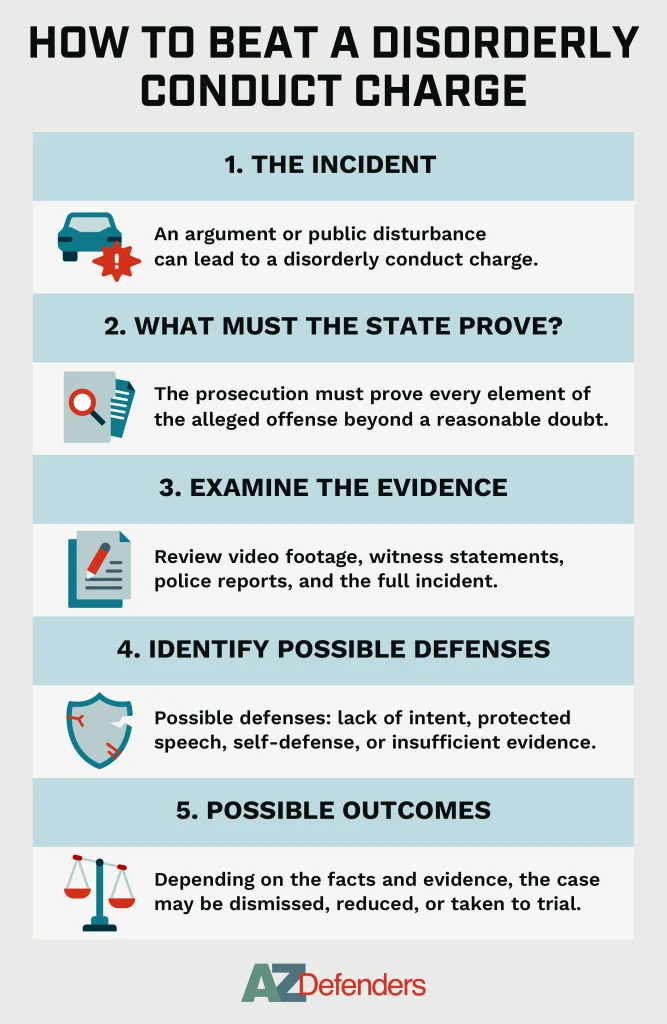
Every case is different, and no lawyer can honestly nor ethically promise a particular outcome. But these are some common disorderly conduct defenses under Arizona criminal law that frequently arise in these cases, and a valid defense can lead to dismissal, reduction, or acquittal, depending on the facts.
Because the State must prove you intended to disturb the peace or knew you were doing so, your state of mind matters. Maybe you were playing music at a reasonable volume and had no idea a neighbor was bothered by it. Maybe you raised your voice in a private conversation that others happened to overhear. Showing that you lacked the required intent or knowledge can undercut the entire case. In a chaotic scene with several people present, police may arrest the wrong person, and mistaken identity can also be a defense.
In felony cases, the State must also prove reckless handling, display, or discharge of a deadly weapon or dangerous instrument; it must still prove intent or knowledge of disturbing the peace. An accidental drop or ordinary use of a tool may not satisfy those requirements.
The First Amendment protects a great deal of speech that is rude, crude, or offensive. Arizona’s statute reaches such language only when it is likely to provoke immediate physical retaliation, which tracks the narrow “fighting words” exception. In In re Nickolas S. (2011), the Arizona Supreme Court held that a student’s insults to a teacher were not fighting words, in part because a teacher was not likely to respond with violence.
Cursing at a police officer, criticizing public officials, or protesting loudly may be constitutionally protected, and rude or profane speech is generally protected unless it amounts to fighting words likely to provoke immediate retaliation. If your charge is based mainly on what you said, a free speech defense may be available by challenging the prosecution’s case.
Arizona law allows you to use reasonable force to protect yourself or another person from what you reasonably believe is unlawful physical force. If you were involved in a fight because someone attacked you, or you stepped in to protect a friend or family member, your actions may be legally justified.
Once self-defense is raised with some supporting evidence, Arizona law places the burden on the State to prove beyond a reasonable doubt that you did not act with justification. That can be a significant hurdle for the prosecution.
Disorderly conduct cases often rely on witnesses whose accounts may come from people who were angry, scared, intoxicated, or simply too far away to see and/or hear what happened. In domestic situations, the accuser may have a motive to exaggerate, such as a custody dispute or a breakup. Officers who arrive after the fact may rely heavily on whoever speaks first.
Your attorney can interview witnesses, compare their statements for inconsistencies, and challenge their credibility through cross-examination to identify weaknesses in the prosecutor’s case, including whether police arrested the wrong person based on mistaken identity.
Sometimes the evidence simply does not add up. There may be no recording, no independent witness, no police reports that clearly support the allegation, and no physical evidence, only a he-said, she-said dispute. Body camera footage, surveillance video, 911 calls, cell phone recordings, and witness contact information should be gathered early when available because they can contradict the police report. When the State cannot prove each element beyond a reasonable doubt, a defense attorney can challenge the prosecutor’s case by exposing holes in the evidence and pushing for dismissal, a reduced charge, or an acquittal at trial.
Depending on the facts, your attorney may also challenge whether a dispersal order was lawful, whether police violated your constitutional rights during the stop or arrest, or whether the State can prove the particular prohibited act alleged, and legal counsel may pursue plea bargains, lesser infractions, or diversion when dismissal is not available.
The steps you take in the hours and days after an arrest can shape your case. Here is what we recommend:
A disorderly conduct charge is not something to plead guilty to just to make it go away. If you are charged with disorderly conduct, a conviction can follow you into job interviews, housing applications, and licensing reviews, and it may leave a permanent criminal record that affects housing, work, and professional licenses. If a weapon or a domestic violence designation is involved, the stakes are even higher.
At AZ Defenders, our team of experienced Arizona disorderly conduct defense attorneys knows how prosecutors build disorderly conduct cases and how to test every piece of their evidence.
With experienced counsel familiar with how prosecutors think, we review police reports, body camera footage, and witness statements to identify weaknesses in the prosecution’s case, explain your options in plain language, and build a defense strategy around the facts of your case.
Contact us today by calling (480) 456-6400 or reach out online to schedule a free, confidential consultation today.