
available 24/7
Free Consultation
There is no specific timeline for expunging a record in Arizona. Expungement removes a conviction from public access and legally allows you to state it never occurred, although sealed records still exist for limited statutory purposes. It is different from record sealing and set-asides, both of which still leave the conviction on your record.
In Arizona, recreational marijuana use has been legal since November 30, 2020. Criminal record expungement is only available in the limited context of certain past marijuana-related arrests, charges, and/or convictions. In this blog post, we cover the kinds of marijuana convictions you can seek to have expunged and how long the expungement process can take.
AZ Defenders attorneys are highly experienced with applying Arizona’s expungement law, Arizona Revised Statutes (ARS) Section 36-2862. We have helped many of our clients to remove marijuana-related convictions from their criminal records through the expungement process.
Not all past marijuana offenses are eligible for expungement. In a free consultation, an AZ Defenders criminal defense attorney can review the type of conviction you are seeking to expunge and inform you about whether expungement is a viable option for you.
If expungement is possible, we can also prepare and submit your expungement petition and represent you through the expungement process.
Having a clean public criminal record can be highly valuable to you in many ways, including whether a conviction shows up during a background check by a potential employer, landlord, or lender. AZ Defenders can provide legal help for you to remove a marijuana conviction from your record, and to explore options to seal and/or set aside other marijuana related convictions.
To schedule a free initial consultation with our legal team, call us at (480) 456-6400. Or, if you prefer, reach out to us online to communicate with one of our quality Arizona criminal defense lawyers in Phoenix, Tempe, or Show Low.
The first thing to know about how quickly Arizona’s expungement law works is that unlike with record sealing, you are not subject to any state-imposed waiting period before you can petition to have a conviction expunged.
The text of ARS 36-2862 includes two timing restrictions, both of which today are in the past:
What this means is that today, there is no waiting period before you can file your petition to expunge. Nor do you need to pay a filing fee.
In fact, official Maricopa County Justice Courts guidance states you can qualify for expungement even if you have not completed the terms of a sentence or probation for a qualifying offense, which is otherwise a requirement to apply to have a conviction set aside.
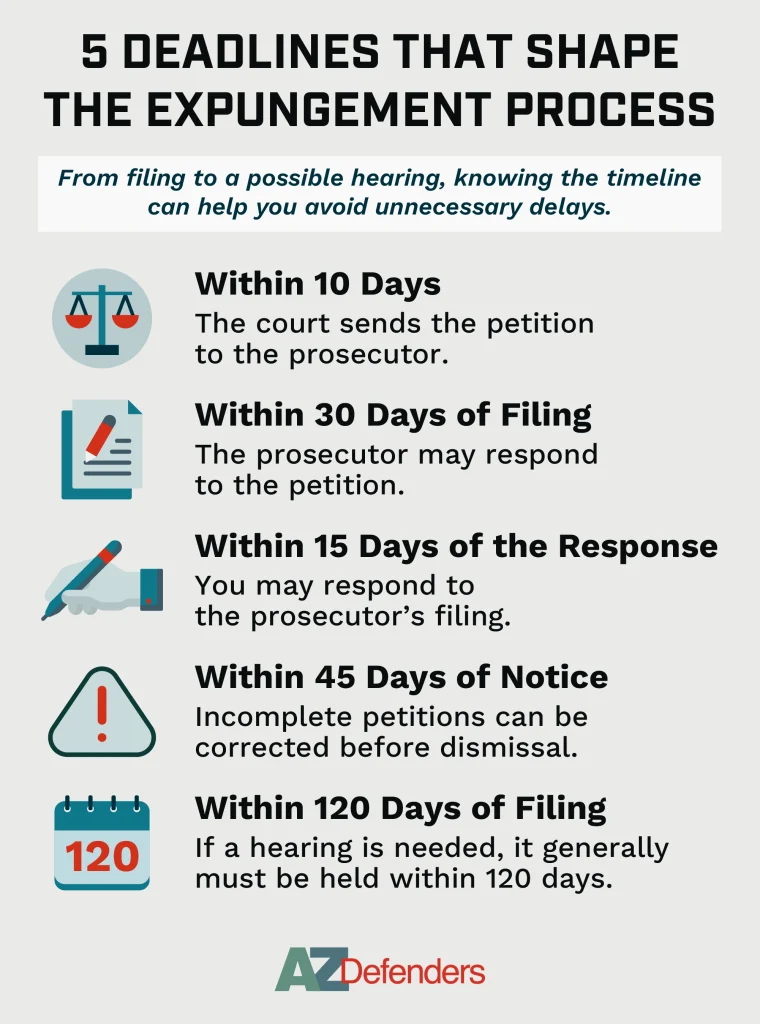
Once you file your petition, the expungement process applies the following time periods:
ARS 36-2862 identifies specific kinds of marijuana offenses that are eligible for expungement. These include:
Whether the underlying offense was a misdemeanor or a felony is not a key consideration when determining eligibility.
The table below gives more details on expungement-eligible offenses.
| Eligible marijuana-related conduct | Notes |
| Possessing, consuming, or transporting marijuana | Not all offenses are eligible. For example, the sale of marijuana is a major limitation. A conviction for the sale of marijuana is not expungement-eligible, because sale is not listed in § 36-2862(A)(1)–(3).Quantity matters, and courts may look beyond the charge label when deciding what the quantity is. For example, in the case of State v. Simental, the Arizona Court of Appeals affirmed denial of expungement when the extended record showed 3.5 ounces in possession. |
| Possessing, transporting, cultivating, or processing marijuana plants | Expungement can be denied for more than 6 plants, or plants not at your primary residence, or plants not for personal use. |
| Possessing, using, or transporting marijuana paraphernalia | Paraphernalia must relate to marijuana cultivation, manufacture, processing, or consumption. |
If the court grants your expungement request, then the court order must:
The DPS must also seal and separate the record and inform appropriate state and federal law-enforcement agencies.
If your case is still pending for a qualifying offense, then ARS 36-2862(G) requires the court to dismiss on motion the pending complaint, information, or indictment with prejudice.
An expunged marijuana offense cannot be used in a later prosecution, though unrelated charges remain unaffected. You may legally say that you were never arrested, charged, adjudicated, convicted, or sentenced for the expunged criminal offense.
Expungement does not sweep away all aspects of a past charge or conviction. For example:
Old marijuana offenses are generally not automatically expunged. Petitioning for expungement of a marijuana-related conviction or charge is an exacting legal process that requires you to carefully follow petition instructions and filing requirements.
If you make a mistake with your petition paperwork, this could cause a delay in the court’s processing of it or even lead to the court denying the petition.
So, for example, you need to file the petition in the correct court and include core identifying and case file information like the offense, arresting agency, and court case number if charges were filed. This is where having an experienced expungement attorney to provide legal advice can make preparing the petition easier for you and reduce the risk of making an avoidable mistake.
AZ Defenders can give you this edge when you are seeking to expunge a marijuana-related mark on your record.
To learn more about our expungement legal services, and to arrange to meet with one of our expungement lawyers to discuss your legal options, call us any time at (480) 456-6400.
You can also use our online contact form to schedule your free consultation.