
available 24/7
Free Consultation
Any adult criminal conviction in Arizona will become part of your public record. A felony conviction will remain visible on your record indefinitely unless a way exists under Arizona statutory law to seal it or, in some marijuana-related cases, to expunge it.
In this blog post, we discuss how a felony conviction appears on your public record, the effects that a felony conviction can have on your ability to engage in public activities and to exercise some of your civil rights, and possible ways to hide or remove a felony conviction from your record.
The Phoenix criminal defense attorneys at AZ Defenders are experienced in helping our clients in post-conviction matters, including record sealing, set asides, and expungement orders. To learn about how we can assist you, call us at (480) 456-6400 or you can use our website to schedule a free consultation with us.
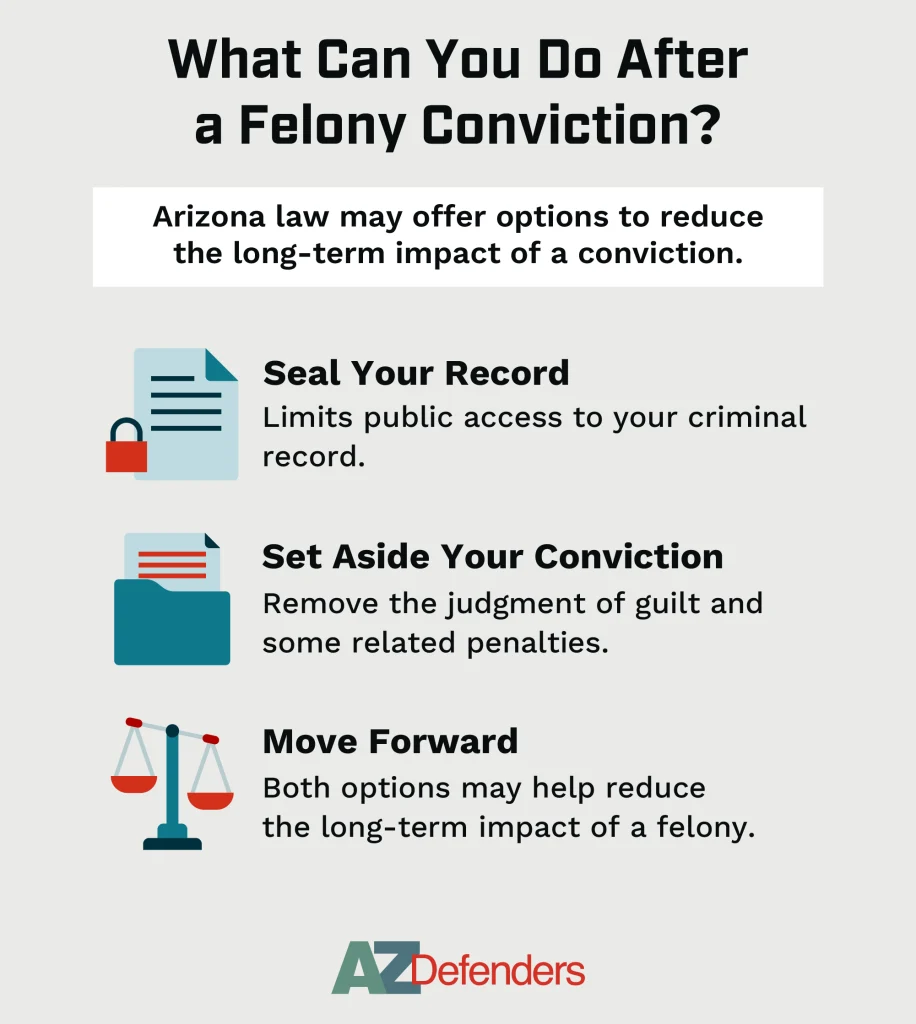
As we mention above, a felony conviction will stay on your criminal record forever unless you take action to keep it from public view. The two most common actions that may be available to you are record sealing, which seals the conviction from public view, and a set aside order, which does not hide the conviction but can limit its effects.
An Arizona felony conviction can be accessed on a background check indefinitely unless you obtain formal record‑sealing relief. Arizona does not automatically remove or hide felony convictions, so they remain fully visible to employers, landlords, licensing boards, and most commercial background-check services for life until a court grants a sealing order.
Arizona Revised Statutes (ARS) Section 13-911 is the Arizona law that governs record sealing. This law provides for three situations in which you can petition to seal the case records of a criminal conviction:
If you were convicted of a felony offense, then you file your petition to seal the record in the court in which you were convicted. The law provides for other possible petition filing locations for situations like if the charges were not filed or were dismissed, or you were found not guilty.
A waiting period applies before you can file a petition to seal the record of a felony charge or conviction. The starting point of the waiting period is when you complete your sentence and any probationary term and the court discharges you.
The duration of this period depends on the class of the felony conviction:
Once the court receives your petition, then it must wait 60 days before considering it. This gives the prosecutor and any victim who has requested post-conviction notice a chance to review the petition, provide their position as to the petition and for the court to determine whether or not to schedule a hearing on the petition. The court can waive this 60-day delay requirement if the prosecutor and any victim who requested post-conviction notice do not object to the petition.
You must make your record sealing petition properly, including filing it with the proper court. If you make a mistake on your petition, the court can dismiss your petition without giving you a hearing.
This is why it is important to have the help of an experienced AZ Defenders criminal defense lawyer in drafting and submitting your petition.
If a hearing is required on your record sealing petition, then any victim of the underlying offense has the right to attend and be heard at the hearing. In any event, if the court decides that granting the petition is in your best interests as the petitioner and in the interest of public safety, then the court must grant the petition.
The main effect of sealing a felony conviction record is that it blocks public access to that record. This means that in situations like when you are applying for a job, or for housing, or for financial aid or a loan, you can say that you have never been arrested for, charged with, or convicted of the crime in the sealed record.
There are still times, however, when you will still be subject to having a sealed record disclosed. Examples include when the past felony conviction is relevant to prosecution for a later offense, or if you are subject to a fingerprint clearance requirement, or the felony was a Class 2 or Class 3 drug felony, or involved burglary, theft, or organized retail theft and you are applying for a job that requires working inside homes.
Other examples where you still MUST disclose include:
These examples do not list all of the situations in which you may not be able to keep a sealed record from being disclosed. An experienced Arizona criminal defense lawyer, like one you will have with AZ Defenders, can advise you whether you are subject to having a sealed felony revealed based on your individual circumstances.
ARS 13-905 is the Arizona statute that applies to set asides.
If you have been convicted of a felony offense, then once you have completed your sentence and any probation requirements and the court has discharged your case, you can apply to the court to set aside the judgment of guilt.
Similar to a petition for record sealing, the state and any victim of the felony offense in question have the right to object to an application for a set aside. In this case, the court may hold a hearing on the set aside application.
If the court grants your application, then it will set aside the conviction, dismiss the complaint or indictment against you, and subject to some statutory exceptions, release you from any other related penalties.
The court that grants your set aside must also provide you with a Certificate of Second Chance if you have not already received one. Your eligibility depends on the kind of felony offense involved:
Unlike a record sealing, a set aside does not conceal a felony conviction on your public record. It will still show up in court records and in any felony background check done on you. Your conviction can still be used against you regardless if sealed and/or set aside, including as a prior offense, or an element of an offense in a later prosecution.
The main reasons why you might seek a set aside are:
Not all felony offenses are eligible for record sealing or set aside in Arizona.
Felony convictions ineligible for record sealing include:
Felony convictions ineligible for set aside include:
Record sealing and set asides are not exclusive remedies under Arizona law. Each offers its own advantages, and you can apply for both. This often involves first applying for a set aside, then petitioning for a record sealing once your required waiting period passes.
Taken together, record sealing and a set aside can vacate your felony conviction, release you from some penalties connected with the conviction, improve your public record as soon as possible, and conceal the conviction from public access.
The key points to remember about the effect of a felony conviction on your public record are:
Although the court that sentences you in a felony case must inform you of your right to petition for record sealing and to apply for a set aside, this is its only obligation to you. This means that you must not only take the initiative in seeking a record sealing and/or set aside, but also that your actions must be effective.
An improperly prepared petition or application, or one that goes to the wrong court, will likely be rejected. This can be a frustrating experience that can lead to avoidable delays in seeking relief.
Seeking the best way to reduce the impact of a felony conviction on your record involves many factors, including misdemeanor convictions versus felony convictions, when the conviction occurred, non-violent felonies versus certain serious offenses like sexual assault, what mandatory waiting period may apply, whether violations of federal law are involved, and more.
When you retain AZ Defenders to help you in preparing your record sealing petition or your set aside application, you can be confident that you will have a highly experienced Arizona criminal defense attorney on your side who can guide you. We have worked with many clients in seeking post-conviction relief for felony crimes, including sealing of records and set asides.
To get started, call us at (480) 456-6400 to schedule a free consultation. You can also reach us online to discuss your legal matter.