
available 24/7
Free Consultation
Sometimes, a criminal conviction results from a mistake at the trial court level. If this happens, a criminal appeal is a process you can use to seek to correct that error. Examples of the remedies you can seek through a criminal appeal include an acquittal of the charge against you, a new trial, or a new sentencing hearing.
In this article, we cover the basics of how to appeal a criminal conviction for a felony offense in an Arizona Superior Court. Specifically, we will address:
Our Phoenix criminal defense attorneys have many years of experience representing people charged with a wide range of crimes under Arizona law, including clients in both direct appeals and post-conviction relief matters.
We thoroughly understand the criminal appeal process in Arizona, how to analyze your criminal trial record to identify reversible errors, and have appeared before appellate court panels to argue on our clients’ behalf vigorously.
The best way for you to learn what we can do for your criminal appeal is to speak with one of our experienced defense lawyers.
You can do this by calling our law firm at (480) 456-6400 or, if you prefer, by contacting us online. We will promptly reply.
A criminal appeal is a request to a higher court, ordinarily the Arizona Court of Appeals, to review your trial for what is known as reversible error.
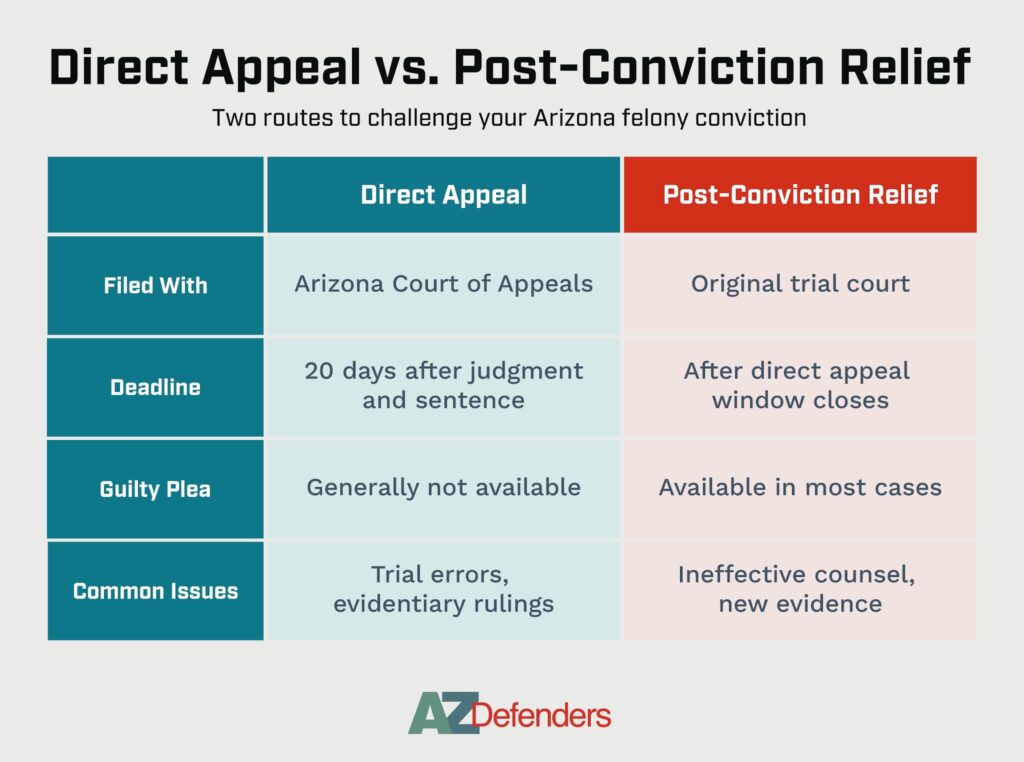
Provided you meet certain legal and procedural requirements, an appeal is available to anyone who has been convicted of a felony in Arizona, a right guaranteed by the state constitution (although Arizona law limits this right for defendants who plead guilty).
Conversely, what an appeal is not is a new or re-trial. Generally, you cannot introduce new evidence when you appeal; the court of appeals can only consider the record of the trial court when it reviews your case. The issue is not to re-argue whether you are innocent, but to see if a legal error made at the trial court level affected the outcome.
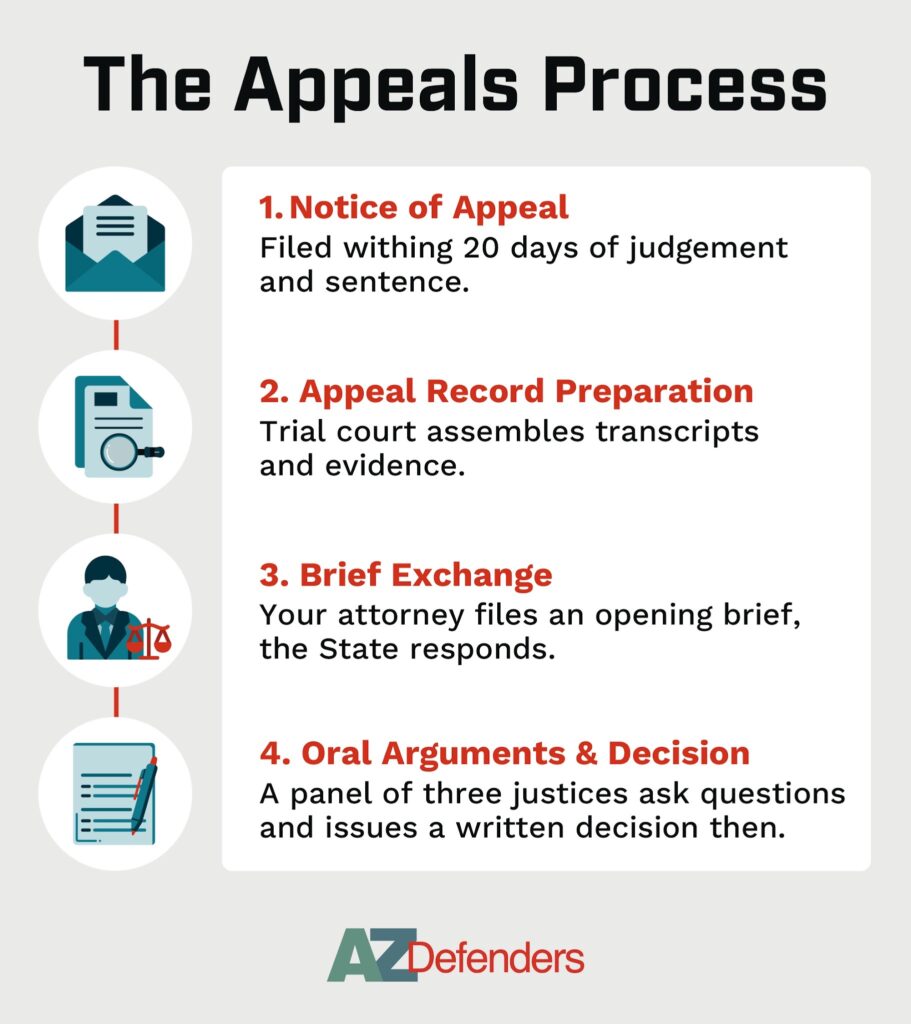
You have a strict deadline in which to file a criminal appeal in a felony case. Arizona law requires that the notice of appeal be filed within 20 days after the written entry of judgment and sentence. If you miss this deadline, you will likely lose your right to make a direct appeal.
If your case involves a sentence that carries a death penalty conviction, then your appeal will automatically go to the Arizona Supreme Court.
By comparison, misdemeanor appeals have a shorter, 14-day notice of appeal period, but in this article, we are focusing on felony appeals.
In rare cases, if you miss the 20-day appeal time limit, you may seek reinstatement of appeal rights through post-conviction relief if the failure to file was not your fault. Still, your best option is to work closely with an experienced criminal appeal attorney who will ensure your appeal is filed with the court of appeals on time.
An important consideration is that not every possible error at the trial court will qualify for a basis for an appeal. You need to raise what can be considered a reversible or “prejudicial” error. Some errors are considered to be “harmless errors,” meaning that even though a mistake was made, it did not adversely affect the outcome of the case against you.
Common grounds for a felony appeal in Arizona include:
If you file your appeal on time, the appeal process will follow a certain timeline with specific steps.
The trial court will prepare a record on appeal. This will include transcripts of the trial and all relevant evidence submitted for consideration. This record is to be sent to the court of appeals.
Your attorney or the state’s attorney can request that certain items be included or excluded from the record on appeal if they are not needed to decide the issues on appeal.
Your attorney will need to file an opening brief that identifies your arguments on why your conviction or sentence is improper. This brief will include all the supporting arguments about why the appellate court needs to hear your case and render a decision.
The State will respond to your opening brief with an answering brief. Your lawyer can then present rebuttal arguments to the answering brief in what’s known as a reply brief.
Once the exchange of briefs is concluded, the court of appeals will schedule a hearing for oral argument by your attorney and the state’s attorney. This is often before a panel of three court of appeals judges who will ask questions of both sides to help them understand and clarify the legal issues involved.
Not every appeal will involve oral arguments, especially if the court of appeals judges conclude they can decide the matter based solely on the briefs and the evidence in the trial record.
The last step is for the court of appeals judges to issue a written decision on your appeal. This decision may be brief, like a simple order, or it could take the form of a detailed opinion.
Once the appellate court’s decision is issued, you and/or the state have the option to appeal the case further to the Arizona Supreme Court. It is up to the Arizona Supreme Court in its discretion whether to entertain such a further appeal.
If the court of appeals agrees with you that prejudicial error occurred at the trial court level, then in its decision, the court of appeals can grant you any of several kinds of relief or uphold your conviction.
A reversal of your conviction will effectively vacate that conviction. A reversal for insufficient evidence requires entry of a judgment of acquittal — double jeopardy prevents the state from retrying you, but most other reversible errors result in a new trial.
If the trial court error affected the fairness of your trial, the court of appeals may order a new trial with the error or errors from the first trial being corrected on remand.
If the reversible error consisted of a mistake in your sentencing, then instead of a new trial, the court of appeals can send the case back to the trial court with instructions to modify the sentence or to hold a new sentencing hearing.
If your appeal is unsuccessful, the court will affirm the trial court’s conviction, and the original outcome will stand.
If this happens to you, you may still have options available through a post-conviction relief petition or an appeal to the Arizona Supreme Court.
A direct appeal is the topic of this article, but it is not the only way you can seek a higher-level review of your criminal trial.
Compared to a direct appeal, post-conviction relief covers a broader set of claims — including challenges to convictions entered after a guilty plea. Arizona generally bars direct appeals from guilty pleas, but limited issues, such as an illegal sentence or certain preserved pretrial rulings, may still be appealable.
Instead of appealing to a court of appeals, in a post-conviction relief, you file a petition with the trial court. Common issues raised in a post-conviction relief petition include:
An appeal is to review an alleged error committed in trial, while post-conviction relief can give you a second chance to bring up issues that cannot be raised on direct appeal or if the direct appeal window has passed.
The purpose of this article is to give you a broad, general understanding of how the Arizona felony criminal appeals process works and its possible outcomes.
Practically speaking, appealing a trial court conviction can be a complex, detail-oriented process with strict rules, multiple stringent deadline requirements, and complicated interpretations of applicable laws and of how the trial court conducted itself under the Arizona Rules of Criminal Procedure.
Because of these complexities and the possible loss of your appeal rights if a procedural error occurs, like missing a filing deadline for your appeal or submitting a brief to the court of appeals, your appeal attorney must have detailed knowledge of how the appeals process works and how to comply with its requirements.
If you have been convicted of a crime in Arizona, felony or misdemeanor, you have only a few days to take action to preserve your right to make a direct appeal.
Do not wait, or you may lose this right: call AZ Defenders right away at (480) 456-6400 or use our online contact form to schedule a confidential, free consultation before it is too late.