
available 24/7
Free Consultation

Posted on January 23, 2026 in Assault & Violent Crimes
Robbery is already a serious felony offense in Arizona. When it is committed with one or more accomplices, it becomes aggravated robbery under Arizona Revised Statutes (ARS) Section 13-1903.
Aggravated robbery is a Class 3 felony in Arizona.
AZ Defenders represents people charged with robbery and aggravated robbery in Arizona. If you have been charged with aggravated robbery, call us at (480) 456-6400 or contact us online to talk with an experienced Arizona criminal defense lawyer.
ARS 13-1903 is a short statute. Here it is in full:
Aggravated robbery; classification
A. A person commits aggravated robbery if in the course of committing robbery as defined in section 13-1902, such person is aided by one or more accomplices actually present.
B. Aggravated robbery is a class 3 felony.
So, there are three basic elements of the offense of aggravated robbery:
Simply stated, under ARS 13-1902, the Class 4 felony crime of robbery in Arizona means taking another person’s property against that person’s will, either from the person of that individual or in that person’s immediate presence, by using force or the threat of force as a means of coercion.
The key distinction between robbery and theft is that robbery is “personal” in nature: unlike theft, which can occur when the victim is unaware, in a robbery, the victim knows at the time of the crime that he or she is the victim of theft, but is letting it happen out of fear of violence by the person committing the act.
A key distinction between robbery and aggravated robbery is that a robbery is a solo crime, while aggravated robbery cases involve the robber acting with at least one other person who serves as an accomplice to the crime.
Who is an Accomplice?
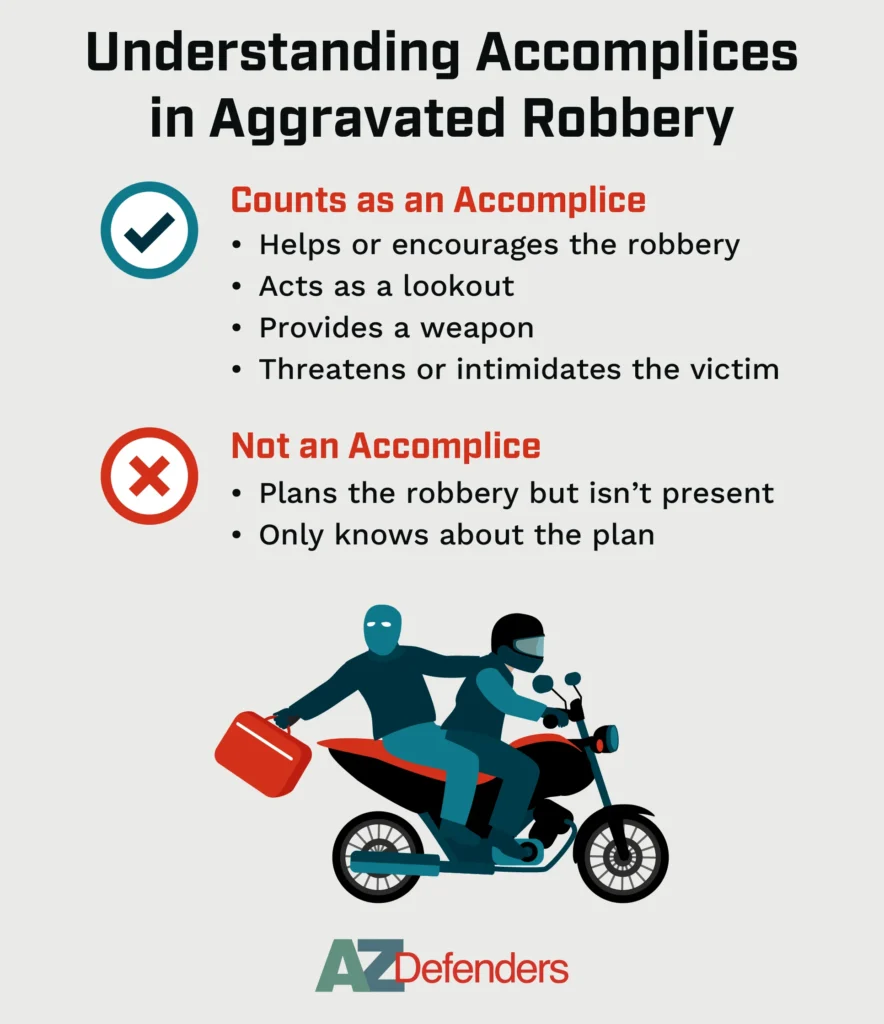
Under ARS 13-301, an accomplice is someone who intentionally does any of the following:
To be an accomplice in an aggravated robbery, a person must be physically present at the scene of the crime and engage in one of these behaviors. Examples of accomplice actions during a robbery include:
Helping to plan the robbery without being present during its commission can be accomplice behavior, but it does not qualify as aggravated robbery because the accomplice is not actually present.
These kinds of behavior may constitute other crimes, like conspiracy or accessory after the fact, but the important consideration for aggravated robbery is that the accomplice must be actually present and acting as an accomplice while the robbery is happening.
Armed robbery under ARS 13-1904 is different from aggravated robbery in two key ways:
As a Class 3 felony offense, the sentence for aggravated robbery depends in part on whether it is a first offense or if you have any prior felony convictions, and whether any aggravating or mitigating factors exist.
Aggravated robbery convictions with any prior felony convictions are not probation-eligible.
Convictions for aggravated robbery are also subject to restitution and a fine of up to $150,000.
Depending on the circumstances of the alleged incident, one or more possible legal defenses may be available to a charge of aggravated robbery in Arizona. Examples of these defenses include:
These are not all the possible defenses that may be available. An experienced Arizona criminal defense lawyer can identify the best defense strategy for aggravated robbery charges against you.
As a Class 3 felony, aggravated robbery is a crime that carries significant incarceration and financial penalties. A felony conviction is a permanent criminal record.
Some specific consequences you may face after an aggravated robbery conviction include:
At AZ Defenders, our criminal defense attorneys have over one hundred and fifty years of combined experience representing Arizona residents accused of theft crimes, including robbery and aggravated robbery. Our Phoenix aggravated robbery lawyers have a proven track record of winning cases and are recognized as among the most aggressive criminal defense attorneys in the state.
If you are facing an aggravated robbery charge, call AZ Defenders at (480) 456-6400 to schedule your free theft crime case evaluation. You can also use our contact form to set up a free consultation with us.