available 24/7
Free Consultation
Arizona law does not make an ordinary household object illegal merely because it could be used with drugs. Under ARS 13-3415, the state generally must connect the object to prohibited drug activity and prove the required use, intent or knowledge.
Using or possessing drug paraphernalia with intent to use it for a prohibited drug purpose is a class 6 felony. The statute also addresses delivery, manufacture for delivery and advertising. Marijuana-related conduct that is lawful under Arizona’s adult-use statutes is expressly excepted.
If you have been charged with possession of drug paraphernalia in Arizona, please contact AZ Defenders or call us at (480) 456-6400 immediately to get premium legal defense.
For the possession-with-intent branch of ARS 13-3415(A), the state must establish knowing possession of the object and intent to use it for a listed drug activity that violates Arizona’s drug laws. ARS 13-105 defines possession in terms of knowing physical possession or dominion or control.
Subsection A separately prohibits actual use for those unlawful purposes. Delivery and advertising appear in other subsections with their own requirements. An object’s possible use with drugs is not a substitute for proving the charged conduct and mental state.
The statute defines paraphernalia broadly and lists examples such as certain kits, scales, containers, syringes, pipes and objects used to manufacture, package, conceal, inject, ingest or inhale drugs.
Many of those objects also have legitimate uses. ARS 13-3415 therefore directs courts and other authorities to consider relevant circumstances, including:
No single factor automatically resolves every case. The complete context determines whether the state can prove the statutory intent.
ARS 13-3415(F)(2)(d) excludes narcotic drug testing products used to determine whether a controlled substance contains fentanyl or a fentanyl analog from its testing equipment category. The article should not be read to classify every drug-testing product as prohibited paraphernalia.
Actual possession generally means the object was found on the person. Constructive possession is an allegation that the person exercised dominion or control over an object found elsewhere.
When an item is found in a shared vehicle, home, hotel room, or bag, the state must connect the accused to it. Presence near an object does not necessarily establish knowledge, control, or intent to use it for a prohibited purpose.
ARS 13-3415 expressly incorporates exceptions in Arizona’s adult-use marijuana laws. Under ARS 36-2852, an adult who is at least 21 may lawfully acquire, possess, manufacture, use, purchase, sell, or transport paraphernalia related to the cultivation, manufacture, processing, or consumption of marijuana or marijuana products, subject to the limits and other provisions of the law.
The statute also cross-references ARS 36-2853(C). The exception does not legalize every object associated with another controlled substance or excuse a different offense. The person’s age, the substance involved, and the alleged purpose all matter.

Possession or use of drug paraphernalia under ARS 13-3415 is a class 6 felony. For a first non-dangerous class 6 felony when no specific sentence controls, ARS 13-702 lists a presumptive prison term of one year, with a range from 0.33 years (approximately four months) mitigated to two years aggravated. The minimum is six months and the ordinary maximum is 1.5 years. The mitigated and aggravated endpoints require the statutory findings; qualifying priors or another controlling sentencing law change the analysis.
Under ARS 13-604, a qualifying non-dangerous class 6 felony may receive a class 1 misdemeanor judgment or remain undesignated during probation. The discretionary provision excludes a person with two or more prior felony convictions. An undesignated offense is generally treated as a misdemeanor, but subsection B preserves felony treatment for specified purposes, including firearm rights, historical priors and sentencing enhancement. Subsection C governs required misdemeanor designation after successful probation and court discharge, with its monetary-obligation qualifications.
A class 1 misdemeanor can carry up to six months in jail under ARS 13-707. ARS 13-802 permits a fine of up to $2,500 for an individual, with surcharges and other obligations potentially additional. The actual result may also include probation and treatment requirements.
ARS 13-901.01 generally provides probation for a qualifying conviction for personal possession or use of drug paraphernalia and requires participation in an appropriate treatment or education program. The statute has exclusions involving a defined violent-crime conviction or indictment, repeated possession convictions, treatment refusal, rejection of probation and methamphetamine. Subsection I preserves other possible probation for otherwise qualifying defendants affected by subsections G or H; exclusion from this provision is not an automatic answer to every probation question.
The statute does not extend its personal possession rule to possession for sale, production, manufacturing or transportation for sale of a controlled substance. Eligibility requires a review of the charged conduct and criminal history.
ARS 13-3415(D) subjects paraphernalia to forfeiture under Arizona’s forfeiture chapter. A criminal acquittal alone does not necessarily resolve whether an object falls within that provision. Procedures for property return and forfeiture should be evaluated separately from the criminal charge. A felony conviction can suspend civil rights under ARS 13-904; an undesignated offense has the specific felony consequences preserved by ARS 13-604(B). Employment, licensing, housing and immigration effects depend on the conviction and the applicable rules.
An undesignated class 6 offense has legal consequences even before final designation. A person should not assume that an undesignated offense is immediately equivalent to a misdemeanor for every purpose.
Potential defense issues include:
The best defense depends on why police attributed the object to the accused and how they claim it was intended to be used.
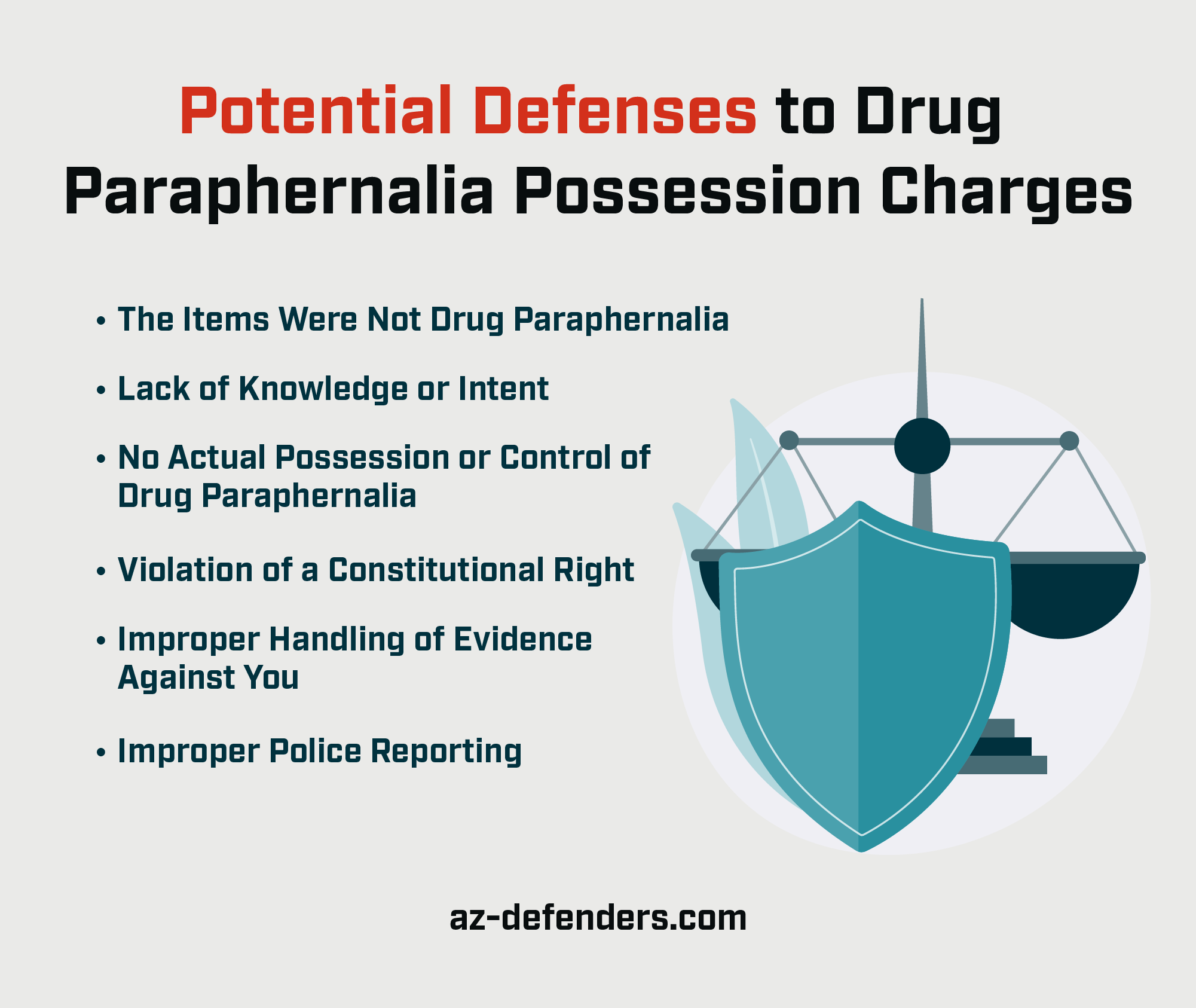
First identify whether the case is filed as a felony, a misdemeanor or alongside another drug charge. Review the complaint, release conditions and hearing notice. In a felony case, the court process can include a preliminary hearing or indictment, arraignment, disclosure, motions, a negotiated disposition or trial.
Counsel can ask for the photographs, residue analysis, officer reports and statements relied on to establish prohibited use or intent. Any offer should specify the classification, treatment requirements and whether a designation decision remains for later. See the Arizona Judicial Branch’s criminal case overview.
Do not bring suspected drugs or paraphernalia to a consultation or send potentially unlawful material through a contact form. Ask counsel how to preserve evidence safely and follow the existing court orders.
A drug paraphernalia charge may not seem as serious as one for other drug offenses like use, possession, or sale of illegal drugs, but it can still result in serious penalties with significant short and long-term consequences for a conviction.
The AZ Defenders Law Firm defends Arizona residents like you against criminal charges involving drug use, sale, transportation, and paraphernalia possession. Our defense attorneys have extensive experience in representing defendants in criminal cases and can help you to put forward the strongest possible defense throughout the legal process:
Call AZ Defenders at (480) 456-6400 or use our contact form to get in touch with an experienced Arizona drug crimes defense attorney and to schedule a free consultation. You can reach us any time, day or night.