
available 24/7
Free Consultation

Posted on March 13, 2026 in Assault & Violent Crimes
If you are charged with a crime while you are on pretrial release, bond, probation, parole, work furlough, community supervision, or, in some cases, the sentence for the new crime will be significantly more harsh than if you were not on probation.
AZ Defenders criminal defense attorneys represent people charged with many kinds of crimes in Arizona, including violations of probation and other offenses committed while on release for a prior conviction. In this blog post, we discuss Arizona’s law relating to offenses committed while released from confinement, Arizona Revised Statutes (ARS) Section 13-708.
If you are facing a charge of committing a criminal offense in Arizona while on probation or release, please call us at (480) 456-6400 or contact us online.
ARS 13-708 has subsections that address situations in which you might be sentenced for an additional crime while on probation or otherwise on release for a prior criminal conviction. We consider each of these situations below.
ARS 13-708(A) covers situations in which you have been convicted of a felony involving a dangerous offense while you:
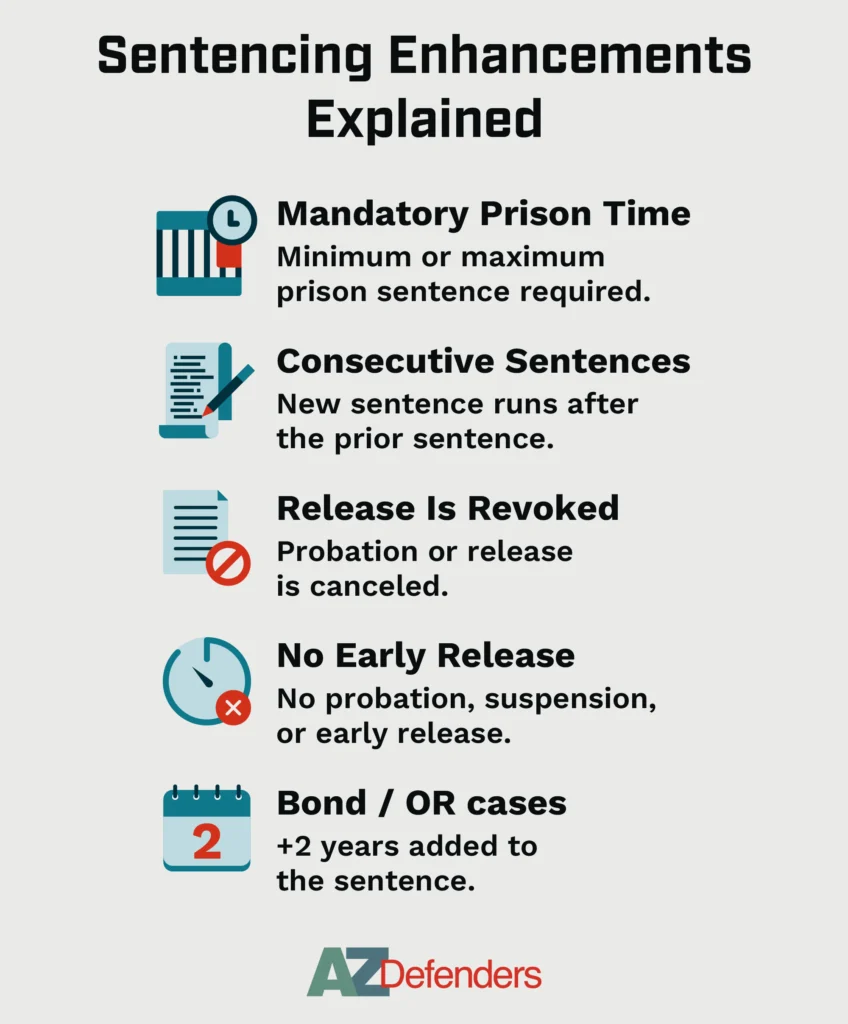
In this case, your prison sentence for the additional offense must be imprisonment for not less than the presumptive prison sentence for that crime.
If you were on release, your release will in all likelihood be revoked. Additionally, your sentence for the additional crime will be consecutive to any prior sentence from which you were temporarily released or escaped, unless another jurisdiction other than Arizona imposed the prior sentence.
You will not be eligible for suspension or commutation of sentence or release on any basis until you have served the sentence the court imposes on you.
Under ARS 13‑105(13) and ARS 13‑704, a dangerous felony involves the use, discharge, or threatening exhibition of a deadly weapon or dangerous instrument, or the intentional or knowing infliction of serious physical injury.
Examples of felonies that are dangerous offenses include:
ARS 13-708(B) covers situations in which you commit a dangerous offense while you are on release or have escaped from confinement for:
In this case, the court must sentence you to the maximum sentence authorized for the additional crime.
If you were on release, this release will be revoked. Your sentence for the additional crime will be consecutive to any prior sentence from which you were temporarily released or escaped, unless another jurisdiction other than Arizona imposed the prior sentence.
You will not be eligible for suspension or commutation of sentence or release on any basis until you have served the sentence imposed for the additional crime.
If the court finds that at least two substantial aggravating circumstances listed in section ARS 13-701(D) apply, the court may increase the maximum sentence authorized by up to 25%.
ARS 13-706(F) defines what a serious offense is:
ARS 13-708(C) covers situations in which you are convicted for any felony offense not covered under ARS 13-708(A) or (B) while you:
In this case, the court must sentence you as a convicted person to not less than the presumptive sentence authorized for the offense.
If you were on release, this release will be revoked. Your sentence for the additional crime will be consecutive to any prior sentence from which you were temporarily released or escaped, unless another jurisdiction other than Arizona imposed the prior sentence.
You will not be eligible for suspension of sentence, probation, pardon, or release from confinement on any basis except as specifically authorized by ARS 31-233(A) or (B), or until you have served the sentence the court imposes on you, or you are eligible for release pursuant to ARS 41-1604.07, or the sentence is commuted.
ARS 13-708(D) applies if you commit a felony while you:
In this case, you must spend two years longer than the sentence that would otherwise apply.
For purposes of ARS 13-708, your legal status when you are accused of an additional felony offense will usually consist of being on probation, release, or community supervision.
If you are eligible for probation in Arizona, your underlying sentence will be suspended during your probation, subject to certain terms and conditions, such as reporting to a probation officer, attending counseling, rehabilitation, and/or treatment programs, and paying assessed fines, fees, and restitution. You may also be subject to travel restrictions.
You may be subject to intensive, supervised, or unsupervised probation. You may also be subject to a community service requirement.
Release is a conditional freedom that the court system may grant to you. You have been charged with a crime, but are allowed to remain out of custody until your case is resolved.
Release can take various forms, such as being released on your own recognizance, where you promise to return for court dates without a financial bond, or on bond, which involves paying a set amount as a guarantee of your return to court.
The conditions of release are tailored to each case but generally include requirements like regular check-ins with a pretrial services officer, restrictions on travel, and, most importantly, adherence to all laws.
Community supervision has generally replaced parole in Arizona as part of a felony sentence served after release from prison. Even if you serve 100% of your original sentence, you may still be required to serve some amount of community supervision afterward.
Community supervision comes with standard conditions and may include special conditions that the supervising Community Corrections Officer could require. These conditions can include:
If you violate the terms of community supervision, you may be required to serve the remainder of your supervision term in prison.
If you are charged with another felony while you are on probation, release, work furlough, or community supervision, an experienced Arizona criminal defense attorney will apply defense strategies to combat the additional charge and possibly help you to avoid any additional penalties under ARS 13-708.
Here are some common defense strategies that may apply to your case.
Your defense attorney can attempt to challenge the elements of the alleged new offense by casting reasonable doubt on the prosecution’s case. This could include contesting whether the police officer had probable cause to arrest you, or whether you had the requisite intent or knowledge to commit the crime when the alleged violation occurred, or by introducing exculpatory evidence on your behalf, or by showing a mistake of fact, like misidentifying you as the perpetrator of the crime.
In some cases, your defense lawyer may be able to argue that there was a misunderstanding or a mistake of fact regarding your alleged actions in the additional charge. This defense would assert that you did not intentionally or knowingly commit the new offense.
Your defense attorney will also focus on procedural errors and/or violations of your rights. For instance, an illegal search or seizure in connection with the new offense could be a viable defense strategy, or the police may not have properly informed you of your Constitutional rights or violated those rights, or the police may have mishandled and contaminated, or corrupted evidence intended to be used against you.
Being accused of a new crime, like a probation violation in Arizona, can result in the loss of your freedom. Being found guilty of a felony while on probation, release, or community supervision is a grave legal situation that can result in consequences such as time in state prison and consecutive sentences, as opposed to concurrent sentences.
As we have shown in this blog post, applying ARS 13-708 to an additional felony charge can be complicated because it involves numerous specific rules and raises several other statutory interpretations. Because of this complexity, having an experienced Phoenix probation violation lawyer on your side can be important in understanding the legal issues involved in the criminal case against you and in securing the best outcome possible.
At AZ Defenders, our criminal defense lawyers have decades of combined experience providing legal assistance to clients accused of felony offenses, including dangerous offenses and serious offenses. If you are being charged with an additional crime alleged to have occurred while you were on release, call us today at (480) 456-6400 or use our online contact form to schedule a free consultation.