available 24/7
Free Consultation
A subpoena from the Arizona Corporation Commission, a call from an FBI agent, or a frozen account can be the first sign that an investment deal is now a criminal matter. Investment fraud cases in Phoenix are built slowly and quietly, often for months before anyone is charged. By the time most people realize they are a target, investigators already have bank records, emails, and witness statements.
If you are an entrepreneur, financial professional, fund manager, or business owner facing questions about how investor money was raised or used, the decisions you make in the first few days matter. An experienced Arizona investment fraud lawyer can step in before you say or produce anything, shape how the investigation unfolds, and in some cases keep charges from being filed at all.
Below, we explain the state and federal laws that commonly apply in Phoenix investment fraud cases, how investigators build these cases, the penalties at stake, and the defenses that can make a difference.
AZ Defenders features Arizona Board-Certified Criminal Law Specialists and a defense team with extensive combined trial and white-collar defense experience, including former prosecutors who understand how the state constructs complex financial cases.
We build strategic defenses grounded in rigorous evidence examination—from financial tracing to witness credibility—while providing the personal attention and clear guidance needed at every stage of an investigation or prosecution.
Call us 24/7 to speak with an Arizona investment fraud lawyer in a free consultation at (480) 456-6400 or fill out our contact form.
Arizona prosecutors have several overlapping statutes to choose from, and a single set of facts often supports more than one charge.
A.R.S. § 44-1991 makes it unlawful, in connection with offering, selling, or buying securities within or from Arizona, to:
The statute reaches transactions that are otherwise exempt from registration, so a private placement or “friends and family” round is not outside its scope. “Security” is also defined broadly in Arizona and can include promissory notes, LLC or partnership interests, and investment contracts. Under A.R.S. § 44-1995, a violation is a class 4 felony.
A.R.S. § 13-2310 is one of the most serious charges in Arizona’s white-collar toolkit. It applies when a person, as part of a scheme to defraud, knowingly obtains a benefit through false or fraudulent pretenses, representations, promises, or material omissions. It is a class 2 felony, and the state does not have to prove that any investor actually relied on the statements. Prosecutors frequently pair this charge with securities fraud.
A.R.S. § 44-3241 targets fraud in providing investment advisory services. Beyond schemes to defraud and material misstatements or omissions, it specifically prohibits misrepresenting professional qualifications with the intent that a client rely on them. A violation is a class 4 felony and also creates civil liability for client losses, interest, costs, and attorney fees.
Investment fraud rarely stays local, and charges may be brought at the state or federal level depending on how the money moved and who was involved. When investors live in other states, money moves by wire, or offering materials go out by email or mail, federal prosecutors with the U.S. Attorney’s Office for the District of Arizona may take the case. Common federal charges include:
Federal and state authorities often coordinate, and the same conduct can be prosecuted in both systems. Investment fraud can also involve complex schemes, such as Ponzi schemes or breaches of fiduciary duty. A defense strategy has to account for both from the start.
Many investigations begin with a business that struggled, not one designed to steal. Investigators commonly look for numerous types of fraudulent activities, not just outright theft:
Phoenix cases may involve the Arizona Corporation Commission’s Securities Division, the Arizona Attorney General’s Office, the Maricopa County Attorney’s Office, local police financial crimes units, the FBI, the Securities and Exchange Commission, the U.S. Postal Inspection Service, IRS Criminal Investigation, and the Financial Industry Regulatory Authority.
Civil regulators often share their findings with criminal prosecutors, so testimony given in an “administrative” matter can become evidence in a criminal case.
The Arizona Corporation Commission can investigate complaints, but does not provide individualized legal advice. Civil enforcement, FINRA proceedings, and a criminal investigation may overlap, so defense counsel should coordinate responses and assess the consequences of testimony or document production.
These cases are document-driven, and investigators gather evidence from documents and witness accounts to build them. Prosecutors typically use:
For someone under investigation, preserving the same records early can help counsel test the allegations and identify evidence of good faith.
Statements to investigators can be especially consequential; obtain legal advice before agreeing to an interview.
For a first-time offender, Arizona’s sentencing ranges under A.R.S. § 13-702 are:
| Charge | Felony class | Prison range, first offense | Presumptive term |
| Fraudulent schemes (§ 13-2310) | Class 2 | 3 to 12.5 years | 5 years |
| Securities fraud (§ 44-1991) | Class 4 | 1 to 3.75 years | 2.5 years |
| Investment-adviser fraud (§ 44-3241) | Class 4 | 1 to 3.75 years | 2.5 years |
The stakes rise quickly. If a fraudulent scheme conviction involves a benefit of $100,000 or more, the person is not eligible for probation or a suspended sentence. Historical prior felony conviction(s) can significantly increase sentencing ranges, and multiple counts and aggravating factors, such as harm to elderly investors, can push sentences higher. Courts also order restitution, and regulators may pursue fines, industry bars, and civil judgments.
On the federal side, wire and mail fraud each carry serious criminal penalties, including lengthy prison sentences of up to 20 years per count (up to 30 years if a financial institution is affected).
Exchange Act securities fraud carries up to 20 years’ imprisonment and fines up to $5 million, and 18 U.S.C. § 1348 carries up to 25 years’ imprisonment. Actual federal sentences are driven heavily by the Sentencing Guidelines’ loss calculation, which is often the most contested issue in the case.
A failed investment is not a crime. Every fraud prosecution depends on proving specific elements, and a skilled defense attacks each one.
Lack of knowledge or intent. Fraudulent schemes requires that the accused acted knowingly, and federal wire, mail, and securities fraud require intent to defraud. Many defendants relied on information from partners, accountants, or management and did not know that the information was false. A salesperson repeating figures provided by the company is in a very different position from the person who invented them.
Good faith. An honest belief in the investment, even one that proved overly optimistic, is a powerful defense. Evidence that you invested your own money, disclosed risks, or paid investors from legitimate business revenue can demonstrate good faith.
Immaterial statements. When a charge is based on an alleged material misstatement or omission, counsel can challenge whether a reasonable investor would have considered it important. Opinions, forecasts, and risk disclosures must be assessed in context; labeling a statement an opinion does not automatically defeat a fraud allegation.
Insufficient proof. Financial cases depend on complex tracing and expert opinions. Defense forensic accountants can expose gaps in the government’s money-flow analysis, show that funds were used for disclosed business purposes, or challenge inflated loss figures.
Constitutional and procedural challenges. Overbroad search warrants, improperly obtained statements, and issues with the statute of limitations can lead to suppressed evidence or dismissed counts.
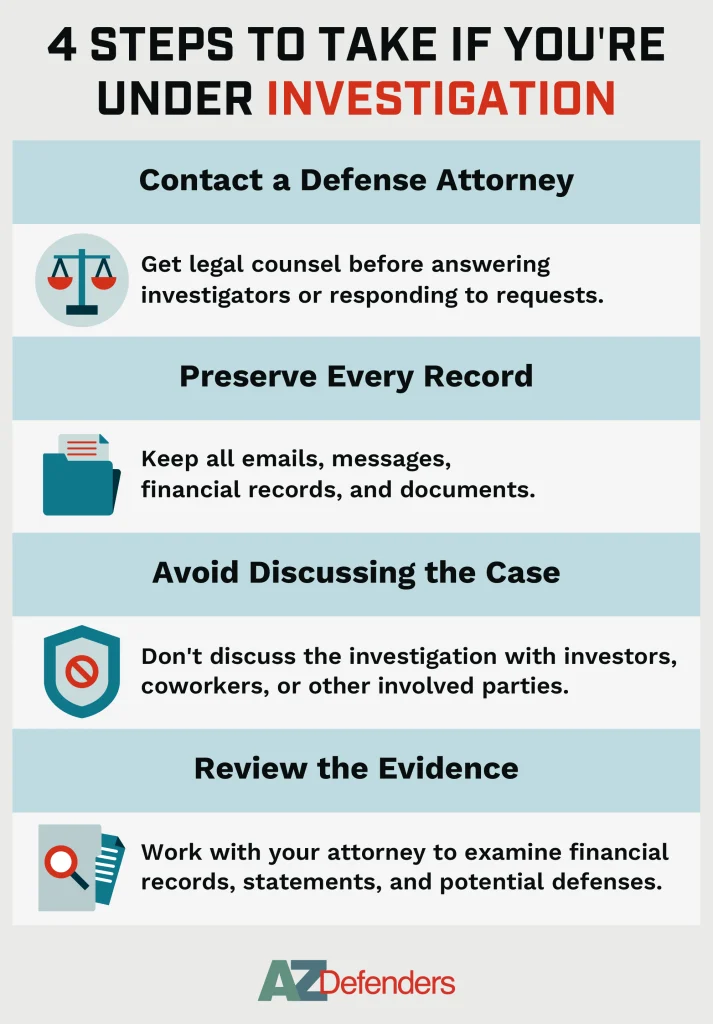
Do not speak with investigators before you have counsel. Agents and regulators are trained to make interviews feel informal. Anything you say can be used against you, and a knowingly and willfully false material statement can lead to a separate federal charge; an innocent mistake alone does not satisfy those elements. Politely decline and say your attorney will be in touch.
Preserve every record. Do not delete emails, texts, files, or messaging apps, and do not alter books or documents. Destroying records can create obstruction charges far easier to prove than the underlying fraud, and the same records often hold the evidence of your good faith while helping defense counsel reconstruct what happened and assess each participant’s role.
Do not contact investors or co-workers about the investigation. Well-meaning conversations can be characterized as witness tampering or used to build a conspiracy case.
Call a defense attorney early. A fraud defense attorney, or a team of fraud attorneys with extensive experience and a deep understanding of these cases, can provide early legal representation when many of the best outcomes occur. Counsel can respond to subpoenas, communicate with prosecutors, present exculpatory evidence, and tailor the defense to the specific circumstances to improve the chance of a successful outcome, sometimes resolving a matter civilly or preventing charges altogether.
Investment fraud allegations threaten more than your liberty. Your reputation, professional licenses, and business relationships are all at stake, and in complex cases, specialized experience in securities and investment fraud matters is critical. AZ Defenders provides discreet, white-glove representation built for clients who cannot afford a misstep and value privacy.
Take action by contacting AZ Defenders to schedule a free consultation and free case evaluation with an experienced Arizona investment fraud lawyer. During the consultation, you will learn about your rights, your legal options, and pathways forward based on your specific circumstances.
Contact our firm by phone at (480) 456-6400. Our team is available 24/7.